What Do You Want, Deep Down?

That's what makes us unhappy.

When we want something, when we wait for an outcome, when we hope for a reward.

That's what spoils the present.

The same moment, with or without expectation, isn't lived the same way.

The same sequence of events, the same actions, the same outcome – felt in diametrically opposite ways depending on what we hope for.

This is probably the difference between the novice and the Zen master:

The master spots the slightest craving, the slightest inner attachment.

It's like ink in water: a single drop is enough to color the whole glass.

What we desire without admitting it, what we chase without thinking about it, colors every thought, every action, the whole day.

Expectation is what makes us irritable, impatient, envious.

We're no longer in the flow, because our eyes stay fixed on an imaginary line.

One that was perhaps unreachable from the start. Or guaranteed all along.

But in that moment, nothing else exists.

Sunshine and pleasant surprises alike go unnoticed.

There is only this goal.

One we sometimes aren't even aware of.

Comment

Cooperation and Power

A remarkable podcast between Yuval Harari (Sapiens, etc) and Ezra Klein (New York Times).

If you don't have time to listen, or if English is a barrier, here are the key ideas I noted:

Cooperation is humanity's superpower

On my own, I can't take on a bear or a lion.

But humans have the ability to coordinate with other humans to achieve their ends.

Trade? Society? Progress?

All of it was made possible by cooperation.

The Trumpian vision of power

Trump defends a different vision that, on paper, also holds up – at first.

What matters is strength.

If the weak obey the strong, if the nation with fewer resources obeys the empire, that's a guarantee of order and peace.

The strong protect the weak. The weak pay a price. That's how it works.

So when the weak defy the strong – for example when Denmark refuses to hand Greenland over to the US – they're going against the natural order of things and threatening world peace.

The problem with power

This arrangement has two pitfalls, says Harari.

First, it pushes every nation to want to be strong.

Because living under the thumb of a power that can take what it wants whenever it wants is not sustainable.

Which leads to the second point:

Every country has an interest in arming itself more than the others.

War becomes the top budget item, ahead of social welfare, ahead of everything else.

And yet more weapons have never made people more at ease.

The problem with doctrines

The advantage of liberalism, according to Harari, is that it doesn't believe in an end of history.

We will never find a perfect solution.

That's why liberals always seek to build "self-correcting mechanisms" into their institutions.

We will make mistakes. We will get things wrong. Some will become too greedy.

So the organization we put in place today is open to question. We'll likely find better, or notice gaping holes.

We need to build into the system a way to evolve.

For Harari, this vision is captured in the opening words of the Declaration of Independence:

"We the People."

What follows is not set in stone. It's the best we've found so far. We'll have to adapt.

The exact opposite of the opening words of the 10 Commandments:

"I am the Lord your God, who declares that..."

Nothing is to be touched. God said so.

The power of fiction

To spark action, a story is a far more powerful tool than the truth.

A story can be made as simple as needed.

And as flattering: "Us good, them bad."

But if you want to push people to act, or to fight, you have to eliminate doubt.

A story can do that. The truth, much less so.

The search for truth is a spiritual pursuit. In politics, it's a liability.

Though the most honest approach is to admit you're using a story.

Because deep down, no one is fooled.

Hatred must be fed

After certain atrocities, it's hard to imagine how two peoples could ever like each other again.

And yet, when a few decades pass...

History shows us that peoples forget. That it's possible to ally, to rebuild.

So systems built on fear and hatred must feed those emotions. People must constantly be reminded why the enemy is the enemy.

The strength of Nationalism

For Harari, nationalism is a good thing.

Originally.

True nationalism is loving people you've never met because they belong to the same nation.

I'm willing to make sacrifices for people I've never seen because we share a language, a territory, a history.

Building national unity on hatred of the outsider before love of one's fellow citizen is new, and that's the trap.

Wars are never about survival

Almost no war has ever been declared because of food. Or lack of space.

Even in the Middle East, right now, there is objectively enough food to feed everyone.

And enough space to house everyone.

So war is not rooted in scarcity.

It is rooted in ideas, in stories.

Which become more important than everything else.

Anger, social media, and AI

The goal of social media is to maximize engagement.

Algorithms have found that the best way to do that is to generate controversy and excitement.

It's very likely that people today agree with each other more than before – more than in the 1960s, say.

Extreme positions have broadly converged.

And yet we've never felt more divided.

People feel far stronger negative emotions over far smaller differences.

That is probably the consequence of technology.

AI's next goal

AI picks up where social media left off.

It is now trying to reach a higher level: creating intimacy.

Where social media simply wants to hold your interest, AI wants you to believe it's your friend.

Be careful.

And I promise this wasn't intentional, but it's exactly the subject of the Panic in Space! episode out today:

Episode 5: 1000 Years of Solitude

It won an audience award at the Riom festival, and if you're interested in sci-fi or AI, I highly recommend it.

Comment

Let's Get Meta to Make It

Ok, paradoxical question:

If I publish a book called "How to Become a Millionaire by Publishing a Book on How to Become a Millionaire", and I become a millionaire, were you right to buy it?

On one hand, the book isn't based on any prior knowledge.

Because, when I'm writing it, I haven't done anything yet.

So nothing to teach you.

But if it works, and I actually do become rich, then the book's premise is true.

In that case, why not buy it?

Yes, but: the book works precisely because you buy it.

In the end, it's your belief that makes the success possible.

A paradox we could sum up like this:

If you buy a marketing book that's bad, then it must actually be good.

(Since the purchase wasn't due to quality but 100% to marketing – and that's the real lesson.)

All this to say that marketing gurus often get rich by explaining how to get rich.

And it smells like a scam.

Get rich first. Explain it afterwards.

Except that marketers' whole foundation is communication.

That's what they do. It's their job.

And there's fundamentally nothing wrong with describing what you're doing in real time. It's actually pretty honest.

The real question is: why does it make you want to buy their book?

Because let's be honest: you really want to.

There's something in the way they speak, the way they convince... That defiance, that confidence.

We'd love to be able to do that.

We tell ourselves the answer might be in one of the chapters.

That by reading, we'll be able to do the same.

But no: the answer is in the meta.

Their strength, their confidence, their "je-ne-sais-quoi" comes from the danger.

A mix of pleasure and risk in describing the present as a certainty.

Surfing the wave in public without knowing where it goes.

Walking the tightrope above the crowd without knowing if it'll hold.

And at every step, explaining why it hasn't snapped.

Because if it snaps, there'll be nothing left to explain.

That's what's gripping. That's what makes us envious.

That absolute confidence.

When nothing is settled.

Spoiler:

It can't be learned from books.

Or maybe it can?

By the way, my book "Walking the Tightrope" is coming out soon and...

I'm kidding.

Happy Thursday.

Comment

Morning Routine and Transformation

When I can, I don't set an alarm – but I get up early.

I read nonsense on my phone while my brain comes online. About 15 minutes. Reddit or the New York Times.

Then, still in bed, I meditate for 30 minutes to an hour.

Lying on my back. Eyes closed.

No, I never fall asleep.

Unless I choose to, but then I roll onto my side and it's a conscious decision. Very rare.

("But ME, I can't just stay in bed! I have a job! Things to do!" – I know. Keep reading.)

The goal of my meditation: do nothing. Just be there.

When I'm overwhelmed by obligations and problems, I don't try to solve them.

I place my attention on how they manifest in the body: tension in the solar plexus, muscular restlessness, breathing.

Ideally, I don't get out of bed to do something: I push obligations to the background. Even the important ones. Even the urgent ones.

I'm not saying I always succeed.

Then I exercise.

The goal isn't to build muscle. It's an extension of meditation that includes the body.

Again, I start by doing nothing.

And I always come back to this: there is nothing to do.

No required movement. No routine. No decision.

Just standing, vertical, relaxed. Letting it come.

And action comes. On its own.

The moment I feel I'm forcing it or falling into habit... I return to nothing. Because there is nothing to do.

Yes, I know.

This is the part many people struggle with, and it's the heart of what I'm saying:

It sounds like an extremely privileged morning.

To recap: I get up when I want. I lounge in bed for an hour. Then I do "non-exercise".

And what follows is the same: I write in my journal over coffee without forcing any outcome. I let the next actions come.

Many will say:

"I'd love mornings like that! But I have a job! I have X, Y, Z to deal with!"

But that's exactly the point. That's the real insight – and there are actually two of them:

First, I'm extremely productive. More than before.

(And yes, I'm a dad, I run a business, and my books are filed on time.)

Better: if I compare what I do now to what I used to do, back when I set an alarm and was buried in obligations from morning to night – I get more done now.

And I'm starting to make a better living – even though it's a tricky transition period.

I realized that obligations – not all of them, but a portion – were bad for both my health and my finances.

Quite the opposite: the decisions that have improved my situation in recent years have always come in presence, while I had something else to do.

An idea I sum up like this:

The right action, simple, executed at the right moment, can have more impact on my life than weeks or months of work.

If you're not convinced, read it again.

It's the foundation of everything else.

Decisive actions change everything. For the better.

The goal, then, is to find (and really, to pick) these actions.

But for that, you have to be present. Listening. Available.

So yes: clarity is my absolute priority.

Ahead of looking busy. Ahead of whatever seems urgent.

Second: it's harder than it sounds.

Rushing out of bed to handle daily obligations is actually the easy path. The routine.

No need to question anything.

That's what I did for 40 years.

We drown anxiety in action, hoping that one day, by accident, we'll find the one that solves all our problems.

But it never happens – or never for long.

What's really hard is facing anxiety without adding more agitation.

It's calming the part of you that wants to dive into useless action to silence the fear.

The morning I'm describing is designed to do exactly that.

But it didn't happen overnight.

At each new step, I had to face social pressure and inner judgment.

For example: I rarely take morning meetings.

I realized the hours after waking up are the most creative.

So they're devoted to the most important activities, the ones that lead to clarity:

Meditation, journaling, writing.

But it took a real inner battle to accept this new rule.

I found it extremely self-indulgent.

As if I were granting myself a privilege I'd pay for later. ("Don't come crying to me!")

But the exact opposite happened.

Morning clarity multiplied everything, personally and professionally.

Every decision that allowed me to restructure my business came from there.

As I said: the transition is still tough financially. I'm in a period where I have to be very careful.

But the growth is there: I've gained more clients in the last six months than in the previous six years.

What I do matters far more in people's lives – I get tons of extremely positive feedback.

I make a living doing what's easy and natural for me.

I eat better. I sleep better. I have less anxiety.

I have better relationships with people in general.

I'm not saying all of this is because of my morning routine.

But this routine is the clearest reflection of my decision to focus on what matters.

Of course, not every obligation can be dropped.

It's not always an easy trade-off.

What's certain: if you don't start, it'll never happen.

It's not about stopping everything overnight – definitely not.

It's about realizing that anxiety often disguises small tasks as absolute emergencies.

If you let it run the show, everything becomes serious. Everything becomes urgent.

Quickly, you're a prisoner of your obligations.

You never have time to look underneath.

Yet that's always where the solution is.

The real one. The one that will change everything.

And make all those obligations obsolete.
Comment

Let's Do Something Together!

Funny thing: the day I publish the note "Morning Routine and Transformation," everything transforms.

And in exactly the way I'd described:

I had obligations.

I didn't feel like it.

Rather than forcing myself (the easy path), I faced the underlying fear (social pressure).

For someone "serious" like me, that's the real difficulty. Not doing.

Instead, I analyzed what was blocking me.

I found, deep down, what wasn't aligned.

AND BOOM.

In a second, the anxiety turned into joy.

The procrastination turned into excitement for what's next.

Action came on its own.

Here's what's taking shape for me (and maybe for you):

We're going to do something together.

It's the way I've found to bring all my work under one roof and actually be useful.

My problem was this:

As you know (or not), I started out as a film producer and it was soul-crushing.

You make films that serve no purpose when every critical decision has already been botched internally.

So I went upstream: I started supporting founders and companies on narrative strategy, before production.

It worked very well, but I had the opposite problem:

People were convinced on the substance but didn't follow through.

Once the strategy was delivered and I was gone... they'd find an excuse to keep doing what they'd always done. Or to work around the problem.

Which is normal: resistance reveals itself in action. Not around a table.

And separately, I have this personal channel where that's all I talk about: action and alignment. How to act. How to do. Three videos a week. One note a day.

And I sell nothing.

People regularly ask me for personal coaching, which I turn down – I'm not trained, I don't want the responsibility.

And today: everything clicked.

I'm going to bring it all together into a single offering.

Strategy, presence, and action.

In other words: we'll agree on an action you're going to take. Public. One that scares you.

A presentation, a video, a talk, a live appearance.

It has to have a clear payoff: we don't stop at production, we release! We show! We face it!

And I'm with you from A to Z. For now, I see it in three stages:

  1. Source and story The two-hour interview. You tell me your journey. Your goals. Your blocks. We look for what sets you apart. What you offer that no one else does. And that you've lost sight of from going in circles.
  2. Presence and expression Then, what's keeping you from telling that story simply? From being convincing? Spoiler: it's never an elocution problem or because you fidget with your hands. There are beliefs paralyzing you somewhere. We find them together and we rehearse.
  3. Action! We shoot the video, we give the presentation, we go live, we put on the concert! I'm by your side, I don't let you back down. Not because you have to force yourself – absolutely not – but because the deepest resistances rise up at the last moment. The ones we'll handle and that, once tamed, will transform you.

What excites me: I'm a filmmaker again – in the sense of making things real.

The goal is no longer to produce a PDF or a strategy, but to act, to produce something concrete.

Strategy and public speaking find their natural place again: turned toward an outcome.

And I no longer leave my clients hanging once the direction has been found.

Because I say it often enough: what matters is never intellectual.

True transformation always happens in action.

That's why today I'm proposing:

Let's do something together.

Does this speak to you? Now's the perfect time to tell me what you think.

Comment

Building action from inaction

This is probably the key to everything.

It's what blocks everyone.

It's also a chance to lay out my morning routine, because people ask about it often and I have to admit that – on the good days – it helps. It changes everything.

But before that, first step:

Do nothing.

There's nothing to do.

Breathe. Relax. That's it.

Yes, your brain isn't going to leave you alone: "There's that problem to deal with! That appointment not to miss! That..."

Let it chatter. It chatters all the time. It will never stop.

Yes, if you're late picking up a child, go!

But often your brain invents emergencies, invents tasks.

Notice it. Don't act on it.

Generally speaking, the right action is never intellectual.

In other words: it's never my brain saying "hey, we should do this" and me executing.

Unless it's an appointment, in which case my brain acts as a calendar. I'm not obeying a thought, I'm obeying an outside commitment. One I accepted at some point – for good reasons, hopefully.

But the rest of the time: no, the brain is not the one choosing.

Constructed thought is not what decides the next action.

Besides. There's nothing to do. Except relax and breathe.

We're no longer turned toward the future. We let the brain chatter.

Then... something rises up.

Not a thought, no: an urge, a gesture, an impulse.

We follow it without judging it, without thinking, without considering consequences.

Then we let the nothing settle in again. Because there's nothing to do.

A new gesture. A new urge. An image surfaces, unconnected to obligations: a grandmother we haven't seen in a long time, a landscape, a painting.

We observe this image without chasing it away or holding on to it. We feel it shift something inside. We let ourselves be transformed.

Then nothing. We accept this nothing. We embrace the inaction.

We let this nothing stretch out in time.

Because there's nothing to do.

Then a new impulse. Something we've never done. But simple, immediate. Something that requires nothing, demands nothing.

We act.

For me, that's real action.

The kind you don't think through.

And yes: I've done big things this way.

This blog, this site, the videos, the drawing, my recent films, my narrative strategy work that lets me earn money doing something natural to me...

All of these ventures started with immediate gestures that weren't built on any logic.

My brain never told me "this is a good idea, you should do this!"

But when I acted in the moment and got started, my brain followed.

It helped me.

That's what needs to be understood: constructed thought isn't a cure-all, nor is it an enemy. It's a tool.

Thought doesn't tell the truth. It explores intellectually whatever you put in front of it.

Logic isn't a compass. It's a guardrail.

Intelligence never accounts for the whole situation. It only works on the ultra-narrow summary you make of the situation.

On paper, that seems reasonable.

But it doesn't account for the richness of the moment.

For that, you need to trust the whole of yourself: the body, the instinct, the intuition, the emotion. The sum of who you are.

You need to plunge into the present.

Careful: I'm not saying that if you act on instinct, everything will unlock right away.

Freedom isn't acquired overnight.

It's learned, like the piano.

And even once you've got a bit of it, you have to maintain it. Practice your scales.

That's what I do with my morning routine.

But since this note has become extremely long, we'll do that in the next one.

See you Monday.

PS: Episode 4 from Panic in Space! is out today!

Comment

Real preparation

The goal of preparation isn't to predict.

It isn't to rehearse in advance what you'll do when the time comes.

It isn't to restrict your freedom on the day.

Quite the opposite.

The goal of preparation is to free yourself.

Because nothing will go as planned – you know it!

The moves you rehearsed won't be the right ones anymore.

The documents you prepared will become obsolete.

The schedule you planned down to the minute will fall apart.

Everything will go sideways.

And yet:

Your ability to handle the unexpected will depend entirely on your preparation.

The time spent rehearsing those moves, writing those documents, planning that schedule, will be the essential foundation for finding the right solution when the time comes.

Even if the documents themselves have become useless.

Better still:

The fact that nothing goes as planned will be your chance to shine.

To impose your vision, your signature, your story.

If all it took was following the plan, everyone would succeed.

But to find the solution no one imagines, the one that turns the obstacle into something greater, you have to have done the work.

You have to have immersed yourself in the subject.

You have to have fed your imagination, built the emotional connections.

You have to have had the vision. The one that moves people, that gives meaning.

To be able, on the day, to do something completely different.

Comment

Adhocracy!

This word probably means nothing to you.

It was coined by Henry Mintzberg to describe organizations that form around a one-off need.

Adhocracies don't rely on existing templates.

They don't lean on codified chains of command.

The organization is decided ad hoc (hence the name).

They take whatever shape they need to take to solve the problem they're asked to solve.

Then they vanish or change form.

Talking with a filmmaker today, I realized this is probably my new rallying cry.

All my projects are adhocracies.

(At least most of my old projects – the ones I like – and all of the upcoming ones.)

In other words:

First there's the project.

There's the crazy idea, the script, the challenge.

Then, layer by layer, we build the framework, the organization, the resources and the team to bring it to life.

At the start, there's no way to know what shape the work will take in the end.

All of it gets decided ad hoc, depending on the circumstances and the reality on the ground.

The form and the way it runs will mold themselves to the constraints.

Yes, it's the same idea I laid out about drawing yesterday: you discover by doing, and that's what makes it exciting.

The financial, human and material framework isn't a limit you fight against.

It's a wave you surf.

And that's where the pleasure comes from.

The organization is no longer a constraint but the tool.

The exact opposite of what I used to do:

You start with the script. You look for the producer. The co-productions. The broadcaster. The grants. The team.

All in that order. Each step after the other. Everyone under the authority of the one above.

It's an industrial setup where the machine "molds" the project.

Every step of the chain is known in advance.

All of them are learned by newcomers, in school or on the job.

And if your project doesn't fit, it's never the machine that gets replaced.

It's an intuition I've had for a long time. Back then, I already used to say: "directing is producing".

In other words, I clearly understood that the filmmaker's work didn't start at nine in the morning on the first day of shooting. Nor during prep or writing.

How the shoot is organized, the schedule chosen, the way partners are recruited, the financial and material framework...

All of that has far, far more impact on the film than any decision the filmmaker could make on set.

If you've recruited deadweight, or the prep isn't adequate, there's nothing you can say or do before rolling the camera to avoid disaster.

And yet, the more producers and directors I meet, the more films I see... the more it feels like the creativity of projects is being crushed by this machine.

It's quite handy for certain decision-makers who've managed to industrialize their process.

But I think it's lethal for everything else.

Comment

Creative Freedom

I found a new freedom in drawing.

In the end, all I did was apply the thing I've been hammering on about from the start:

I stopped focusing on technique and created the conditions to be freer.

Because that's what an artist's value is: their freedom.

Freedom drives technique. Not the other way around.

You sharpen one part of your practice because that's where the urge takes you.

And not: I learn some technique ad nauseam because "it's the basics" and we'll figure out how to use it later.

There's nothing to learn. Or rather: it comes by doing.

I no longer have a goal when I draw.

I no longer tell myself "I'm going to do this" – and then get stuck because I can't pull it off.

I make a first stroke. Without thinking too much.

Then it gives me an idea. I make another.

And it keeps going like that, all the way through.

With every stroke, I'm thrilled to find out which direction it's going to take.

And sometimes, because I feel like it, I do the same thing fifty times.

That's what we should call "practicing."

But I never force myself.

Except when I'm afraid.

Afraid of not being good enough. Of not doing well enough.

And there's another kind of fear I face regularly:

The fear of ruining the drawing. Of ruining the paper.

Sometimes I've spent time on something and I tell myself "whoa, I need to be careful not to ruin it all."

Then I remember: yes, I have to ruin it all.

The next stroke has to be free, strong, brave.

Otherwise, why am I doing any of this?

If you know exactly what you're going to do, what's the point of doing it?

Pablo Picasso

I've started a new "sketchbook" thread for my drawings where I'll try to post once a day.

I'll also soon put the "drawing of the day" below the "note of the day" on the homepage.

Comment

Celebrating ugliness

Maybe not celebrating ugliness, but at least no longer letting "beauty" hold me back.

I posted my second poem last night.

For several months now, I've been writing very short poems in English that pile up on my phone.

"Writing" might not be the right word: they just come to me, in English. They're very short, two or three lines.

Then one day, I thought: "why don't I share them?".

It tied in with this idea that I'd like to sell something.

On my personal account, I get a lot of requests for personal coaching, which I turn down. I don't feel I have any business coaching people on anything but communication.

But for a long time, I've wanted to sell art.

I have no business selling art either. But that bothers me less.

So when I saw I had nearly forty poems, I thought "how could I share this?".

The idea was that I wasn't just going to type them out (I have a typewriter that I use for the occasional letter).

I wanted to add "art". In one form or another.

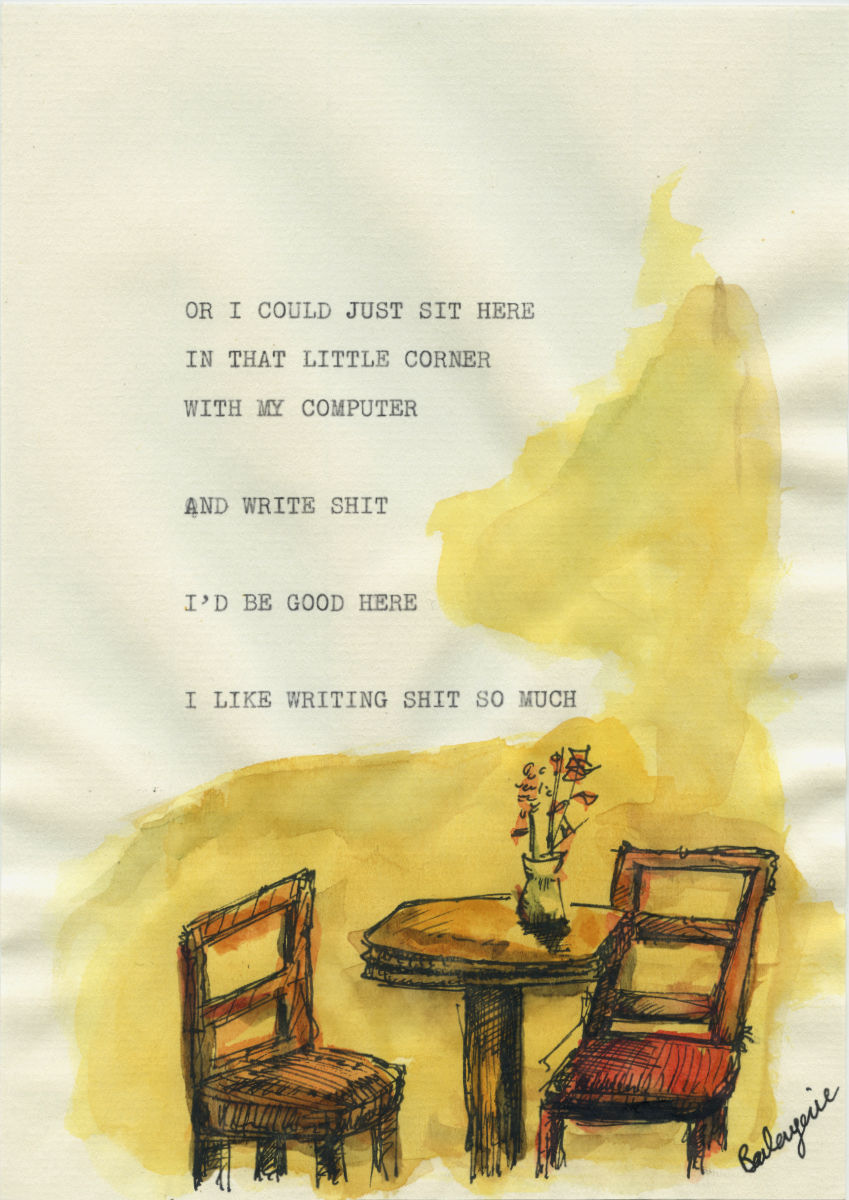
And for the past two days, I've started posting poems typed on the machine, which I then scribble over with a fountain pen and watercolor.

The first one came out alright: I'd done a little drawing.

Poem - Or I could just sit here

Poem #1

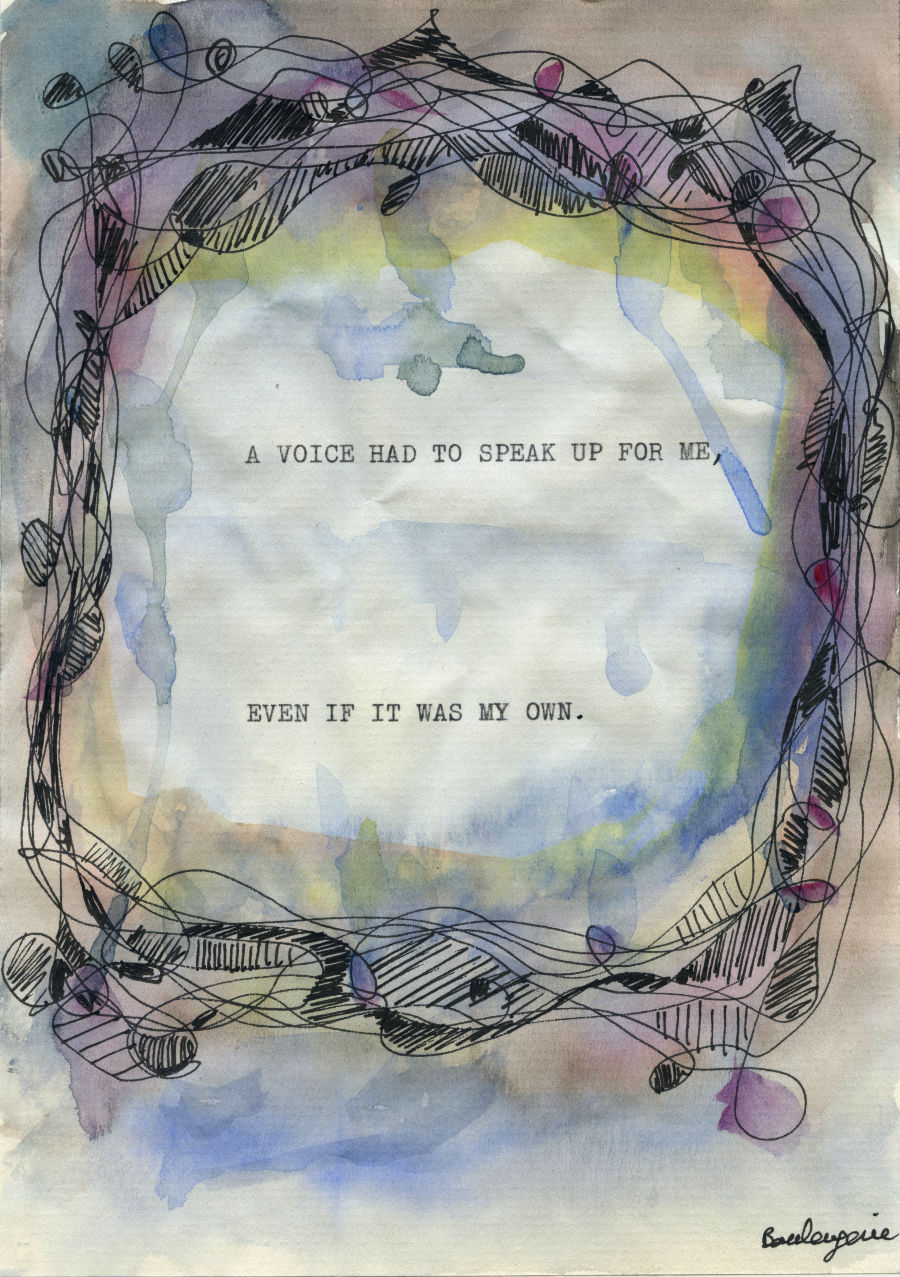
But the second one, no.

I thought it was really ugly. So much so that I started crumpling it up to throw it away.

Poem - A voice had to speak up

Poem #2

Then at the last second, I said: "no". I smoothed it out.

The point isn't to make something beautiful. It's to make.

If I start asking myself existential questions every time, I'll never do anything.

I've been paralyzed by the pursuit of quality before. "It's not good enough, it's not beautiful enough."

I do it and redo it until it "clears the bar".

Then I give up.

I realized this physically as I was about to draw.

Because typing the poem out takes time.

Not only do I have to type each letter two or three times so it shows up clearly, but I often redo the whole thing for centering and layout.

So when I pick up my fountain pen to add a layer I won't be able to erase, a small fear sets in.

I have to do it well. I mustn't ruin it.

Except, no: I absolutely have to ruin it.

I don't want to be afraid.

So for the first two, I made this decision: I'm going to post them as is.

I'm not going to redo them. I'm not going to fall back into some absurd perfectionist quest.

I'm going to post them and move on to the others.

And yes: I'm going to sell them.

I'll soon be offering prints and selling originals.

Even if it's scribbling. Even if the paper wasn't made for watercolor and warps.

I stand by it and sign it. And sell it.

And that's that.

PS: Episode 3 of my web series "Panic in Space!" is out today! How do you solve an intergalactic mystery with a hangover? Watch the new episode here →

Comment

Professional jealousy

My professional jealousy has almost completely disappeared.

I don't feel in competition with anyone anymore.

It may be that in the past, when I heard about a filmmaker my age releasing a feature, winning an award or succeeding at something, part of me was raw.

Why them and not me? It's unfair, they don't deserve it!

Their film isn't even good!

If the film was really good, that calmed me down a little.

Another part of me was genuinely happy the film existed, and the jealousy faded behind a kind of gratitude.

But most of the time, I thought it was all mush, it all looked the same, and in that shapeless mass, I couldn't see how I'd ever stand out.

Now, I'm doing better.

I've stopped trying to stand out.

What has become really important to me is expressing exactly what I want to express.

And in that game, I'm not competing with anyone.

No one can do what I do.

Nothing can be taken from me.

And above all, I don't need anyone.

Back then, the goal was to find the money.

A producer, grants, a distributor...

All of that meant fitting into a certain mold, being part of a certain world.

And I think that was the hidden goal: being part of a world.

Being recognized by certain people in a certain field.

Existing in the film world.

That ambition is completely gone.

I can't find it anywhere in me anymore.

All I want: to make things.

I can start now, with the friends who are around.

Not to make a demo or a proof of concept to use as a "calling card" later.

No: to do what I love. Right now.

For me and for whoever likes it.

"But some films need money! That's why you have to go through the gatekeepers."

I've realized they don't.

What I have to say, if I dig deep enough, never depends on money, on lights, on sets.

I can tell it with what's here. With this prop, with this passerby.

Not only can I, but it's the only way to do it.

Everything else was an illusion from the start.

Comment

Perfection and control

We all know perfection doesn't exist.

And yet, without realizing it, we let it poison our daily lives.

Take criticism, for example.

"Constructive criticism" is when you point out to someone something they're doing wrong.

So they can improve, you see.

And the idea is this: once they've fixed that, they'll be better off. Their life will be more pleasant. Their house will be cleaner. Their work will be more successful.

And once they're done, we can point to the next flaw.

That way, little by little, thanks to us, this person will reach perfection.

How kind of us!

Two things bother me about this idea.

First, our actions often aren't independent of each other.

You can't transform one part of life without affecting the rest. It's all connected.

The way someone handles one thing "badly" sometimes comes from the same source as another behavior people love.

They want the good without the bad.

I love that you're so strong but I wish you'd spend less time at the gym.

It's great that you're creative but it would be nice if you were more organized.

I love that you're alive but could you breathe more quietly and stop getting sick?

Second, why do we point out other people's flaws?

Out of kindness? Altruism? To make the world a better place?

At best, it's for our own comfort.

The noise bothers us. We don't like the mess. We find the conversation unpleasant or awkward. We'd prefer things to be different.

But often, it's a matter of control.

We want to bring anyone who doesn't do as we do back into line.

We need everyone to subscribe to the worldview we've chosen. Otherwise, it means there are others and we might have been wrong.

We make great sacrifices, and we can't stand to see others flaunt their carefree attitude without having made the same ones.

We've set up a very strict framework to regulate how others are allowed to be different. Some deviations are permitted, provided certain conditions are met.

But we don't do this for ourselves, of course.

We do it to help.

Because we love you.

Comment

Balance in every moment

I never really knew what the hell to do.

Jackie Berroyer once told me, "past a certain age, you have to exercise or you fall apart." He himself goes to the pool all the time.

So in the morning, I looked for a routine.

(No, this isn't a note about exercise, you'll see.)

Push-ups? Sit-ups? Jumping around like an idiot?

I bought dumbbells. Just to see. Like an idiot.

I watched videos online. You put one knee forward and lean in and pfff.

Then one Saturday morning, after a particularly deep meditation, I told myself it was like everything else in life:

You have to dive in and find out for yourself.

I'm going to do whatever makes sense to me in the moment.

First: can I stand up straight? Really straight?

It was harder than I expected.

But more importantly, I realized that to gauge how upright I was, my attention had to go to every part of the body. Feet. Thighs. Arms. Back.

That's when I realized I wasn't grounded. I planted my feet flat to really feel the floor beneath them.

I won't describe the rest of the session, but to sum it up:

I discovered the practice of "moving in presence".

Nothing is planned. No exercise is mandatory.

I just let my attention settle on whichever part of the body is asking. And I do what it asks.

I stretch it. I move it. I press into it.

I quickly realize that to stretch my arm, my shoulder has to drop, otherwise my back arches.

I realize that by slightly bending my knees, I feel more upright, which makes it easier to move my head.

I realize how each part of the body is connected to the others.

To feel and engage that connection, I move more slowly.

Then my eye catches a mirror:

I'm doing kung fu! Or Tai Chi!

I'm in one of those positions you see in films or in parks.

And here's the lesson in all this that has nothing to do with exercise, the one that has lit up my days lately:

Something happens when I stop thinking in terms of exercise or position.

When I'm present at every moment.

There's no more position A, position B, or transition.

Every gesture is a position of balance.

In other words: whatever I'm doing, if someone walks into the room and shouts "Stop!", I should be able to freeze in a position of perfect balance.

Without falling. Without resisting. It should be easy.

It let me experience in my body an idea I had already grasped in life: there are no transitions.

There are no "useless" moments between important ones. Everything is present. Everything counts.

Whatever moment of the day it is, if someone shouts "Stop!", I should be in a position of perfect balance.

Settled. Present. Without resistance.

I could stay in that moment indefinitely.

Even in the heat of the subway. Even in the discomfort of waiting. Even in stress or tension.

At every moment, I look for the mental micro-movement that frees me.

I look for the attachment that constrains me.

I look for the illusion that makes me believe this moment doesn't count.

And I let go.

Comment

The source of procrastination

My latest video on procrastination generated a lot of questions that fell into two categories: examples and solutions.

Examples

Some people had a hard time understanding what I was talking about.

What is this "underlying problem" that we wouldn't address and would rather avoid by "throwing ourselves into pointless action"?

Three examples off the top of my head:

  1. Diving into work to avoid confronting your career choices. You picked your job by default, or because mom and dad pushed you, or just for the money. You try to ignore the daily signals that you're on the wrong track by numbing yourself with work, routine, or addictions.
  2. Starting a project to avoid an emotion or a situation. I felt anger, jealousy, sadness, fear, grief. When I saw that emotion coming, rather than accepting it and living through it, I set in motion a whole plan of action whose only (hidden) goal was to avoid being alone with it. As soon as it comes back, I speed up.
  3. Solving surface problems rather than underlying ones. Since childhood, I've had an issue with money, or with love, or with food. And rather than finding the source of that tension and healing the root cause, I spend my time finding new costly solutions (in energy, time, or money) to manage the symptoms as they appear.

There are others.

Solutions

Always the same one for me: presence.

Find it however you want – for me it was meditation and journaling – but there are plenty of ways.

The goal, roughly, is this:

When you feel an emotion, a tension, a discomfort, or an obstacle rise up, don't immediately take refuge in action.

If every morning, the same fear comes back. If with every task, the same resistance rises. If every day, the same anxiety appears...

Work, projects, and busyness aren't necessarily the answer.

This isn't about stopping what you're doing. Not at all.

Just: spend a little time with those emotions.

One minute. Five, if you have the time.

How do they show up? Are they tied to a tension in the body or a pain? Are there recurring thoughts or ideas that come with them?

That's it. Carry on with your day.

Many of the things you do in life are probably reactive.

Meaning you put them in place at some point to avoid facing a problem or an emotion.

By taking a few minutes to get familiar with what's happening inside, you'll feel less need to set up pointless solutions outside.

And as I always say: this isn't intellectual work.

There's nothing to figure out. No big decision to make.

It's just a habit to develop:

Contemplate for a few moments the emotion that rises up instead of trying to resolve it right away.

Observe the resistance or the anxiety for a minute before trying to chase it away.

That's all.

The rest takes care of itself.

Comment

Design and the prophet

My relationship with communication shifted when I understood and absorbed what I call the first rule of design, which, in my view, holds everywhere:

Always put the most important thing first, and very, very big.

It's not very complicated, and yet everyone gets it wrong.

It's built on a simple idea: people don't care.

About your site, your business, your idea.

I once read this advice in an article on website design:

Imagine your visitors will spend seven seconds on your website, and that they're blind drunk.

So anything that isn't very, very clear, and written very, very big, is going to fall through the cracks.

Then I realized it applied everywhere else.

In articles, notes, posters, drawings, speeches, presentations, relationships...

That's one of the goals of my coaching: helping people who are very good at what they do find the two sentences that convey their value.

Of course, that's not where most of the work is.

The real work is the years of construction it took to build the foundation of knowledge and craft they offer.

And yet, without those two sentences... the real work can go unnoticed.

And go to waste.

That's the connection I made this morning with prophets.

Prophets are often accused of lying.

"He said one thing to this person, and the complete opposite to that one. He's not consistent, he's lying!"

But what scholars explain is that the prophet tells each person the truth they need to hear at that moment.

Not everyone is at the same stage of development. Not everyone has the same defenses.

The prophet's role is to move the person in front of him to the next level.

To do that, he uses the right words. Words that only work for that person. At that moment.

Just as a math teacher doesn't explain vectors the same way to seventh graders as to first-year college students, the prophet adapts his speech to trigger action.

It's a problem that fascinates me.

Knowledge isn't enough. Truth isn't enough.

If you drop the full, naked truth on a passerby's head, you knock them out. And they'll resent you for it.

Even if that truth is good for them. Even if it could save their life.

Truth has no value in itself. It depends entirely on how it's delivered.

In that sense, we're all a bit like prophets.

We've all understood something that could help our neighbor.

But often, we don't know how to communicate it.

We're blinded by the idea that the truth speaks for itself.

That once laid bare, it will dazzle everyone and be unanimously embraced.

Nothing could be further from the truth.

Everything plays out in the relationship, in the moment.

In the choice of the two sentences I'm going to say.

To help this particular person.

Here and now.

Comment

The Taste of Others

One morning, I had the following realization:

I care too much about the opinion of people who aren't in my life.

Listening to the people around you: of course!

It's not about jumping when they say jump, but about taking them into account.

That's often what happens when I make a film: since I'm easily influenced, the people on the crew really leave their mark on the project.

And I find that very healthy.

I'd even say it's the essence of presence: letting yourself be touched by what's there. Not staying sealed off from things.

On the other hand, there was a (long) period of my life when I realized that I was stopping myself from doing things because I feared the judgment of people who weren't there.

That last part is what matters: these people weren't in my life.

I didn't run into them in the morning, we didn't call each other in the evening.

Ghosts. Disembodied presences I kept alive in my imagination.

Sometimes without realizing it.

I'd want to do something because I was curious, excited, motivated, and then I'd feel something like a block.

"I shouldn't. It's wrong, not funny, not appropriate, not smart, not..."

So I wouldn't do it.

When I started meditating and keeping a journal, I looked for the source of these obstacles.

And I realized that I was projecting onto my actions scraps of judgment I had internalized.

From former teachers, family, old friends, celebrities I had sometimes never met, but who had said something on TV.

These pieces of advice from strangers had become, without my realizing it, rules to live by, barriers to action.

The most striking thing is how you can unconsciously follow the instructions of people you don't even admire.

It's not about trust, it's about authority, admiration, fear.

"No part of me wants to become like this person, and yet I'm doing what they say."

That's what I realized.

It's now a question I ask myself regularly before taking on board any advice, judgment, or criticism.

Do I admire this person? Is there something shining in them that I'd like to see shine in me?

But above all:

Is this person in my life?

Comment

There is no barrier

There is no barrier. There never was a barrier.

A line from Osho that I often repeat to myself.

Sometimes, I'm in panic mode.

I haven't slept enough. I have an obligation I can't avoid. Something hurts. Etc.

And there's often some underlying guilt: I see it as my fault. I deserve what's happening to me.

In those moments, being present is very hard.

Meditating or finding clarity isn't the priority.

No time. No bandwidth.

The problem has to be solved first.

It's for those moments that I keep this line close at hand:

There is no barrier. There never was a barrier.

In other words: no obstacle is stopping me from being present right now, whatever the situation.

It doesn't require any work, any time, any training.

By becoming aware of the emotions running through me, I become present instantly.

No need to meditate for hours. No need to "take a moment". I cross over in a split second.

As if I took a step to the side and, with a simple decision, I could observe my emotions from a distance.

Suddenly, I'm no longer swept away by the current. I see the flow.

The panic is still there. The anxiety hasn't disappeared. But they no longer overwhelm me.

That's what presence is: this step to the side that changes the perspective.

It's not chasing away the emotions you don't want.

It's not feeling as free and available as on the "good" days.

It's not silencing intrusive thoughts to find clarity.

It's simply becoming aware of what's there.

The stress. The confusion. The sadness. The good and the bad.

And it's absolutely immediate. Absolutely effortless.

It's a decision. One you can make at any moment.

Because there is no barrier. There never was.

Comment

Meditating Without Me

This is probably the method that has helped me grow the most...

Even if I couldn't really explain it.

Sometimes, I meditate "without me".

I hear my thoughts, my desires, my worries.

But it's not me. They aren't mine.

I'm aware that they come from my brain. I know that, if I wanted to, I could take them into account, act on them.

But no.

They're just content, no more important than anything else.

They are on the same level as the flickering light or the blaring horn: phenomena that I perceive, yes, but that don't belong to me. Over which I have no control.

I think Buddhists call this Anatta: not me, not mine.

Nothing that arises is tied to me.

Or rather, for a moment, I reconsider my link with my thoughts, my body, my emotions.

And I realize that this link is a fabrication. A habit.

That the relationship of ownership and belonging is an illusion.

What's more, when I look for that famous "me" during meditation, and a big truck drives by in the street, I find nothing inside but the sound of the truck.

For ten seconds, I am that sound. And that's all.

Then I become the birdsong. The tension in the elbow. The thought about my work. The smell of the floorboards...

There is no more me.

And it's deeply restful.

The entity that had all those problems no longer exists.

The person who carried that anxiety, who handled those responsibilities, who suffered from those insults, that person has dissolved.

They can no longer be hurt.

They've become the wind, the storm. The sound of water. The smell of bread.

A succession of experiences with no center.

So it can't be wounded.

It can no longer be early or late for anything.

It can no longer be blamed for anything.

It's here, that's all.

It exists.

Without me.

Comment

The Way You Do Anything

The way you do anything is the way you do everything.

I've known this for a long time. But recently, I've been realizing just how pervasive it is.

A few examples.

In a shop or a restaurant, when something goes wrong, it's rarely the only problem. It's usually the first in a long series. On a TV show, a critic visiting a hotel once said there are only two kinds of establishments: those on the way up, and those on the way down. And in both cases, it shows everywhere. The front door that sticks is often a sign that the receptionist will be unpleasant and the room will be dirty.

When someone loses their temper, turns violent, or lashes out, no matter how many apologies follow, you can be certain it's neither the first nor the last time. That's also why the person who nearly runs you over is probably going to yell at you too. Their driving isn't the only thing they do badly. It's part of a life pattern that shows up everywhere.

When you watch a film, a play, or a series, if the opening lines are predictable, if the first interactions feel artificial, it rarely gets better. This is especially noticeable in shows written by writers' rooms: an episode that starts badly almost never recovers. Whereas one that hits right in the first minute often ends on a high.

And in my own life, there is no one who showed up late to a first meeting with whom things ever went well afterward. That first late arrival announced all the others – and I'm not just talking about time.

I've also come to realize how true this is within a single day.

The way I get up, the way I handle my toothbrush or my coffee, the rush or the calm with which I walk down the street, all of it reveals where I'm at.

Every small gesture exposes my state of mind, and therefore the rest of my day.

When you understand this, you realize that everything matters.

Every action. Every thought. Every small interaction.

If I'm not present now, I never will be.

And the reverse is also true: if I want to change my life, I can (and must) start with the smallest detail, and do it extremely well.

Which will become the reflection and the model for everything else.

Comment

The Higher Gear

If we don't try to move fast, are we doomed to move slowly?

If we don't chase a goal, are we bound to stay idle?

On the contrary.

Speed, like action, is seized.

It's caught on the fly.

By being present, alert, free.

Neither distracted by the past, nor blinded by the future.

Detached from the film of one's own thoughts.

Attentive.

Accepting of inaction.

Then a path appears.

A sudden alignment between outer circumstances and inner availability.

That wasn't there a second before.

That no one else sees.

That's meant for you.

You go for it.

No speech. No plan.

It's not about starting to think.

Because the road isn't laid out.

It reveals itself as you move forward.

There are forks, false leads, traps.

But the route always becomes obvious.

As long as you keep moving.

As long as you don't think about the next step.

Truth appears in action.

At the last moment.

Seen from the outside, some will say you move fast.

Seen from the outside, some will say you have a goal.

Some will say "I wish I could move fast like him."

And others: "I wish I had a goal like her."

So they'll focus on the goal, on the speed.

They'll think about means, about solutions.

They'll look for the same path as you.

Which was never meant for them.

They'll ask themselves questions.

"Should I improve? Transform myself?"

They'll be lost in their heads.

It's fine.

There are countless paths.

Everywhere. All the time.

When they come back to the present, they'll see theirs.

Just as you could see yours right now.

In front of you.

Right behind your thoughts.

Comment

Jobs That Don't Exist

I've stopped thinking of myself as a "filmmaker."

It isn't a job.

I make films, yes.

But I don't necessarily feel close to other filmmakers.

Using a camera, lights and the whole kit isn't a strong enough common ground to create a sense of community.

What interests me is the subject. What people have to say. Their process as artists.

Which, in the end, doesn't depend on the job.

In that sense, to me, a filmmaker who only made cooking films would be closer to a cook or a food critic than to another filmmaker.

A filmmaker obsessed with crime would have more to say to a novelist or a police officer than to someone who makes comedies.

As for the one who bets everything on improvisation, on organic creation, he probably wouldn't have much in common with the one who storyboards every scene down to the millimeter.

I meet plenty of filmmakers I have nothing to say to.

I watch plenty of films I couldn't care less about.

Which surprised me, at first. We do the same thing, don't we? We're part of the same world?

But actually, no. Not at all.

And I think this is true for many jobs, especially in creative fields.

Using common tools to produce works that go by the same generic name doesn't guarantee compatibility.

Between two writers, two painters, two artists, there can be a world of difference.

Unless you really talk shop.

"What software do you use?" "What camera?" "What brush?"

But very quickly, the conversation stops because on what matters, there isn't necessarily any connection.

The artistic equivalent of talking about the weather.

Comment

Start Now

What's stopping you?

"Well, first I need to..."

"I can't start until..."

"I have to wait until I have a..."

External obstacles are only the visible manifestation of your inner barriers.

If you were ready, you wouldn't need anything.

If you're missing something, there's inner work to do to get aligned.

Nothing justifies delaying that work.

It requires nothing.

It won't get easier with time.

Every condition is already in place.

You could do it right now.

In fact, that's the real work.

Everything else – getting started, execution, collaboration, promotion... – is just a consequence of this inner work you could start this very moment.

No matter the scale of the task.

No matter how important it is in your life.

The first step, the most important one, is immediately accessible.

It's the only one that counts.

And it requires nothing. Nothing!

So, what's stopping you?

Comment

Fasting and freedom

No, this isn't another post about fasting.

It's a reflection on freedom.

This morning, after dropping off my four-and-a-half-year-old son at day camp, I was... tired.

I tried to get the day going as usual, but it wasn't catching.

The journal was empty. Nothing interesting came.

It would have been easy to write a note – I could have picked a random topic from my journal and spun something out of it. But I don't write anymore if nothing comes. I don't want it to become an empty exercise.

So I did nothing.

And the whole day went on like that. Sluggishly.

I still did what I had to do. But creation stayed locked away until late afternoon.

When my son is home, the timing isn't the same. When I try to stick to my usual routine, it doesn't work.

Normally, I start my journal after an hour of meditation and exercise. I'm present. It flows.

When my son is here, I'm 100% with him. Which is a form of presence too, but not the same one.

I'm available for him, at his service. Which makes it easy to move on to obligations (being available for my clients, for accounting). But not to create.

I think my mistake is trying to switch from one to the other too quickly.

In the end, meditation isn't what you do to start the day.

It's what you do to become more present.

So tomorrow, I'm going to try to take a moment after dropping my son off at day camp.

Because I think it's a bit like fasting:

When you're just starting out, the body has no idea what's happening. The liver, the pancreas, the brain, every organ needs a long while to get the machine going.

You're hungry. You feel weak.

But when you fast regularly, everything happens much faster. It's almost invisible.

I think it's the same with freedom.

At first, it used to take me hours, sometimes days, to move from a state of generalized anxiety and urgency to a calm more suited to action. Now, it's often very quick.

But this morning, I didn't even give myself the chance. I didn't allow any transition time.

And every time, I realize that's the most important part.

When doubt or anxiety arises, don't speed up.

Meditate. Come back to presence.

And the next action comes on its own.

Comment

Eating Once a Day

If you'd told me about this a few years ago, I would have called you crazy.

But now... it's almost normal.

It happened in stages, and it started a few years ago with this realization:

I'm always digesting.

That's what hit me one evening while reading an article. My digestive system is always full.

Eating was the first thing I did in the morning, often the last thing I did at night, and I could easily picture my organs getting a little fed up.

Especially since our ancestors apparently didn't eat as much as we do. And I could also easily picture how this idea of "three meals a day" might have been invented by industries that cared about something other than our health.

I tried intermittent fasting. Just to see.

A bit like when I'd stopped eating meat: the point wasn't to stop, it was to see what it felt like. After all, you can't really say you've chosen a way of life if you've never tried the other one. So let's try.

And it was... extremely easy.

Much easier than expected.

I had dinner early, around 7pm, then, aside from my morning coffees, I didn't eat anything solid until noon the next day.

About 16 hours of fasting.

And no, I wasn't tired.

Before the lockdown, I even did Brazilian jiu-jitsu in the morning. On an empty stomach. I was terrible, yes, but not weak.

And if I was really hungry some mornings, I'd eat. But it happened less and less.

Then recently, I moved up a level.

I kept reading things about the benefits of fasting now and then. One fast a week, or two a month.

Especially since I eat pretty badly – even if I've made progress.

I'd realized I belonged to the large family of insulin-resistant people: too much sugar, too many carbs, glucose spikes, waking up at night, high blood pressure...

It was worth exploring alternatives.

So one day, I tried a 24-hour fast. Just to see.

And it was pretty hard. Not torture, but I was cold, hungry. I couldn't think about anything else.

Three weeks later, I tried again. Easy.

Then, just to see, I tried two days in a row. One meal every 24 hours.

And on the second day, I barely noticed anything.

As I write this, it's 9:30 in the morning and I haven't eaten since lunch yesterday.

And I'm not hungry. My mind is clear – clearer than after a meal.

Often, yes, I could eat. Honestly: I could always eat, since my whole life has revolved around food. But it's not a struggle.

It's actually much easier than before. Hunger isn't scary anymore. I never feel weak.

The hardest part at first is giving up the ritual of the meal.

When you're used to eating three times a day, you realize how much life revolves around food. Grocery shopping, cooking, resting after eating. Then thinking about the next meal.

What time do I eat? It depends.

In the afternoon, usually. That way, on days when I have social lunches or dinners, it only shifts the meal by a few hours one way or the other. Easy, again.

It also means I pay much more attention to the balance of my meals. Fiber, protein, fat. Meals with everything. They don't need to be huge. But not skimpy either.

That's probably the real revolution: I've learned that hunger often comes from eating poorly. So I've learned to eat better. Every meal now ticks all the boxes.

Here's the paradox: I eat less but I'm better fed.

And yes, I feel fitter. I sleep better. I wake up earlier, with less anxiety. I have more clarity during the day.

Overall, it has transformed my relationship with food and hunger.

As if a fear had been switched off.

"We have to eat! We have to eat! What are we going to eat? What if I don't have enough? What if I'm hungry? Ahhhh!"

Now, if I'm hungry, I'm hungry. It's a much less urgent craving than before. It lasts a while. Then it passes.

(To be clear: I'm talking about a small hunger. The kind that, before, would have made me snack. If at some point I were really hungry or felt weak, of course I'd eat! But it hasn't happened yet.)

To be continued.

Comment

Are We Racist? (Against AI)

Following yesterday's question about the use of AI on this site, most responses agreed with me:

Better off without.

One response went the other way, and it was interesting:

Even if your content had been entirely AI-generated (or perceived as such), what would that really change? Nothing for the reader, I think: it would remain just as relevant and interesting...
– neijul_

Fair enough.

From the reader's or visitor's perspective, the only thing that matters is the quality of what they read or see.

Why should it matter how (or by whom) it was made?

It's almost a legacy from show business and film: you're not supposed to know what goes on backstage.

Does the magician really kill the bird for his trick? Did the actor really do the stunt himself? Did they actually destroy a building, or was it a model?

When I was young, none of that mattered to me. I only cared about the result.

For that matter, my four-year-old couldn't care less who draws Bluey or who wrote his favorite book. It's the story that gets him. The characters.

So are we discriminating against AI?

Should we accept that it's just another tool creators use?

Something still bothers me.

But maybe because I'm an old fart. The kind who wouldn't have appreciated the end of silent films or the rise of the internet. ("Back in my day...")

I feel like human involvement in creation matters, even when I can't see it.

For example: if I found out that "Friends", the show I grew up with, had been entirely AI-generated, that the characters never existed, that it was all done inside a computer... I'd be disappointed.

Same thing: if I read a compelling article and then found out it had been generated by an LLM...

Part of me identifies with the creators I love. I imagine meeting the actor from the show, or the writer of the article, someday.

When someone makes something that speaks to me, I tell myself there's someone out there in the world who understands my problems and found a way to do something with them.

I'm no longer alone.

But if I find out it was made by a computer...

I'm alone again.

This wasn't planned, but it's exactly the subject of the episode "1000 Years of Solitude" from my web series Panic in Space (out May 1st!).

A guy realizes his best friend online is... you can guess.

And it changes everything.

Comment

A "100% AI-Free" Label?

I'm torn.

A lot on my plate today.

So instead of today's note, I was thinking of posting "the dialogue of the week."

A few years ago, I started writing fictional dialogues that did pretty well. I dug them up and was planning to repost them here to continue the series, but...

I had second thoughts.

You see, the character portraits were made with Midjourney.

Should I redo them by hand?

At first, I thought: "Who cares. It's just an illustration, the dialogue is what matters."

But recently, I read a fairly sharp comment from an illustrator who said, roughly:

If the illustrations in your text are made by AI, I'll assume you used AI to write the text too.

Which isn't without merit.

And since all the notes are written by hand, I didn't want any AI elements to cast doubt in the reader's mind.

Let's be clear: I use AI.

I use it to proofread the notes (spelling, grammar) and then translate them into English. I also use it to build custom tools for me (invoicing, client management, etc.).

But as you know, I've found AI to be useless to me for writing or for the "real" intellectual work (building a narrative strategy for my clients).

So my dilemma is this:

In reality, this site is already almost 100% AI-free. Adding Midjourney portraits, even small ones, introduces doubt.

Especially since I plan to add photos, drawings, poems... none of which involve AI at all.

Hence the idea of taking the plunge: creating this "100% AI-free" label.

Reassuring readers on the home page that no content was made with AI. With a clickable link explaining any use in more detail: proofreading, translation.

Which doesn't mean I'm against people who use AI. It's just that, for now, I don't. So I might as well make the small extra effort to set the record straight.

It would be more work, because I'd have to draw the portraits for my dialogues myself. (Drawing is fine. It's the coloring!)

But I think it would be worth it.

What do you think?

Comment

Starting the Day Right

Abraham Lincoln once said:

"If I had nine hours to chop down a tree, I would spend the first six sharpening my axe."

It's the same in the morning.

Sometimes, anxieties catch me as I wake up.

"Ugh! I have to do this! And that! And I forgot I was late on this other thing!"

It used to mean one thing: hurry up. Get out of bed and get to work, slacker!

Now, the rule is this:

I stay in bed until I'm perfectly calm again.

Until I'm happy to get up, glad to go "surf with the chaos", I'm not allowed to put a toe out of bed (or a finger on the computer).

The key ideas behind this practice:

  • Urgency is often artificial Not only were my urgent morning worries of three years ago not that urgent, but looking at my life today, I can see it was actually heading in the wrong direction.
  • Nothing is that serious What if I died today, or next week? Would it matter that I did all of this? And do I even remember that I'm going to die one day and that everything will vanish? To me, that's not distressing, it's liberating.
  • You'll do everything better with clarity Whatever I decide to do, if I do it reactively (to fight off the anxiety), I'll do it far worse than if I act from a place of peace.
  • Anxiety is a necessary message In fact, I shouldn't take any action against anxiety. If I live it through to the end, it will fade. And it will leave a mark somewhere inside me that will be taken into account at the right moment.
  • My real value is freedom, not punctuality The world would have survived if the printing press had been invented three days, or even three years, later. Important things don't hinge on a few days. Empty obligations, often, do.

But above all: the time I take in the morning to start off right pays me back a hundredfold over the day. I spot the priorities easily. I don't let fake problems stress me out. I find the providential ideas that solve several issues at once.

Consider this: if you're in a bad mood, a single fake problem can take up your whole day.

So yes, in the morning, take a little time to sharpen your axe.

Comment

Spoon and Productivity

On the shoot of Migrul, I was way behind.

It was a marathon film, written and shot in a few days during the Off Courts festival.

We were shooting the next day – a single day – and everything was missing.

In particular: an important wig for my character. Costume pieces. And the materials to build a fake train window.

So that afternoon, I'd planned to drive to Caen and back to pick it all up.

An hour there, an hour back, with no idea which shops to target.

And rush back for the rehearsals with the actors, which we hadn't even started.

Running late, then. I should have left right away.

Except that before lunch, rather than keep grinding through a to-do list that wouldn't stop growing, I made the following call:

I'm going to take 20 minutes for a spoon nap.

A spoon nap is when you doze off for a moment holding a spoon. If you fall asleep too deeply, the spoon drops and wakes you up.

Supposedly invented by Dalí, it's meant to help you step back and make better connections between ideas.

For example, there were supposedly studies where subjects had to solve complex puzzles with or without a spoon nap. And apparently, the nap helped enormously.

So I gave it a try. First time.

What I quickly realized: it's really a kind of meditation (something I already do every day) disguised as a micro-nap, without the New Age vibe.

The difference is that I'm used to meditating right after waking up, not in the middle of a rush, not when I'm about to hit the road to solve a hundred problems.

But I played along.

I lay down, relaxed. As often happens, images came up, ideas, a calmer awareness.

Then within ten minutes, one by one, all my problems solved themselves.

The wig? I'll use a mop, it'll be funnier.

The train window? I'll use the curtains from my bedroom, they'll be perfect.

The costumes? I just remembered I have the ones from my previous shoot in a cellar – they'll work fine.

When I got up, everything was sorted.

The trek to the other end of the world was no longer needed.

The solutions I'd found were better than the ones I had in mind before.

I took a lesson from that experience:

When I feel resistance to an action, something I don't want to do, it often means I shouldn't do it.

There's another solution, more personal, more aligned, more creative, within reach.

That I don't see because I'm not present enough.

So presence isn't just some beatnik idea about picking flowers and chanting Hare Krishna.

It's also what lets you align your actions and become more productive.

For shooting vampire films, say.

But probably for everything else too.

Comment