Audience Award at the Riom Festival!
Episode 5 of our web series Panic in Space won second prize in the Audience Award at the Scientific Short Film Festival of Riom!
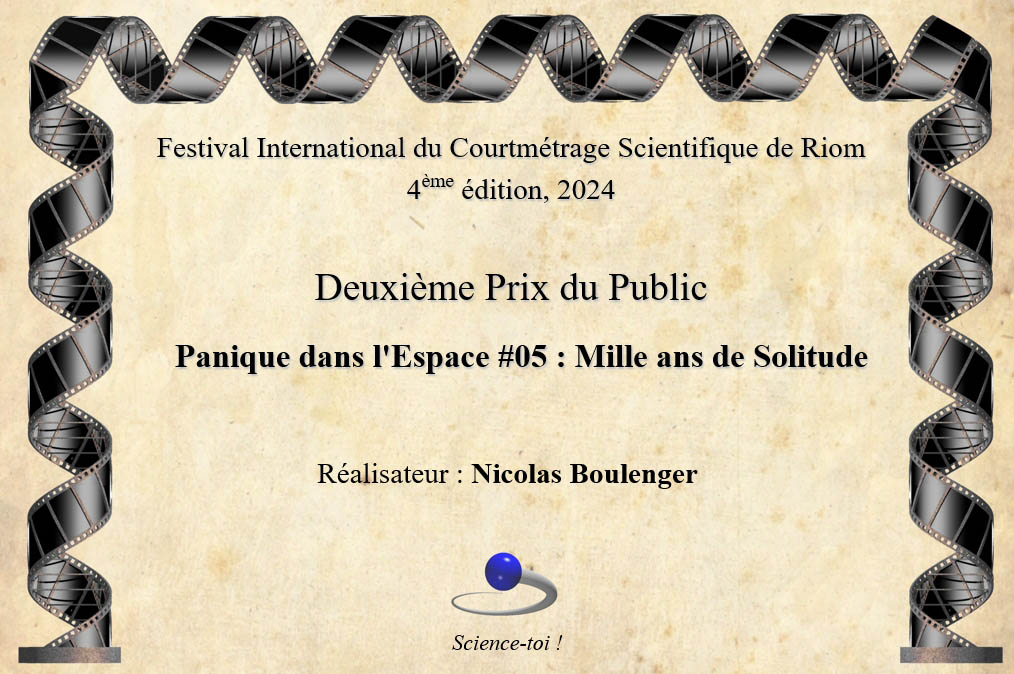
Episode 5 of our web series Panic in Space won second prize in the Audience Award at the Scientific Short Film Festival of Riom!
Since the start of fall, I've been trying something new:
Every Monday evening, along with some improv friends, we invite anyone interested to join us in the basement of Barlone for an improv workshop. Then, once a month – one Monday out of four – we record sketches with a live audience in front of a green screen. Entry is free as long as you order a drink.
So far, we mostly have professionals (actors, filmmakers), but everyone is welcome. We haven't fully nailed down the rules yet.
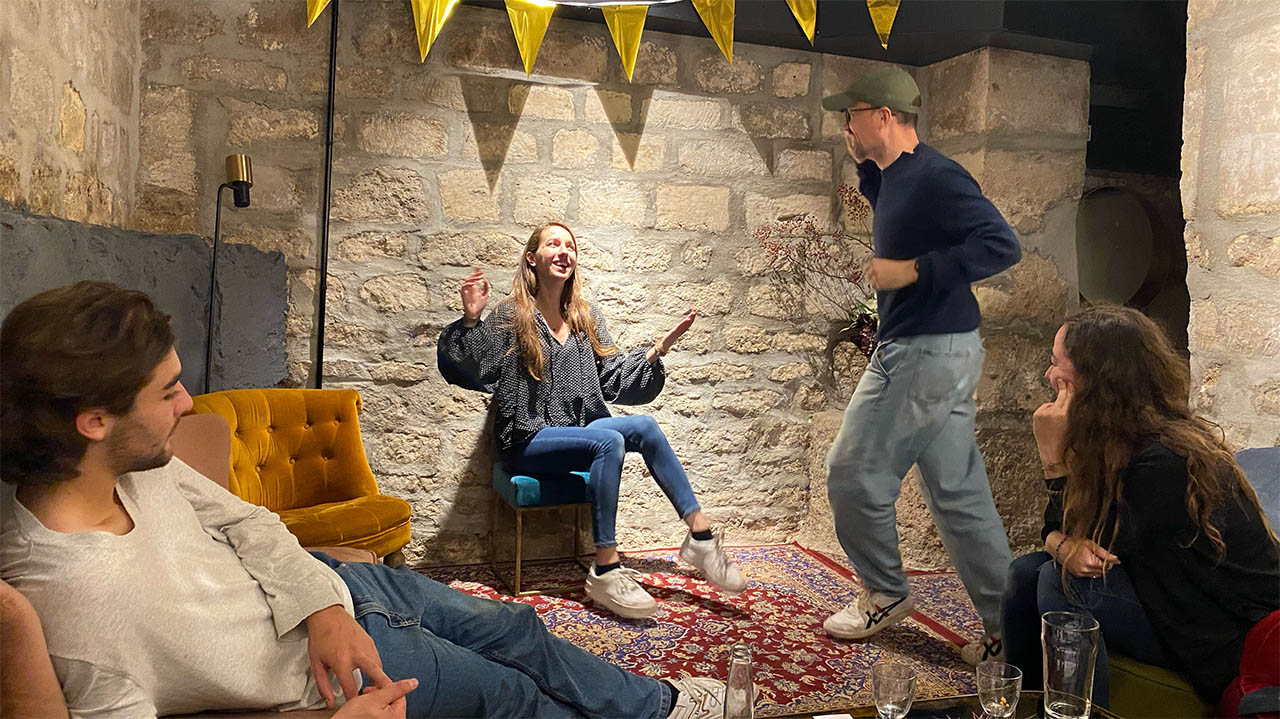
Improv session with Nino, Noémie, Stéphane, Constance and, in the back, Nicolas and Antoine.
What we're aiming for is a new way to create fiction, where acting – not writing – is at the heart of the process. We invent, build, and rehearse on the spot, without going through the script stage.
First shoot tonight. Theme: "The Catastrophe." Nothing is ready. I'll let you know how it goes.
Thanks to Barlone for hosting us with genuine warmth, as they do with all their events. And thanks to Cynthia Pedrosa for the illustration.
If you're interested in the adventure or want to join in, there's more info on our Facebook and Instagram pages.
The methods we're taught in school are bogus.
While you're busy researching and working on the fundamentals to avoid mistakes or rash actions (and not getting a bad grade because "you didn't work hard enough"), some smart alecks have already jumped in to grab everything there was to grab.
They've understood that the jury doesn't deliberate after the closing arguments: the decisions have already been made in the hallways, in the antechambers, between two doors, driven by those who didn't stay home to calmly ponder the problem.
Besides, what's the point of thinking? When the world boils down to "me against the others," there's no subtlety left to weigh. Acting is easy.
Thomas Piketty explains this well in a paragraph from Capital in the Twenty-First Century:
To be sure, there is a simple economic principle to balance the process: the law of supply and demand. If a good is in short supply and its price is too high, then demand for that good should fall, which will calm things down. In other words, if real estate and oil prices rise, just move to the countryside or ride a bike (or both). But aside from the fact that this can be unpleasant or complicated, such an adjustment can take several decades, during which the owners of the buildings and the oil can accumulate so many claims against the rest of the population that they will end up permanently owning everything worth owning, including the countryside and the bikes.
I think you can clearly see the consequences of this idea in the testimony of Jean-Baptiste Rivoire, former deputy director of Special Investigation, who recounts how Vincent Bolloré worked to strip Canal+ of real journalism (French only):
Jean-Baptiste Rivoire before the investigative commission regarding Vincent Bolloré's editorial influence over Canal+
It's a note I remember writing in my notebook a long time ago: "It's not the best who rise to the top." Or, as Keynes said:
"Capitalism is the extraordinary belief that the nastiest of men for the nastiest of motives will somehow work together for the benefit of all."
John Maynard Keynes
UPDATE: Another example from the New York Times. The lead Google has amassed by abusing its monopoly is one its competitors won't be able to close, despite the recent ruling against it.
A.I. didn't invent anything.
If you have 7 minutes, I recommend watching this Armenian animated short film from 1983. Starting at 1:30, you'll see that the psychedelic transformations of the demon Ekh closely resemble the nightmarish deep dreams of today's A.I.:
Moral of the story: always be kind to talking animals.
What a pleasure it was to attend the premiere of the documentary Les Sirènes de Dieppe at the Max Linder yesterday morning! An hour in the company of the drag performers of the Sirène à Barbe cabaret: the backstage, the camaraderie, the financial struggles, the fight against intolerance, and a bit of musical comedy. A film as accomplished as its subject is unexpected.
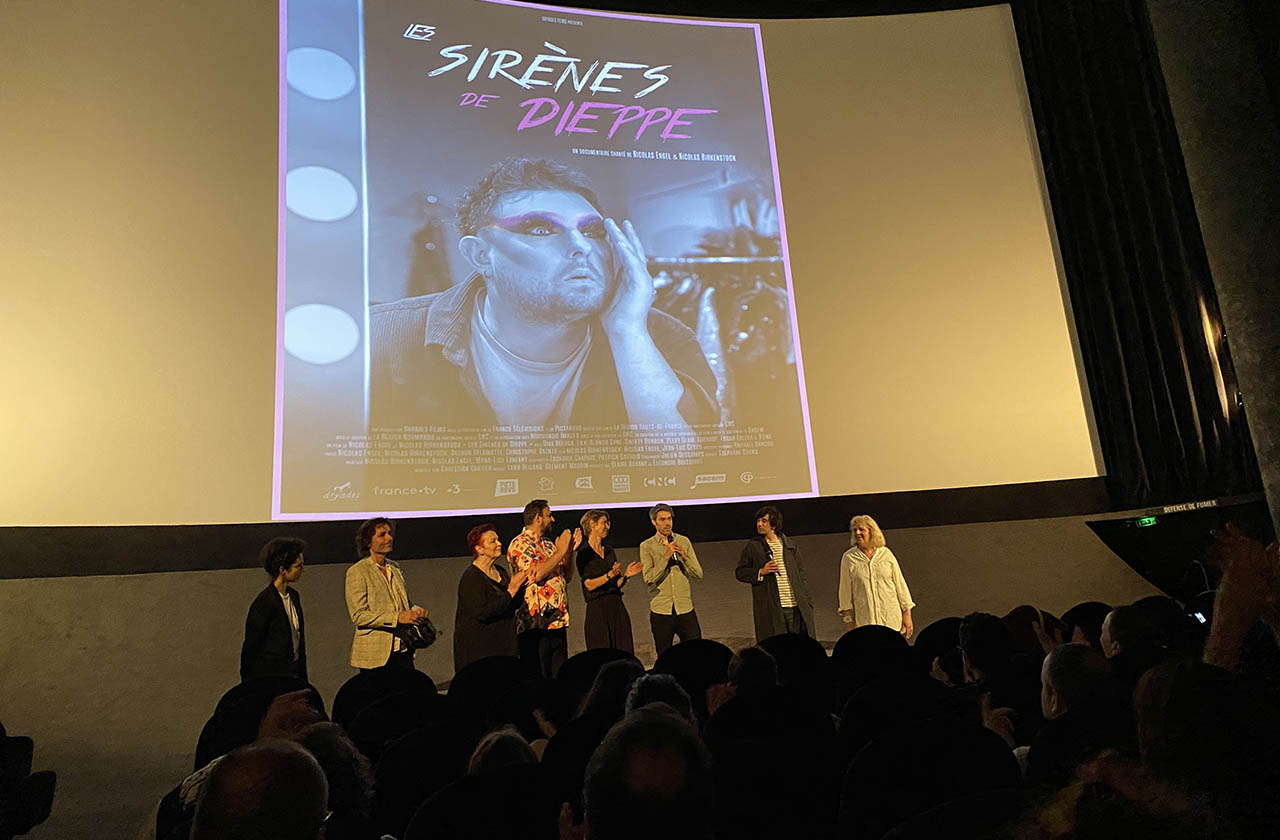
From left to right: Claire Babany (producer), Raphaël Bancou (composer), Fabienne Thibeault (godmother), Diva Beluga (performer and owner), Lily (performer), Nicolas Birkenstock and Nicolas Engel (filmmakers), and I can't remember the rest.
My composer friend Raphaël Bancou – whom I'd reconnected with after 10 years on that occasion – wrote the music. More on him soon.
If you're interested, the film by the two Nicolas (Birkenstock and Engel) will be available on replay starting September 19th on France TV, don't miss it. And if you're ever in Dieppe, go see the show!
I'm belatedly exploring the output of Giorgio Moroder, aka Giorgio, who seems to have influenced every electronic artist on the planet. Recently, I've been listening to this 1972 track on repeat:
The simplicity, the repetition, the crescendo. That's all it takes.
I registered after the deadline, so I couldn't schedule my meetings as well as I would have liked. Despite that, I caught up with friends, met some very nice people, went to some truly enlightening talks, and had a few drinks – it had been a while.
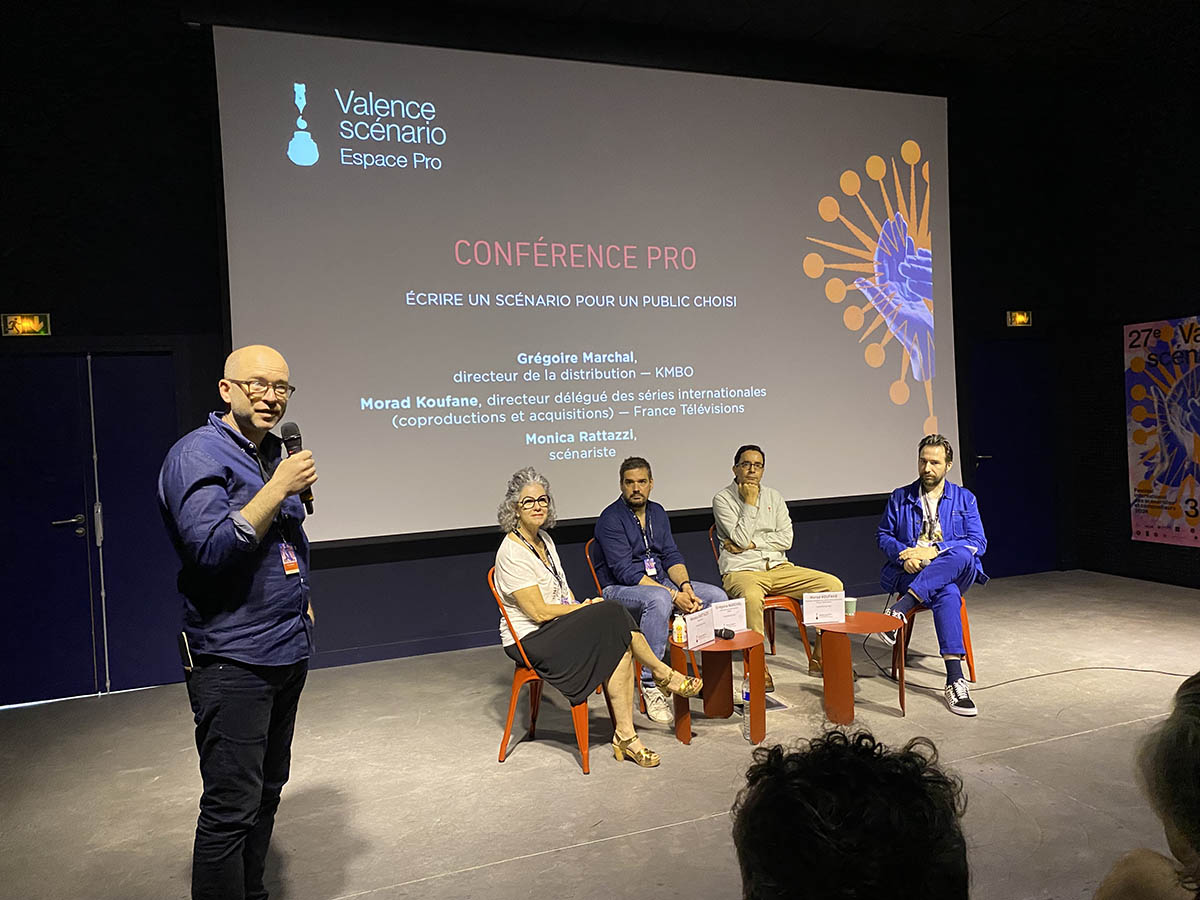
This festival is very well organized for meeting people – with meetings set up in advance and an app to get in touch. And Valence, I forget every time, but it's really pretty.
If you had asked me the day before yesterday, I would have told you I'm not really into concerts.
The music is too loud. There's too much commotion. It's too long.
But that was before my buddy Jackie Berroyer (who, let's not forget, was a music columnist for Hara-Kiri, and whom I'll be writing about here soon) invited me to see Fat White Family last night at La Cigale. Never heard of them. I wasn't expecting anything. "You'll see, they're pretty good, you might like them."
OK, now I get why people love concerts.
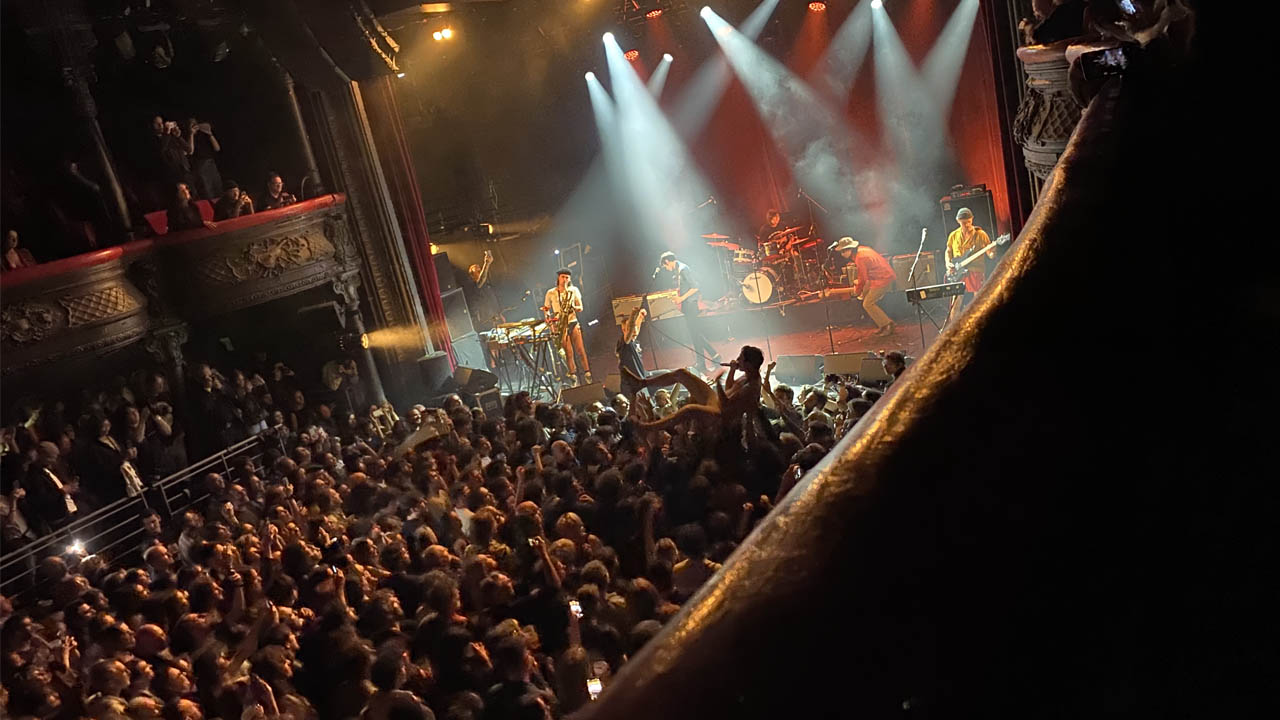
Incredible experience. Yes, the music was wild, hard-hitting rock, but with real craft, a progression, and some unexpected instruments (flute, baritone sax). Then there's the lead singer, Lias Saoudi. He's in shorts. By the second song, he's down in the pit singing in the middle of the crowd. That sets the tone. For the rest of the concert, he sings (sometimes screams, but without ever losing the music) balanced on amps, in a fetal position on the edge of the stage, or crowd-surfing.
From above, the pit pulses. It's a collective experience. But you can tell it's all masterfully controlled by a seasoned band: here and there, you catch the small, extremely precise signals the band gives the crew; behind the wild personas are professionals who have crafted a structured and generous show. And La Cigale, where you can move around freely, gives you both freedom and intimacy to enjoy it.
I can see how people who've experienced this once can keep going back to concerts, chasing that first "high". And why some old-timers endlessly reminisce about a show they saw in their youth: "Oh, you know, when I saw that band back in '76..."
"A concert like that, you remember it for the rest of your life," Jackie told me as we walked out. Looks like it.
If Sting repeats it three times in his song, it must be important.
It seems crucial to me, but also extremely difficult. All the authors (and all the humans) I admire found, at some point in their lives, "their" voice, their way of being, their view of the world, where many others keep "doing it like" their idols, imitating them (badly). Mind you: imitation is probably an essential first step. To admire is to be moved. Wanting to "be like" someone means recognizing something sublime in them that you wish you had. It shows a sensitivity that marks the beginning of everything. But to reach the next level, the second step isn't optional: you have to find those qualities in yourself. Develop your own tools. Shape your character out of what's inside you.
The main obstacles are always the same, it seems to me: fear and ignorance.
Fear of not being interesting enough. Fear of not being as cool, strong or tormented as those we envy. Fear of not having the right past, the right look, the right mind. Fear that it's too early or too late.
Spread over all of it, a layer of ignorance. Ignorance that these fears are natural, shared, collective. That they are often the driving force behind the talent and careers of those we admire. That, regardless of success, they will never leave us and so, when we put them to use, they are an intimate and inexhaustible source of creation.
"What they criticize you for, cultivate it: it's you." – Jean Cocteau
My English feature film screenplay, "The Stagemaster", has just advanced to the semi-finals of the Emerging Screenwriters Drama competition!
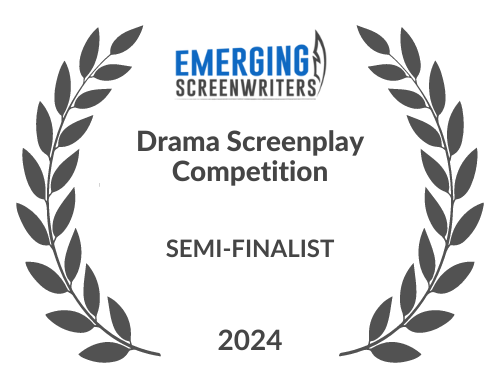
This fourth U.S. accolade puts me in the top 6% of screenplays on Coverfly.
Another Surprise Culture Night!
I've mentioned before that I sometimes go listen to poetry in a cellar. Well, completely by chance, I stumbled upon the host of those evenings in another cellar, in the middle of a show.
I was blown away by her energy, confidence, and humor. It's funny, touching, unhinged, but always kind. You can watch her latest video here. And here's another one with a bit of French in it (Sophia Lucia is American but lives in France):
You should spend more time in cellars too. It's (literally) where the underground scene is at. And it starts on her Insta account --> @freakshowcabaret
I've reached the end of the novel I've been writing for... oh wow... fifteen years?
"When the Gondolier Dies", 105 pages, a little over forty thousand words. There's one chapter to revise in the middle, a few corrections to make here and there, but all in all, it should be finished soon.
This is the first novel I've ever finished. Before that, I'd started plenty that never survived the test of dispassionate rereading after a few months. But this one did. No matter how much time had gone by, months, sometimes years, I was always surprised to find it good. And to want to keep going.
There are advantages and disadvantages to taking so much time to tell a story.
On the advantage side, there's a "Boyhood" vibe (the Richard Linklater film shot over 12 years): the person who starts the book isn't the same one who finishes it. You can feel a genuine transformation in perspective as the story progresses. And I'm not making it up: it's mine.
On the downside, there's the evolution of style: I write better now than I did fifteen years ago. Still, I didn't want to rework the beginning too much, to keep the original energy. I trimmed it a little, aired it out a little, but I respected the progression and the turns of phrase as if they'd been written by someone else.
Next step? Get people to read it. Find a publisher. Write the next one a little faster.
The first sentence:
If you ever run into one of my friends, tell them I'm doing fine.
A premiere is always nerve-wracking for a filmmaker – especially at the Opéra Bastille – but this evening organized by the École des Ponts went extremely well. A full house, with the people in the film and a large part of the crew in attendance... very moving.
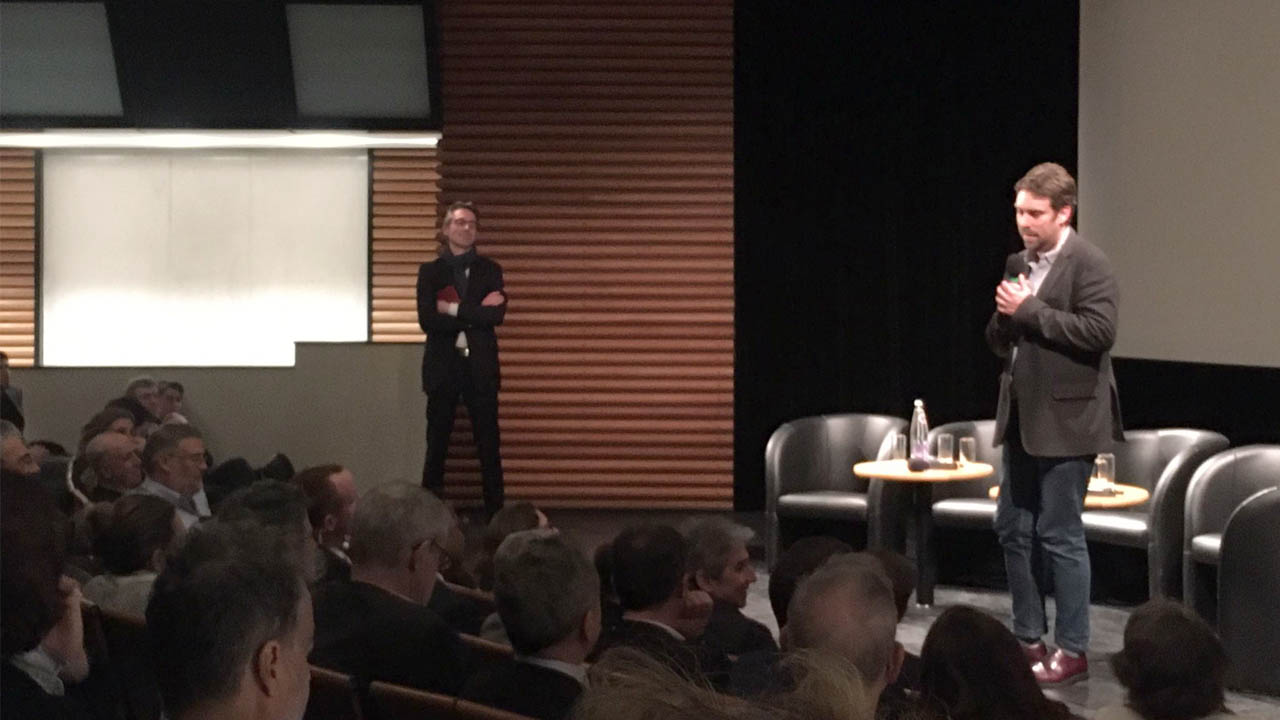
A few words of introduction after the opening by Anthony Briant (left), Director of the École des Ponts.
I loved producing and directing this film. I met and collaborated with extraordinary people.
I'll put a trailer online soon. For a year, the film will only be shown in theaters (festivals, events), while we look for a broadcaster. Then it will be released more widely. Screening dates here or on the École des Ponts LinkedIn page.
A culture night less surprising than usual, since I'd booked.
When I go see my friends' shows – especially in small venues where you can't hide – I always prepare a line to say afterwards in case I hated it. ("You made me dream," Françoise Sagan is said to have told Jeanne Moreau after a play she slept through.)
I'm happy to say I didn't need it.
(I'm going through a time when my friends are doing amazing things. Here and there, for example.)
The play is simple, intimate, yet uncompromising. It builds. The staging is delicate, made of small objects and small gestures that come back here and there and tell a story. It was also a chance for me to see the path and the talents of someone I know come into their own in a personal, powerful play. Very moving. But don't worry: you don't need to know her to enjoy it.
Oh, and also: you'll learn things (about Chile, about Louise Michel...) and you'll come out a little less stupid. Which isn't true of most shows, or, let's be honest, of most of my films.
Tant que nos Coeurs Flamboient with Lorena Felei, written and directed by Laurent Contamin. At the Théâtre Essaïon until April 30th.
There's something for scientists and for beatniks. The common thread: reality isn't what you think. Here we go.
Science first: I discovered Don Hoffman on this Lex Fridman podcast. He's a researcher in the Department of Cognitive Sciences at the University of California. The thesis of his book The Case Against Reality is simple: evolution doesn't care about truth. Working from models grounded in evolutionary game theory, he concludes that our perception of the world is biased toward survival. In other words, our brain has no qualms about ignoring or distorting the truth as long as it gives us an adaptive edge. It's not its fault: millions of years of evolution programmed it that way.
So a species that perceived every subtle variation in a signal could be at a disadvantage against one that saw things in a much more black-and-white way (red = danger!), but much easier to process in an emergency. In this race – as in many others – neither aesthetes nor poets survive.
On the beatnik side, I've been working my way through Seeing That Frees by the late Rob Burbea for over a year.
I'd describe it as an advanced meditation book centered on the notion of "emptiness", which I've talked about here before. The core idea is that reality is much less real than we imagine. We're convinced there's a "solid" material world that lasts over time and goes on existing when we stop looking at it. Through a series of meditations on impermanence, non-attachment and dependent arising, Rob Burbea shows that reality is partly an inner fabrication, built and unbuilt as consciousness moves. He teaches us to use different ways of seeing the world as tools we can pick up and put down, to gain freedom.
To my friends, I sum these ideas up in one sentence: "reality is made of the thoughts you can't get rid of." The day I understood that, a lot of things changed.
Finally, somewhere between science, philosophy and New Age, there's Why Materialism Is Baloney by Bernardo Kastrup.
Kastrup started out as a Brazilian computer engineering researcher who worked at CERN, among other places. When he set out to build a "conscious" computer program, he got interested in the problem of consciousness from a philosophical angle, and came out of it with a metaphysical theory that brings idealism back into fashion. His idea goes like this: today, it's impossible to understand how matter creates consciousness – David Chalmers's famous "hard problem". So he flips it around: consciousness creates matter. The laws of physics would no longer follow from the standard model, but would be regularities in a shared consciousness that each of us perceives only part of. According to him, we "think" matter. It sounds a bit crazy, but his whole point is to show, through an Occam's razor kind of argument, why it's "less crazy" than the materialist hypothesis.
Of course, we're deep in metaphysics here, so none of this will change how you pick your socks in the morning anytime soon. But eventually, it should.
UPDATE: All these thoughts led me to imagine the film "Permis de Conscience" (Consciousness License) – which I'll probably never make.
Originally the soundtrack to a video installation by Pipilotti Rist, it's a cover of Wicked Game. Despite (or thanks to) its strangeness, I find myself listening to it regularly:
"I'm a Victim of This Song," music and recording of the installation.
It starts off normally, then it goes off the rails. Just like my projects.
For me, keeping a journal comes down to a single activity: describing the obstacle.
What's blocking me now? What's stopping me from being free, happy and creative right away? What hidden snag is getting in the way of the next step?
Two things matter:
First, it's only about describing. Not finding a solution. Not trying to fix myself. I dig up the obstacle and look at it from every angle. I trace where it reaches inside me. I ask myself why it bothers me now, and in this particular way. And that's it. Once the problem is out in the light, I let other forces inside me take care of solving it.
Second, it's an immediate obstacle. Something that's keeping me from moving forward right now. I'm not trying to settle the situation forever. So the effort is neither theoretical nor intellectual. I deal only with what's in front of me, assuming the next difficulties will be handled the same way: in the present, when they come up – if they come up. We'll deal with the future when it gets here.
That's why the journal has been part of my daily routine for almost 3 years, and why it's an essential exercise for staying present.
Another surprise culture night (SCN):
I found out that the café I go to regularly, called "La Cave" ("The Cellar"), has... a cellar. Where people read poetry on Monday nights. Lots of people, mostly English speakers. Poems, songs, stand-up, "anything goes." Great atmosphere.
I got on stage to recite this short poem by François de Cornière in French and English (translated by ChatGPT) because you have to start somewhere.
Then came the special guest of the evening: Bonafide Rojas, a poet from the Bronx who came to read excerpts from his book Excelsior. So funny. So charismatic. They call it poetry, but it's very personal trains of thought bursting out on stage.
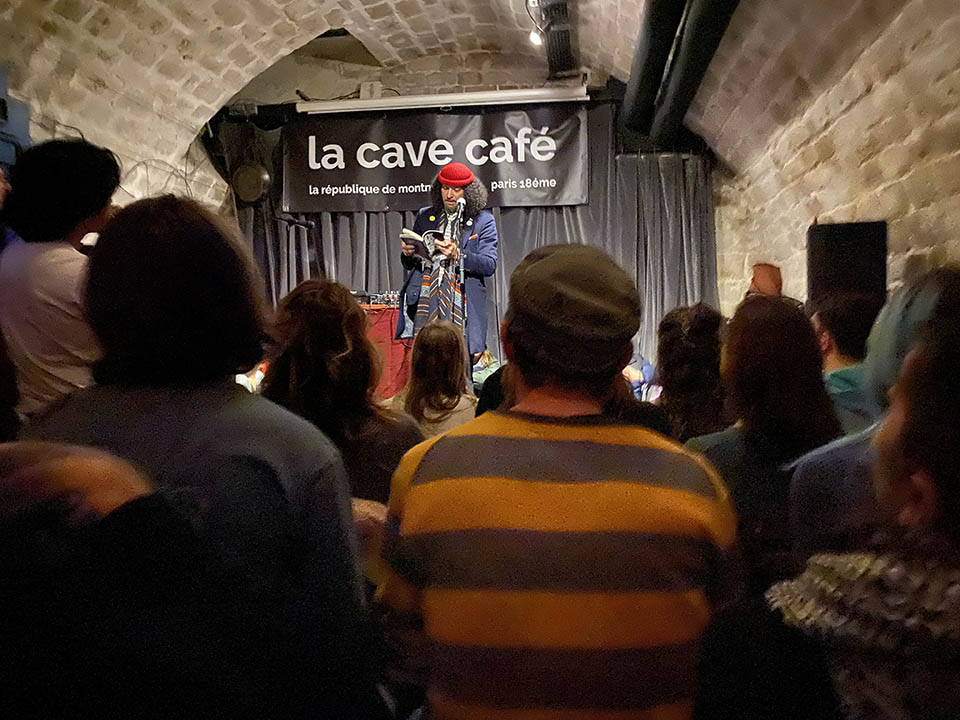
Bonafide Rojas reading excerpts from his book "Excelsior".
He signed his book for me. I've only skimmed it so far, but here's what I like: every poem is loaded with notes explaining the cultural references. In case you're not a hip poet from the New York scene yourself. Smart.
I don't go there often, but every time I do, I come out transformed.
I never read the blurbs: the author, the artistic approach, the family traumas that led them to make ceramics on cows, I couldn't care less. I switch off my brain.
And every time, I'm overflowing with gratitude to live in a country where, for €9 (SACD author rate, €11 otherwise), you can feel so much freedom in a public place where human beings are welcome. At a time when train stations have more billboards than benches, that's no small thing.
Three things I liked – among many others:
The statues look at the artworks while the mannequins discuss the exhibition. Makes you wonder what the audience is for.
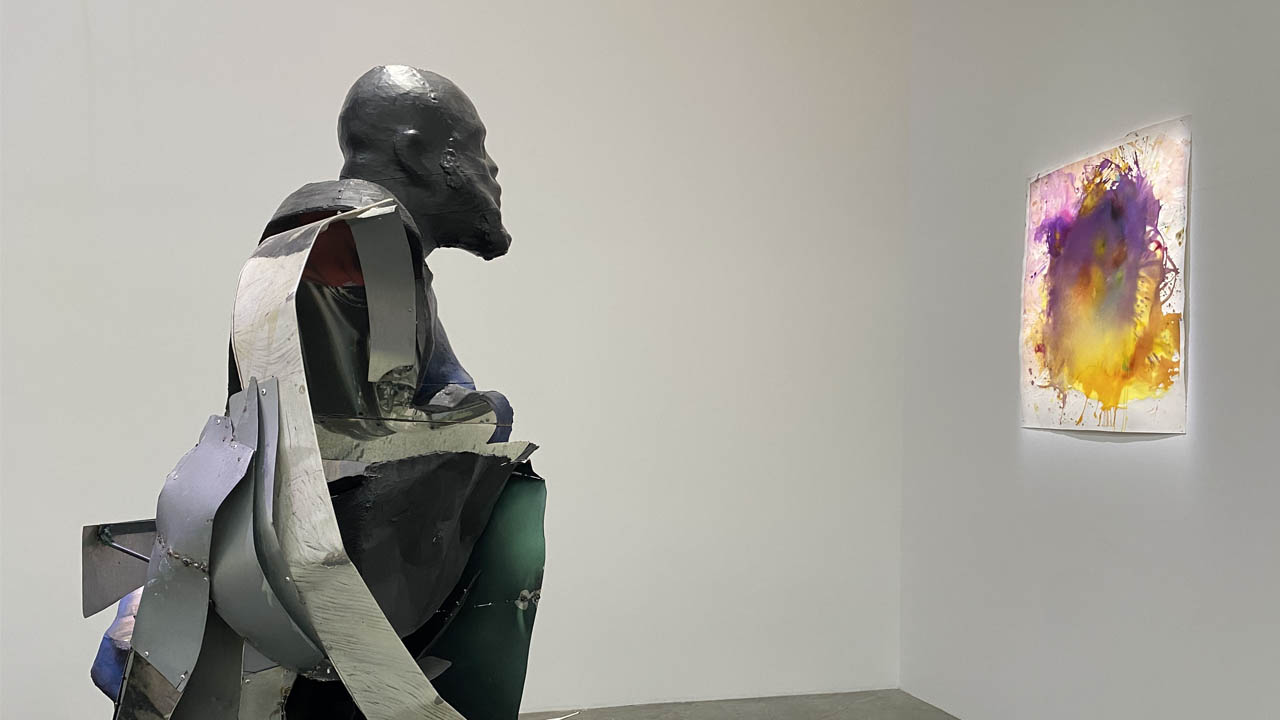
Lenin contemplates the painting that will inspire Sovietism.
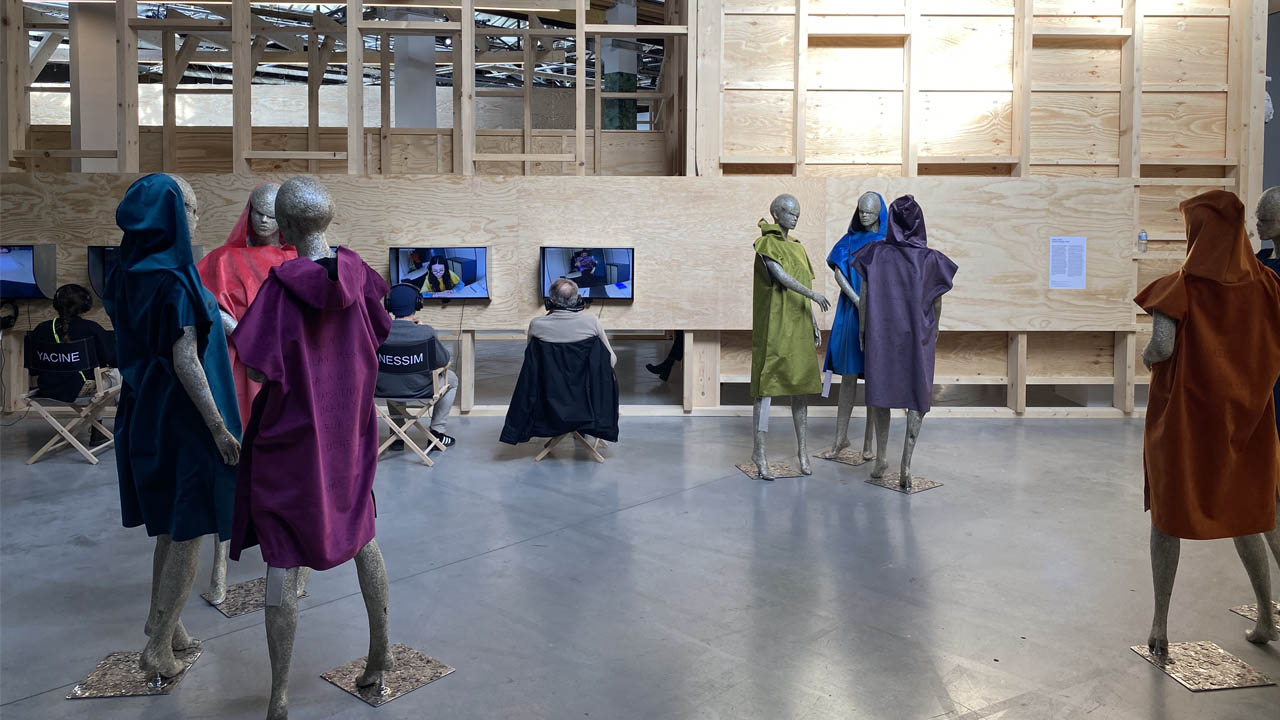
Mannequins in ponchos discussing the relevance of modern art.
There's always some thinking about the medium. You don't just paint on paper, you think about the limits of paper, how it relates to ink, how it relates to the viewer. And every time, you think: "Wait, you're allowed to do that?"
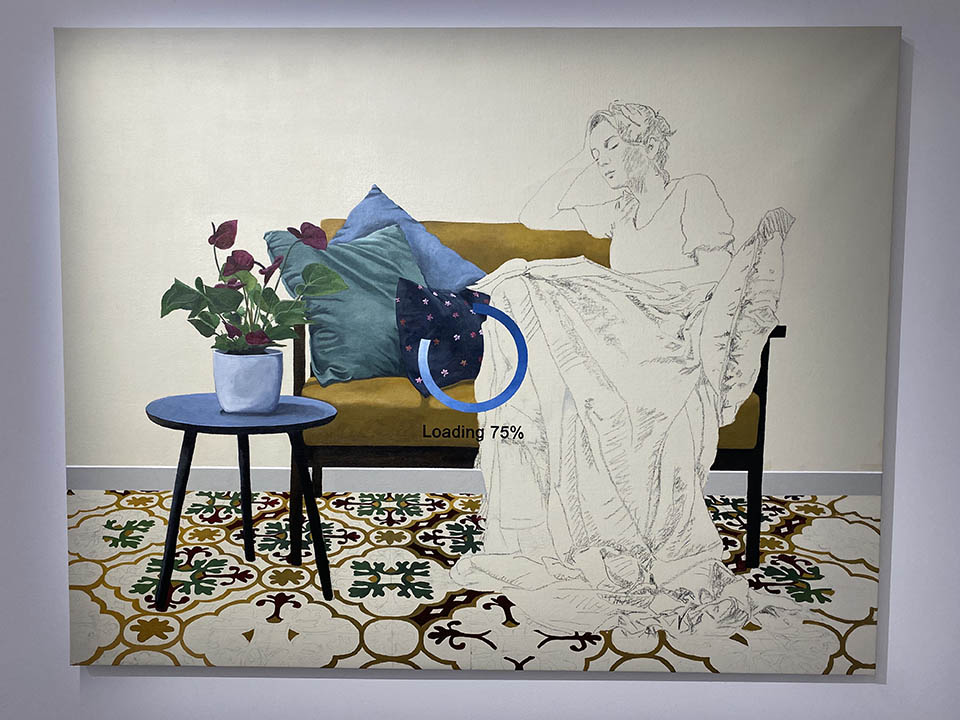
Painting Loading, by May Murad.
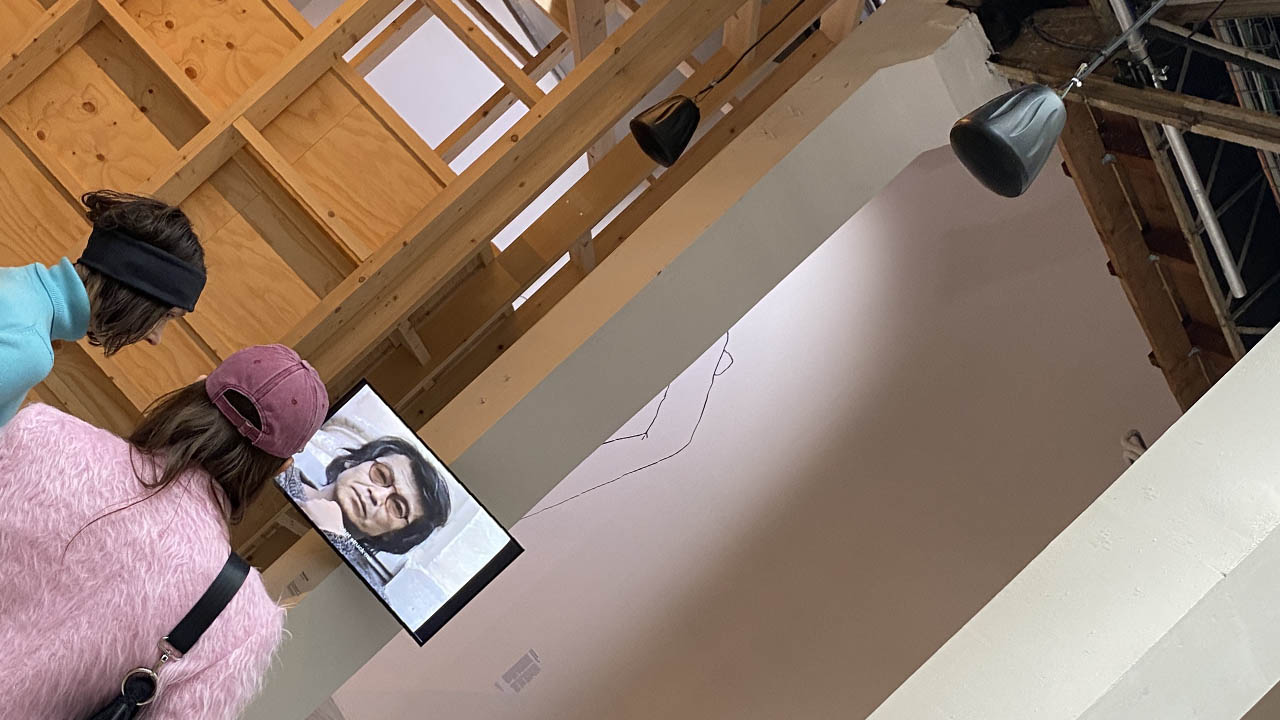
I've dubbed it "video showers": the speaker only sprays sound on the people underneath, so you can have several films in the same space.
Every time, I pick a book at random by looking at the pictures or reading a paragraph in the middle. Over ten years ago, I picked up "On the Inside of Jokes" by Nik Christiansen.
This year, I picked up "The Waterfront Journals" by David Wojnarowicz – apparently, he's quite well-known. I'm halfway through. This book blows my mind.
An afternoon... and everything changes.
I liked the original and – once again – nobody thought to tell me about this new version, which you all know by heart and which I only discovered this afternoon:
I took the chance to read the lyrics, which I'd never understood, and which are a bit reminiscent of Nobody Knows while keeping an almost childlike simplicity, especially:
Went down the hill, the other day
Soul got happy and stayed all day
My eyes well up every time I hear that part.
UPDATE: I made a film with rockets flying backwards too. And we won an award.
I was about to write an exciting article about the psychological component of effort based on my experience with the rowing machine at the gym: some days, it's a breeze; other days, on the same machine set at the same level, it feels like it weighs a ton.
Of course, I was going to explore in detail the psychological, neurological, and physiological origins of this discrepancy, and everyone would have found my article funny, well-researched, and so well-written.
Except that this morning, I figured out what was really going on.
When I lay my towel on the roller, the fabric prevents the moving air from escaping, and the suction maintains the rotation – or something like that – so that the exercise becomes much, much easier. But as soon as I put my towel somewhere else... Welcome to the Roman galleys.
All of this to say that the laws of physics have spared you another stupid article.
Thank you, science.
Another surprise trip to the theater last night, where I saw "Contre-Temps" by Samuel Sené. Fantastic!
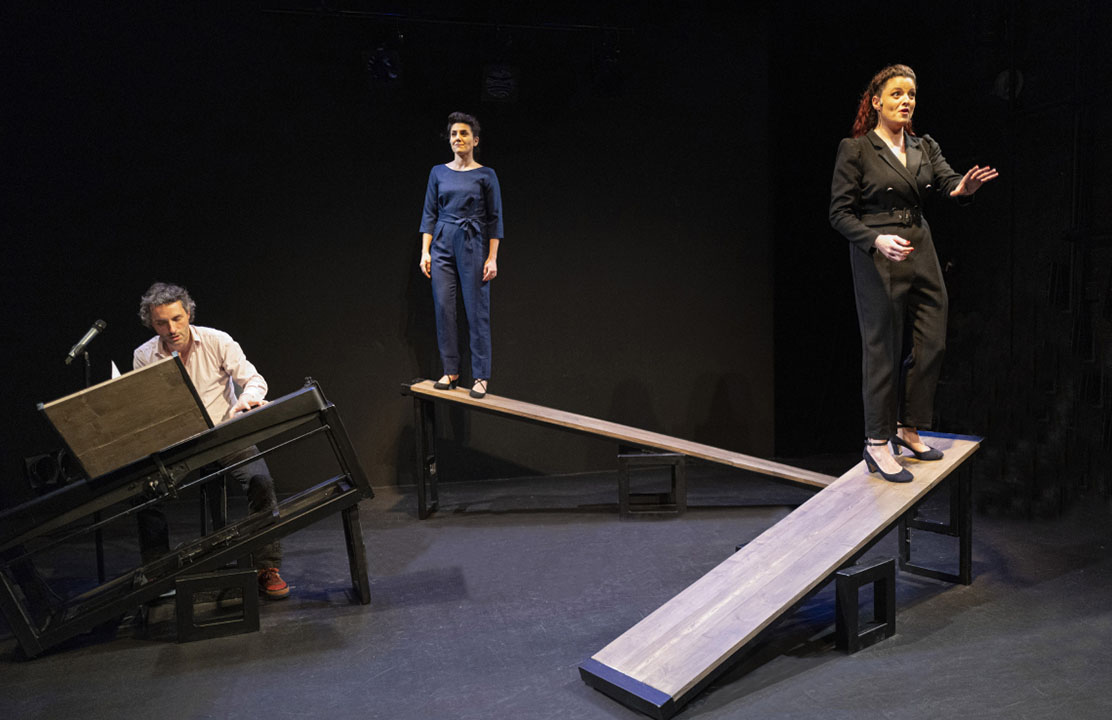
Julien Mouchel (piano), Marion Préïté, and Marion Rybaka in "Contre-Temps".
Like a documentary but on stage: instead of archival footage and a voice-over, everything is narrated in the present by two singers and a pianist who recount the – exhilarating – life of the composer François Courdot by performing his main works.
At the heart of the show, there's a magnificent rendition of Purcell's "Cold Song". Here's Klaus Nomi's version again:
On the way out, I looked into this piece: everyone knows the melody, but often not the lyrics – which could come straight out of Game of Thrones:
What power art thou, who from below
Hast made me rise unwillingly and slow
From beds of everlasting snow?
See'st thou not how stiff and wondrous old
Far unfit to bear the bitter cold,
I can scarcely move or draw my breath?
Let me, let me freeze again to death.
Another amusing detail: I realized that the music for the show had been arranged by Raphaël Bancou, a pianist friend I hadn't seen in ten years. I sent him a message, and I'm going to see him on Tuesday at the Rond Point in "Je suis Gréco." Life, sometimes.
It might sound like a New Year's resolution, but it's not at all. It's the culmination of a rebellion I've been brewing for a while.
Last year, quietly and without fanfare, I (almost) abandoned Facebook, LinkedIn, Twitter, and the like. My problems with social networks were many:
Meanwhile, I'd created this blog.
My idea was simple: I would post here everything I posted elsewhere. On a site I manage, whose appearance I choose, that isn't controlled by a third party or an algorithm. And that doesn't enrich anyone (except my web host – and even then, not by much).
Of course, in doing so, I lost some advantages:
No more likes. No more shares. And, honestly: no more visitors.
This last point should have been a dealbreaker – after all, we publish to be read – but strangely, I kept going. For a year, I posted content on a blog that almost no one came to see.
Then something unexpected happened.
As the months went by, what I posted changed. My articles got longer, closer to what really matters to me. I started doing photography again, writing dialogue, publishing drawings, creating more.
I also began to improve the site – appearance, navigation, features – so that it quickly became a "home." A place where I feel good. That inspires me the way a studio inspires an artist.
But most importantly, despite the lack of visitors, each publication brought me more satisfaction. Oddly, I enjoyed creating for no one more than for the elusive, shapeless audience of social networks.
A year on, I'd say I've learned three things from this experience.
First, personally, I realized that the shelf where I put my pottery matters more than I thought. I need places to put what I make – even the little things – otherwise the creative process stalls upstream.
Second, you create for yourself first.
Rather than a clumsy explanation from me: I recently came across two videos of artists I admire who put it much better – and with more authority – than me:
"Never play for the gallery. Never work for other people."
David Bowie, in this video.
"The audience comes last. And I believe that. I don't do it for them; I do it for myself."
Legendary producer Rick Rubin, in this short.
(Not forgetting this video I've already mentioned: Create or Be Consumed.)
Finally, of course, you still have to share. Otherwise, it's just masturbation.
That's why I've recently started posting on social networks again. With one important difference: now, creating and sharing are separate.
Everything first goes on my shelf. Which imposes no rules, puts no pressure, plays no games. It's an engine that asks a single question: "Do I really like it?"
Only then do I put it in the window.
During this holiday season, a song that celebrates love. (Not the possessive, syrupy love of American romantic comedies, but the pure and immediate love of Eastern wisdom.)
As a teenager, I had missed out on Pearl Jam, and I didn't know much about Eddie Vedder except that my musician friends idolized him. Then, I discovered the soundtrack of Into the Wild), especially No Ceiling and Society. Then I realized he was also behind the soundtrack of the wonderful Dead Man Walking).
So recently, I've been revisiting this song:
A blend of country and traditional chants that I would have loved to see live. The cry at the end should be enough to trigger a spiritual awakening when it hits you head-on.
For English speakers, three articles I read years apart, about death as described by healthcare professionals. I've already mentioned the first two, but after reading the third, I thought a little roundup was worth it.
Kicking things off, in 2011: "How Doctors Die" or how doctors at the end of life tend to avoid the aggressive treatment they've seen far too often in their patients.
The second, which I recently found among Scott Alexander's wonderful essays, dates from 2013: "Who By Very Slow Decay" or how medical staff lose their illusions in palliative care.
Finally, the last one, published very recently in the New York Times – if you only read one, I recommend this one: "A Hospice Nurse on Embracing the Grace of Dying". A hospice nurse describes her work and her patients' last moments in a book, "The In-Between: Unforgettable Encounters During Life's Final Moments." The stories and analogies she shares in the article are deeply moving.
The point isn't to depress you. Quite the opposite: the truth sets you free. A sharp awareness of our own finitude is the first antidote to a life lulled by illusions.
During the "Nuit des Ponts" organized for the 25th anniversary of the Fondation des Ponts, 7 projects were pitched at a special fundraiser in the Grand Amphitheater of the Sorbonne.
I was the last on stage, asking for money for the post-production of To Build, the feature-length documentary I'm producing and directing with ChezFilms for the École des Ponts.
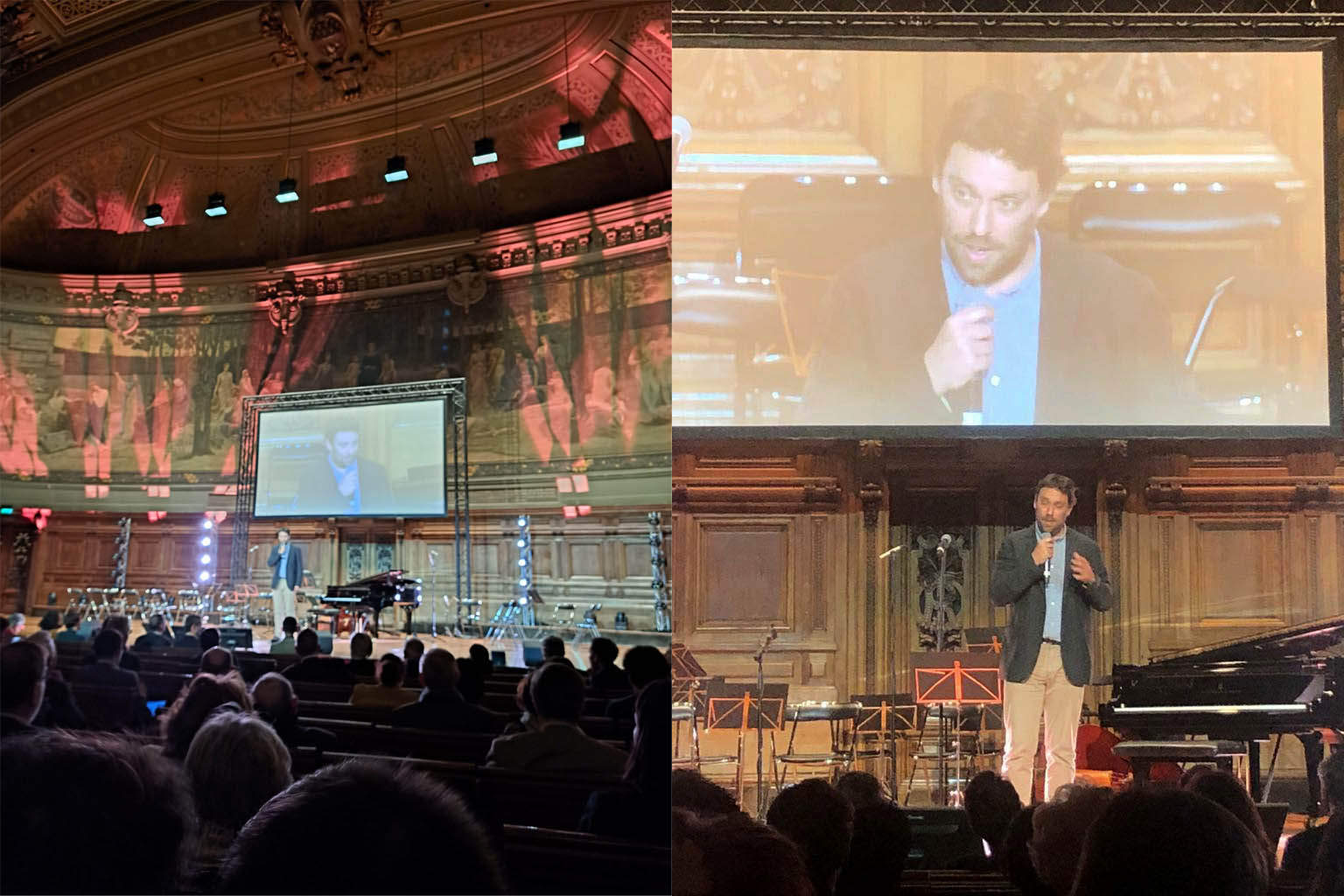
On the right: a magical photo where my eyes are closed on stage but open on the screen.
Happy to announce that, thanks to the generosity of donors, we secured over €50k for the post-production of our film. Thanks also to the sound team, who came to support me:
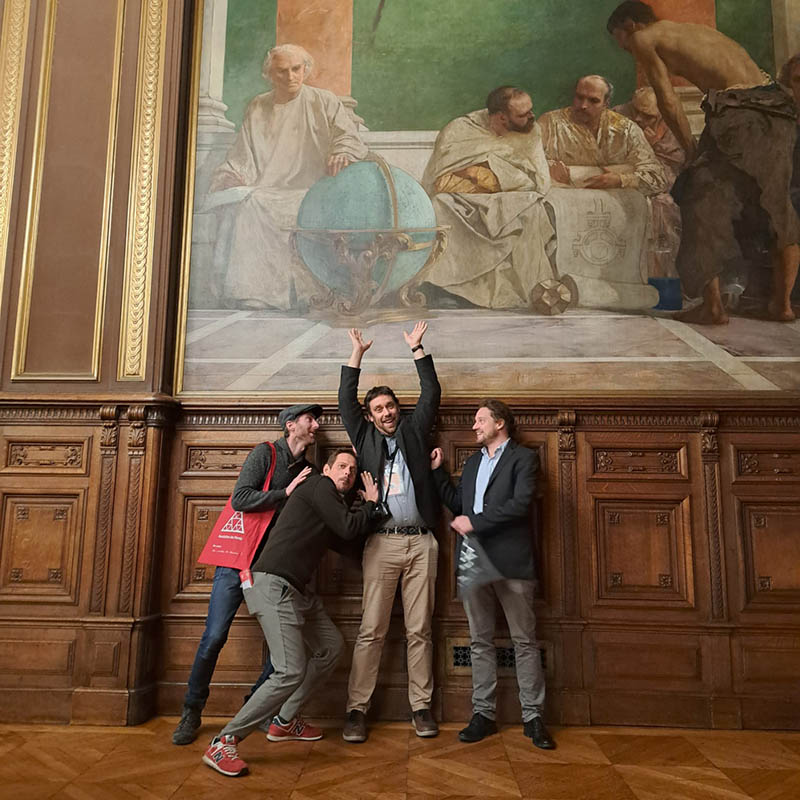
Vincent (sound), Dom (mixer), me, Mathieu (sound) hard at work. Photo Cristina.
Premiere coming soon. I'll keep you posted.
I find it quietly hilarious.
A lot of commentators seem very worried about the "AI alignment" problem, namely: if we ever reach the famous "A.G.I.", or Artificial General Intelligence – one that could solve all kinds of problems better than we can, including ones it was never trained for – how do we make sure it would use its intellect in the service of values we share?
The example people use most is toothpicks.
Say we ask it to "maximize toothpick production" at a factory. Who knows whether this intelligence, in its computer urge to carry out an order that means nothing to it (it doesn't have teeth, does it?), might not set off a mechanism as diabolical as it is irreversible, ending, before our stunned eyes and despite all our attempts to stop it (remember: it's much, much smarter than we are), with every forest on the planet razed and the whole population enslaved to make the little sticks we asked for.
After all, it knows nothing about the human values that matter to us: freedom, dignity, sharing, etc.
Anyway, that's the argument.
Remind you of anything?
I'd like to point out that money started out as a simple accounting tool, meant to make trade easier. Then, over the decades, maximizing profit for shareholders became the excuse to colonize continents, start wars, impoverish the masses and destroy the planet.
So an artificial intelligence that started doing the same thing faster would in fact be perfectly aligned with our current values.
The only real misalignment would be if the A.G.I. answered: "What the hell are you going to do with all these toothpicks? Wouldn't you rather go play in the park with your kids?"
Needless to say, that version would be reprogrammed the same day.
UPDATE: It inspired this script.
I don't choose what I write.
One morning, I realize my dramedy script has stalled. The new scenes are labored, predictable. Even the fixes I make here and there don't seem to go in the right direction. It's all going to crap.
Meanwhile, without even looking: three ideas for a comedy.
Everyone knows writing (creating in general?) is 10% inspiration and 90% work. So if you wait for the divine spark to get going, you'll never do anything. Sometimes you have to push yourself a little. Get the machine running and see what comes out. Right?...
I'm less and less sure.
Of course, the writing process itself – the work it takes to get the idea down on paper, to revise, to reread, etc. – can hardly be shortened. I'd even say it tends to get longer with experience. In many ways, what makes a professional, a craftsman, is knowing how long their work takes. Unlike me with music, for example, getting offended that I can't crap out a track in an hour like the musicians I follow on YouTube. (The word "crap" isn't chosen at random, as we'll see.)
But when it comes to pure creation, the mental process of making new ideas, of pulling them out of nowhere, my theory is that the time it takes, like the quality of the ideas themselves, varies exponentially with the circumstances.
The line you come up with in one go as you walk out of a meeting where you got pushed around a bit, say, which you build on with a comeback you didn't dare say in the room, then a whole exchange that could have happened, until you've invented an entire scene that could go in a courtroom drama or a crime film: you could never write the same thing the following week, sitting at your computer. Not with the same energy, the same wit.
Same with the nonsense your brain can't seem to stop producing after an improv session with other creators sharing the same old joyful silliness: none of it would come easily on a Tuesday morning at the office.
And finally: the nostalgia that colors everything after a painful breakup, the sadness of the world, the shittiness of things, you never express it better than at rock bottom.
The best comparison I have for this idea involves toilets and number two – here we go. Not out of a love of vulgarity (though used well, it rarely bothers me) but because I couldn't find anything clearer or more universal:
Picture an office worker whose job is to produce... shit. Literally. He's paid to deliver one quality turd a day, so he's not allowed any blessed laxatives, which would contaminate his sample.
His day can go two ways:
Or:
Put that way, everyone agrees.
And yet, how often do we try to force things instead of letting nature take its course and picking the fruit when it's ripe? Count them over a day. It's often much, much more than we think. When the job itself isn't built on constantly violating the natural timing of the world.
That said, it depends. I made progress on my novel by writing very regularly every morning for long stretches. So it can be done. But usually, those writing sessions only serve to arrange, into nice compositions, the fruit already picked up by chance along the way. And nothing says it'll be a quality turd in the end.
UPDATE 1: The sociologist Niklas Luhmann, not exactly known as a slacker, says it better than I do:
"I only do what is easy. I only write when I immediately know how to do it. If I falter for a moment, I put the matter aside and do something else."
- Niklas Luhmann
UPDATE 2: Since we're on the subject of toilets and creation, go watch this (very) short film I just put back online, which is about exactly that. One of my first films.
Lately, I've been going back to the theater.
Yeah, I don't know what's gotten into me: must be the start of a depression.
I've seen some fantastic stuff – including I Wish I Were Jeff Bezos which is currently playing, go check it out!
And then I saw... Edmond.
It's the hugely successful play by this wildly successful playwright who only produces hits. Honestly, I was thrilled at the idea of sharing the love for a popular show with the rest of France. I was going to laugh, be moved, then join the conversations in cafés shouting "I saw it too!!" and we'd reminisce about the best moments, laughing together. I might even have made some new friends.
And then... flop.
That said, it's always tricky to speak ill of a play that so many people have loved. To keep it measured, I'll just say this:
This play is garbage and everyone who liked it is an idiot.
Oh well, no new friends for me.
To keep it brief: I found the writing labored, the humor lowbrow, relying on overdone accents and heavy-handed jokes. It's yet another remake of "Shakespeare in Love" except the connections between the author's life and his work are artificial and anecdotal – a clumsy device that serves as an excuse for cheap twists.
All of this is performed by actors – all very talented, I'm sure – who rotate from show to show in what has become industrial theater.
On the "plus" side: yes, the staging is dynamic, very cinematic, the scenes flowing like in a film, with music that sounds like a soundtrack. Cinema recreated on stage. Why not.
Then I went to see A Flea in Her Ear at the Comédie-Française.
The play is long – over two hours – but a real delight. You can feel a company that has had time to work every scene, every exchange, every line to get the most comic effect out of it – that's what public theater is for, after all. You're surprised by unexpected shifts, gestures, sometimes even stunts that emphasize and invigorate the text, making it lively, accessible, and modern.
And the venue. I had forgotten how beautiful it is.
Okay, maybe I'm being a bit mean to Edmond. It's still well-constructed, well-directed, and visually pleasing. It's a show. If you go with friends, you'll probably have a good evening. And above all, when you leave, don't forget to delete my number.
A small touch of the blues on the highway.
For no reason. Nothing hurting. No new abyss in my life. Nothing that should worry me more than usual.
Then I understood: nothing exciting was waiting for me in Paris. Not when I arrived, not that evening, not in the week ahead. Not an unpleasant week coming up – not at all – but nothing I was looking forward to.
Which made me realize two things.
The first: my happiness depends almost entirely on anticipating happiness to come.
Something has to be shining in my future.
Either a small spark in my immediate future: a pastry, a meeting, a distraction. Or a big sun in my distant future: the success of a long-term project, a life change, the promise of a brighter tomorrow.
Strangely, the actual size of the star doesn't matter, only its apparent size. If it's small, it has to be close – I want it now. If it's far away, it has to be big – worth the wait. So its diameter, seen from the present, always stays roughly the same: I need a certain amount of brightness on the horizon.
This way of seeing things helps explain certain behaviors, I think.
People with no long-term prospects, for example, those who have lost faith in the future (who have no distant sun), often make up for it with a multitude of short-term sparks. That's the first step toward addiction: wallowing in immediate pleasures to forget the lack of an overall direction.
Conversely, it's easier to keep up a discipline day after day when you're aiming for a dazzling light on the horizon. The reward shining in the distance makes the daily sacrifices easier to bear.
And that was exactly it: in the car, nothing was shining. And I felt... weary. Listless. Almost depressed. That was the second realization:
What if this is my baseline? My emotional resting state?
Is the state I call "depressed" actually my "everything's fine" state, which I misread because I depend too much on the future?
Have I become like an addict too obsessed with his next fix to notice the sources of joy right in front of him? Do I really need a reward on the horizon to enjoy the moment? Is it possible that I've organized my life (and for how long?) so that I'm always waiting for something, even if I have to make it up? Even if it means spoiling what's here and now? Have fantasies of what's coming dulled my palate to the subtler emotions within reach?
But above all: can I recalibrate my brain to be less hypnotized by the future and the junk it keeps dangling in front of me?
(Answer: yes, very easily. Bisou.)