Making No Plans?

Faith is essential to presence.

Presence means being fully immersed in what you are doing.

It means being steeped in the present, in sensations, in the activity, without passing judgment or hatching plans. You simply do the best you can, without thinking about the rest.

It is a way of operating that can be unsettling at times.

If we plan nothing, what happens next?

Shouldn't I also anticipate the future a little, prepare for what follows? Otherwise, don't I run the risk of being left high and dry?

This is where faith steps in. It says this:

The best way for the next activity to emerge is to do the current one well. If I am entirely present in the moment, the next step will take shape on its own as a natural consequence. There's nothing to plan.

If I start anticipating, however, it means I am no longer fully focused on what I am doing. A part of me does not trust and would rather make plans. Intellect takes the reins from action. We are no longer in the flow.

To be yourself, you must have faith that the future will arise as a natural consequence of the present fully lived.

Comment

It's Always the Solution

Lost in life? Not sure anymore where to go, what to do, what goal to pursue?

Place your attention on the present.

Tired? Not feeling like yourself? The sense that you're not where you should be, that you're wasting your day?

Place your attention on the present.

The present is the draft. The tension in your neck. The blinking light on the car. The green of the plants swaying in the wind. The light in the sky. The smell of coffee.

In this immediate and ever-changing present, there's no room for the story you're telling yourself.

That's what's putting you in this state.

Comment

Pissed Off Morning

And yet I meditated this morning. It's a quieter day – well, not quieter, lots of things to do, but not too much work.

But there it is: bad mood.

Maybe the flight back. Maybe the food. Nerves unwinding.

Here's at least one mistake I don't make anymore: thinking that whatever triggered the irritation is the source. Ha! Not falling for that one anymore. Proof: I moved on to something else and that second thing pissed me off too.

So there you go.

I could have put off writing this note until later. When things felt better. Writing yet another piece of bullshit about meditation. "Oh, you just have to place your attention on blah blah blah..."

But no, that's the whole secret now: I'm not waiting anymore for things to be okay.

In fact, I'm not even hoping for things to be okay.

Now I just do. With what's here. I accept.

Dammit.

Comment

Splinter Rice Recipe

Woke up in the middle of the night with this very clear recipe idea in my head:

Splinter Rice Recipe
(20 minutes, difficulty: easy)
Mix a bowl of rice with a large quantity of splinters that will flavor the dish but that you absolutely, absolutely must not swallow.

What exactly is my brain trying to tell me?

Comment

We said no more flying

My mom lives in Morocco, so it's not easy to avoid flying.

But here I am at the airport for work.

And honestly, I could have organized things differently, but everything happened so fast.

The success of an offer I put together kind of accelerated my life. And since the situation was new, I didn't have the right reflexes to find an alternative.

Goes to show you have to think about it ahead of time.

But before you can think about it, you have to decide to think about it. In other words: notice it when it happens and make a mental note for the next time the situation comes up. That's the real beginning: noticing and taking note.

So there you have it: I'm taking note. Literally.

Comment

Introducing myself

When people used to ask me "what do you do?", I'd always say:

"I make films."

I never dared say "I'm a filmmaker" because that would've implied I made a living from it, which has never quite been the case. (I've made money, sometimes good money, but not enough to live off it consistently.)

And it also felt more honest: I'm not just a filmmaker. I write, I produce, I edit... I make things.

Recently, I've changed my answer. Now it's:

"I make films and work in communications."

Because with ChezFilms, I help experts and innovative companies tell their story to take off. It's starting to go well.

So when I give that answer, people can choose which direction they want to take: they ask me a question about films, or a question about communications, and either way, I've got stories to tell.

Or they don't ask any questions and the conversation moves on.

That works too.

Comment

Dialogue with Oneself

I'm blown away by the relevance of my posts 😎.

Only for me, though.

I realize two days after posting a video, or three days after adding a note right here, that the content in question answers exactly the question I'm asking myself at the moment.

But like... exactly.

So much so that it's staggering that I don't realize it while writing or filming it.

But no: I'm convinced I'm talking about something else. Something personal, yes, but at no point do I feel like I'm providing a solution to my dilemma.

And yet, when I connect the dots, it's impossible to doubt that I was indeed talking about that.

It doesn't surprise me. I know full well that art works this way: whatever the subject, as long as you create in the moment, you express what's deep down.

But I wasn't expecting such a masterful demonstration of it, every day.

Comment

The Stress of Rain

When it rains hard on the house, I feel a little stress.

A few years ago, the roof had problems and there were regular leaks inside.

That's fixed, but recently we discovered there was water seeping into a shared wall.

Rain is the anxiety of repairs we can't afford to make.

(This reminds me of that cartoon: a guy is woken up at night by a noise and finds a ghost in his living room. He's relieved it's a ghost and not a repair job.)

When stress arises, I use meditation to place my attention on it. I make the knot in my stomach or the tension in my body the focus of my attention.

Usually, it goes away quickly. To pass, emotions – like ghosts – need to be lived, felt.

But this time, it took longer than expected.

As if I had stumbled upon a "pocket" of anxiety that had accumulated over years and needed to be drained.

A stress that seems superficial ("eh, it's nothing") but keeps coming back often has a deeper cause. On the surface, it looks like just another puddle, so you don't pay attention to it. Except that you only need to step in it to realize you could easily sink.

The work to be done (on the house) will be all the easier to undertake once you've done the inner work to manage the anxiety.

Deal with the emotion before the action, always.

Comment

My Sources

Many people have asked me whether I had reading or other material to go deeper into what I talk about in my videos.

Answer: yes, plenty!

My personal path – which officially began 7 years ago with meditation – came with a huge amount of reading, listening, videos, podcasts (...) that were essential to give a framework to what I was discovering.

Problem: most of my sources are in English... and haven't been translated.

Worse: the few French sources I came across struck me as... how to put it? Less rigorous. Mixing a bit of everything: spirituality, wellness, alternative medicine, astrology...

What I've appreciated in most of the sources I list here is a certain rigor. Not always, not everywhere, but on the whole: they don't use pseudoscience to justify what belongs to the spiritual; they stay very conservative in their everyday advice; they rely above all on practice and personal reflection rather than devotion to anyone; they encourage free, independent thinking rather than joining a sect.

Another problem: some of the sources I list here cost money. Not a fortune, but they're books or recordings I couldn't find for free.

If you're not discouraged, here they are in order of preference 👇

Alan Watts' Recordings 🇬🇧

The most important for me.

Alan Watts was an English writer and philosopher who did a lot to bring Eastern philosophy (Hinduism, Buddhism, Zen) to the US.

But above all: he was a speaker like no other.

He's funny, smart, a great teacher, deeply cultured (in philosophy as much as in science), and hundreds of hours of his lectures were recorded.

I started by listening to dozens of hours of Alan Watts in the street, in lines, on the subway...

But there are three problems...

Problem 1: the sound of his voice can't be separated from what he says. You have to listen to him. So I'd avoid dubbed versions, or worse, AI recreations. With subtitles, it can work very well.

Problem 2: his family exploits his recordings commercially, so they aren't freely available.

Problem 3: they're audio recordings. So when you find bits of them on YouTube, they often come with images... not always well chosen.

So essential for me... but paid, and hard to access if you don't understand English.

Yes, he wrote books that have been translated into French, but they had less impact on me than his recordings.

Acharya Prashant's Books 🇬🇧

Acharya Prashant is an Indian guru in all his glory (i.e. a teacher).

The first book of his I read was one of the most important for me: Advait in Everyday Life.

If you can get past the very kitschy cover (Indian style), don't worry about the word Advait in the title (it means non-duality, but that doesn't matter), and skip the first chapter they recently added to the digital edition (probably for marketing reasons), it's a deeply transformative book of Eastern philosophy.

So much so that it's what led me to read...

The Bhagavad Gita 🇬🇧🇫🇷

The Bhagavad Gita (the "Song of God") is a very small part of the famous Mahabharata, the Indian sacred poem.

In this story, Krishna (an avatar of the god Vishnu) drives King Arjuna into battle. On the way, he explains... life.

The precepts he shares are the basis of a life well lived – at peace, yes, but without withdrawing from the world, quite the opposite. It was one of Gandhi's bedside books.

That said, you'll probably struggle to tackle the text on your own. It's very old, very Indian, and full of references you don't have.

That's why most people – me included – read commentaries: books that contain the whole poem with, after each chapter, an explanation, examples, advice.

I've read several books like that, but the best, in my view, was Acharya Prashant's version – the author I just mentioned. BUT: it's paid, in several volumes, and only in English.

Then again, I have no doubt you'll find plenty of French authors who've written very good books on the subject, and plenty of very good translations. But you'll have to look a little, that's part of the game.

The "Waking Up" App 🇬🇧

No, I've never tried the "Petit Bambou" app. I have nothing to say about it... except maybe that I get the impression, from several friends who've used it, that it's... how to put it... a bit "storified"? A lot of what's supposed to be guided meditation is more like stories, contemplations. Why not, the stories are probably very instructive, but then... is it meditation?

An app I used for a long time is "Waking Up," by Sam Harris – which is paid and only in English.

But it's interesting for two reasons:

It offers a series of guided meditations for beginners. With a certain rigor, precisely. It helps you really understand what meditation can be for – which is what you need at the start.

But also: it gives you access to dozens of hours of recordings by great teachers... including Alan Watts! (Who I talked about above.) Or Rupert Spira (who I talk about below). Or James Low (further below)!

So a wonderful way to discover other sources... but all in English.

James Low's Recordings 🇬🇧

James Low is a Scot, still alive, who for me took over from Alan Watts.

I discovered his recordings in the Waking Up app, and he too has a breathtaking intelligence and clarity.

He explains the basics of Dzogchen, the principle of emptiness in Buddhism, meditation, balance in everyday life (...) so simply that you feel transformed just listening to him.

But him too... English only.

Krishnamurti's Videos and Books 🇬🇧🇫🇷

Jiddu Krishnamurti was an Indian thinker who refused to belong to any school.

In fact, he held that there is no collective solution, and that you shouldn't trust any group or any guru. Only yourself.

As it happens, there are loads of video recordings of his talks, some of them subtitled (sometimes badly). As with Alan Watts, you need to see him in the flesh. His face, his voice, his intonation.

He also has books translated into French, but they can be a bit hard to get into.

Osho's Books and Videos 🇬🇧🇫🇷

Come on, you know Osho (aka Bhagwan Shree Rajneesh)! He's the scandalous guru from the documentary Wild Wild Country!

But he's also one of the sharpest thinkers and writers on Hinduism, Eastern philosophy and living well. And most of his books are translated!

I'm currently reading "The Book of Secrets" (which also exists in French) and every chapter is a revelation. But I might not start with it if I weren't at all familiar with Eastern philosophy.

"Seeing That Frees" by Robert Burbea 🇬🇧

Speaking of fascinating books you maybe should NOT start with, Bob Burbea's Seeing That Frees was very important for me.

It presents advanced meditation methods, builds a fascinating case about emptiness, and shows us how much it can matter for living better.

The Present with Eckhart Tolle 🇫🇷🇬🇧

On the other hand, in the "excellent introductory books that also exist in French" category, there is of course Eckhart Tolle's The Power of Now.

With his books, his seminars, his look, his manner, Eckhart Tolle has become a central figure of spiritual growth through presence.

I didn't start with him, but when I read him I found it very interesting. He also makes lots of videos... but in English, rarely subtitled.

Rupert Spira's Books and Videos 🇫🇷🇬🇧

Rupert Spira writes books and runs retreats in England.

His approach is based on awareness, non-duality, and the teachings of Ramana Maharshi (like many others!).

His guided meditations are always interesting (but in English). His books are very interesting too, and are now translated into French.

Ramana Maharshi 🇫🇷🇬🇧

He's the source for many of the people above – including Alan Watts, Rupert Spira, etc.

As a young man, Ramana Maharshi was terrified of death. So he started meditating... and kept at it his whole life.

He's the proverbial hermit who went off to meditate alone on the mountain. Little by little, people joined him. He found himself at the center of a community he never tried to control.

He wrote nothing himself, but many people have written about him or transcribed his teachings, sometimes word for word. So you'll find plenty of different books about him and his teachings.

And Also 🇫🇷🇬🇧

In no particular category, and in the order I discovered them, these (fairly well-known) books also helped me a lot and are often available in French:

Zen Mind, Beginner's Mind by Shunryu Suzuki, The Gateless Gate by Wumen Huikai, Zen Flesh, Zen Bones compiled by Paul Reps and Nyogen Senzaki (haven't read it all, but interesting), Meditations by Marcus Aurelius (great! a must-read), The Way of Liberation by Adyashanti (not bad, a former cyclist turned spiritual teacher), Journey from Many to One by Swami Bhaskarananda, The Tibetan Book of Living and Dying by Sogyal Rinpoche (a very well-known, very good book), The Middle Length Discourses of the Buddha (not something you read in one sitting, but a paragraph now and then).

And Finally 🇫🇷🇬🇧

And of course, you can read my writing in the journal.
Comment

Meditation, a How-To

Meditation is bringing your attention to the present.

The arm. That tension in the neck. The bird singing. A thought arising. A sudden feeling of sadness. Which shifts and fades. The foot against the floor. The breath. The bird, again. The head moving.

(To begin with, people sometimes recommend focusing only on the breath. See what works.)

This is called the flow: perceptions, thoughts and emotions arise, change, then disappear. Everything passes.

But every so often, we get stuck on a thought.

We wake up as if from a dream, realizing we've been chewing on something for several minutes. This fixation that blocks the flow is called (fittingly) "an attachment."

It's normal, it's part of the process: we notice it and come back to the present.

Some even say this back-and-forth between thought and the present is the heart of meditation, like a muscle you build by repeating the same movement.

Then we carry a bit of this flow into our daily life.

And everything gets easier.

Comment

ChatGPT and Me

I've discovered that I work like ChatGPT.

And you probably do too.

Meaning my next action is mostly decided by whatever context I have in my head at that moment.

And, like ChatGPT, that context is tiny.

We don't carry our whole life around at every moment. Depending on the day or the hour, we focus on some problem coming up, some difficulty of the moment, some goal that's in fashion.

The decisions that follow rest on a tiny and often trivial sliver of everything we know – and above all, one we don't consciously choose.

So lately, I've decided to change all that.

Every morning, I read the same note, which holds the context I think matters for my day. Context I chose consciously.

I no longer let social media, TV or unexpected calls fill my head. I fill it myself, every day, with hand-picked thoughts: positive, strong and organic.

In soil like that, the right action grows without effort.

Comment

Three People

Three people recognized me on the street in Paris because they follow me on Instagram.

One the night before last, and two this afternoon.

All very kind, each time.

So what do I do, quit everything? 😅

Comment

Jealousy and Time

I'm realizing that professional jealousy has a lot to do with time.

In rivalry with our peers, we want to do it before the other person.

The hardest moments are when the people we admire or envy reach a peak before us. We feel left behind – even if it isn't exactly the peak we were aiming for.

So we want to join the race, hurry up and do it now.

Sometimes losing sight of what we really want to do.

Because at the end of a career or a life, does it matter that much when we did things? Doesn't fulfillment come instead from having done exactly what we wanted to do, whatever the timing?

It's easy to lose sight of what matters.

Comment

A Poor Interpreter

Verbal thought is only commentary. (We've talked about this before.)

It isn't what chooses the action. No: it watches and it comments.

A bit like a babushka sitting all day long outside an apartment building:

"Did you see that, they've decided to raise their right arm again. What a world we live in, I swear."

Sometimes she uses her memory to interpret what the body is doing:

"You feel that knot in your stomach? It's the same one we felt during the divorce. They regret it, that's for sure!"

Except most of the time, the babushka is wrong. Because her world revolves around two or three obsessions that keep coming back and that she thinks she sees everywhere.

So rather than listen to the interpreter, go back to the source: the physical sensation, what the body is doing.

By examining the present, by simply watching what comes up, you'll start learning the language.

Soon, you'll be fluent.

And believe me: it's a far more important language than English or Spanish, because it's the one you'll use all your life to talk with yourself.

Comment

Everything's Taking Off at Once

Personally, I've just reached 12K followers on Instagram.

I remember a time when I wanted to set up group chats with friends: a kind of virtual salon where you could find conversation and company 24/7. It never worked. That's more or less what I have now with the messages and comments on the channel: conversations at any hour with people interested in the same things as me.

It opens up a lot of opportunities. I say yes to some of them. Projects, people to meet. Not everything.

Professionally, the channels I created for ChezFilms are taking off too. (Insta, TikTok, Youtube and Linkedin.)

The numbers aren't huge, but it works for what matters most: I'm getting client inquiries.

This week I have five phone calls with qualified prospects: people interested in exactly what I offer. (The hardest part was defining that offer precisely.)

We'll see how it all goes. It's exciting. We keep going.

Comment

Being Present in Every Moment

Everything is so clear when I'm present.

When I'm curious about the moment, when I examine the colors, sounds and sensations that come to me... The world is no longer mysterious. It's no longer frightening. Stories of success and failure feel far away.

Action gets easier, too.

Every gesture is obvious, and problems seem to solve themselves.

And yet I spend most of my time elsewhere.

Even though I meditate in the morning and come back to presence several times a day, I keep getting caught up in urgency and mental fabrication. Less than before, maybe.

Still, in those moments it feels like going back to square one. Everything turns serious again. The past and the future are threatening again. We're back to trying to solve problems that didn't exist two minutes earlier.

Apparently it's normal: we move in and out of presence.

The goal is to stabilize it, to truly change our operating system.

I'm going to work on it.

Comment

10K 😳

Hit ten thousand followers on Instagram.

Am I officially an influencer?

The best part: the messages and comments.

It's helped me find a whole bunch of people interested in the same things as me.

And I also get lots of messages from people my videos seem to help.

And for now, the videos are easy to make.

So that's good.

Comment

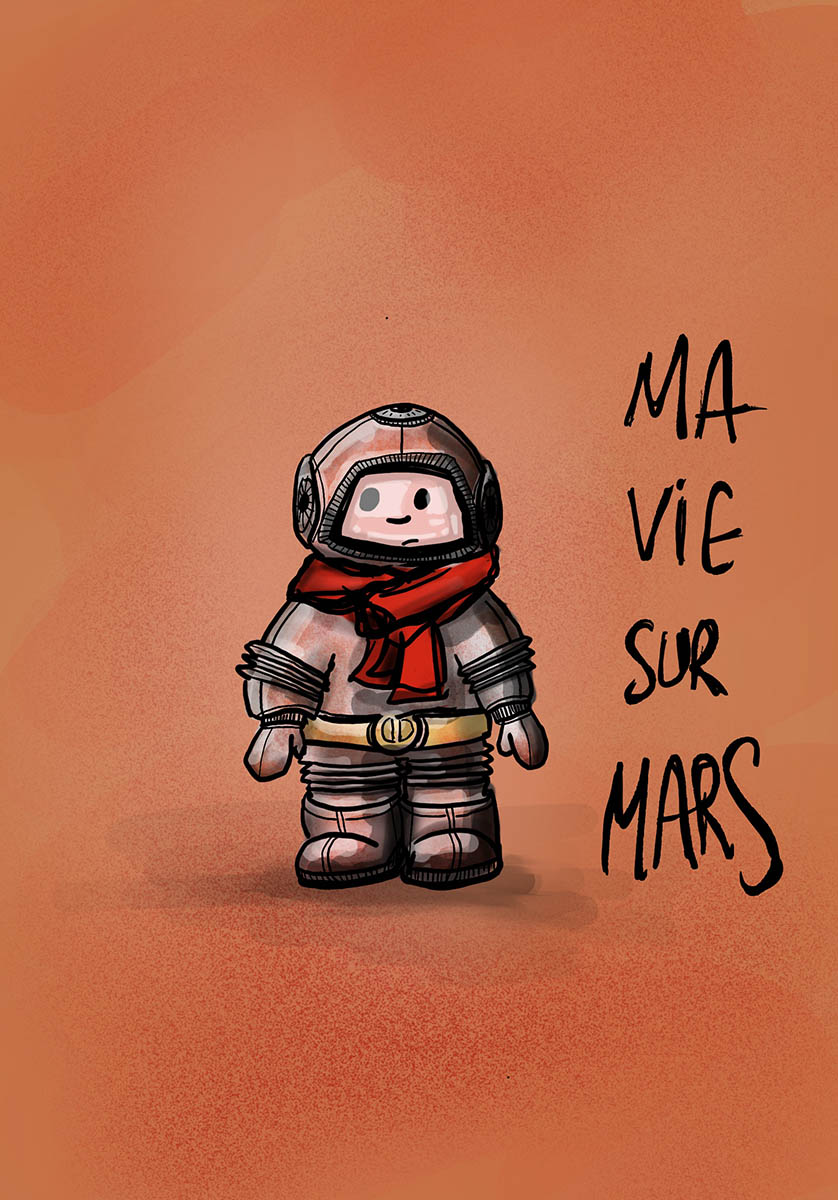
My Life on Mars

Another abandoned project (for now).

An animated science fiction short film about the life of the first human on Mars... who happens to be a 7-year-old kid.

My Life on Mars

When technology became advanced enough to reach Mars, every government on the planet wondered... "Who do we send?"

"I know!" someone answered. "What if we sent a child?"

And everyone thought it was a brilliant idea.

But if you want my opinion...

It was a crackpot idea.

Comment

Being a Race Car Driver

Race car drivers want to drive cars at 300 km/h around a track. To win.

To get there, they have to be able to do other things: get in physical shape, know their way around an engine, build a network of partners, etc.

But a driver who did nothing but physical training, day after day, wouldn't become a driver: they'd become an athlete.

One who cared only about mechanics would become an engineer or a mechanic.

As for the one who puts all their time into their network, they'll end up an agent or a manager.

Never lose sight of the source.

What you do now is what you'll do later. Preparation can become your whole life.

The whole game is finding a way to do it now, even when the conditions don't seem to be there.

Comment

Best Album Review

I couldn't find the original source (and I looked for at least 30 seconds), so I'm quoting it from memory.

A music critic once said of a new song:

"Anyone eating alphabet soup would shit better lyrics to a better tune."

Which raises the question: how many people eat alphabet soup and shit out works of art without ever knowing it?

Comment

L'Aigle Noir Is About Incest?

In the "everyone knew except me" series, subcategory "pretty song about birds that actually isn't," I give you Barbara's L'Aigle noir, which is really about the incest she suffered as a child.

A friend mentioned it in passing, so I went and checked.

The lyrics take on a completely different meaning.

My God.

Comment

Seum - part 3

A music video I love, shot by Camille Tardieu in a single take during the Off Courts festival this year:

The musician is Édouard Pons (who did the music for my film Migrul, also shot at Off Courts this year). And the video is directed and animated by Camille Tardieu, who makes great stuff.

Comment

Shaping Your Day

When I get up in the morning, I don't know.

I have things to do (the "what"), like everyone, but I have no idea how I'm going to go about them.

And I think that's the secret.

Obligations are like contracts with the outside world: we commit to a result.

But how we do it, and in what form, is entirely up to us.

So every morning, I take stock. What emotions are here? What do I feel like doing? What's the weather like outside? What is this day telling us? What's showing up on its own?

We spot these scattered ingredients, then invent a recipe that didn't exist the day before.

Not knowing is key to the process.

Without a plan made in advance, we have no choice but to open our eyes, improvise, dance with whatever comes.

Otherwise, why get up?

"If you know exactly what you're going to do, what's the point of doing it?"

Pablo Picasso

Comment

Enshittification - Part 2

I liked the first podcast with Cory Doctorow so much that I listened to a second one: "Capitalism ruins everything".

Roughly the same subject as the previous podcast, with a particular focus on mergers and acquisitions that create giants which become de facto monopolies.

A few new ideas that stuck with me:

  • "Chickenization" describes the horizontal and vertical integration of some industries, on the model of chicken farming: the big agribusiness group tells farmers which breed to raise, how to feed them, how to lay out the space, what time to turn the lights on and off... The farmers have no power. Without knowing it, they can be part of an "experiment": overnight, the chickens die. For the farmer, it's a tragedy; for the group, one more data point to gain more control.
  • When buyers consolidate into large groups, sellers have no choice but to do the same to fight back, which leaves the end consumer with even less choice.
  • Amazon lost $100 million in one month giving away baby diapers... to sink a competitor that had started delivering diapers. A warning to every entrepreneur.
  • Artists' individual copyright can't protect them against large groups when the negotiation is that lopsided. Collective rights look like a better way.
  • Microsoft may have won the 2001 antitrust case, but Bill Gates's deposition was devastating for him and for his company. The punishment is the process, not the outcome. That's why most large groups prefer to negotiate. Even so, we need faster solutions than lawsuits that sometimes take decades.
  • Not having a map doesn't mean there's no path. Sometimes you have to feel your way to find the openings: that's the foundation of hope.

This guy, Cory Doctorow, a former science fiction writer turned activist, is fascinating. I'm going to follow him more closely.

Comment

One Thing Done Right

Tired, a bit rushed, so I'm looking for something quick to put up on this blog.

An old video, maybe? Something from the archives?

Then I remember:

If I put filler here, I'll put filler in the next thing. And the one after that. And soon the whole day gets done in a rush.

Do, or don't.

But if you do: do it well.

Take the time to ask yourself: what do I really want to say? What comes naturally?

It doesn't have to be long, or clever. Just true.

In my experience, one thing done well, sincerely, all the way, pulls everything else along and can change the course of a day.

The dishes. A drawing. A blog post.

And here we are, connected again.

Comment

It (re)starts today

I'm starting my "Today" document again.

It's a short note on my phone that I read every morning.

It holds:

  • What I do every day if I can (meditation, mini workout, daily video, post for ChezFilms), with a tip or a strong idea where needed.
  • Broad long-term directions: ideas to put into practice regularly about presence, social life, creativity.
  • A few short-term ideas and reminders, for work or current projects, for example.

There's no point piling up notes if they don't get used. In that sense, the "Today" note is a way of talking to myself: I keep in it everything that seems important and that I don't want to let myself forget.

It's a very short, living note that I update regularly: whatever stays has been polished by many reads and rewrites, so it's usually very strong and very clear. New ideas get added from time to time – and they pass the test of time, or they don't.

Comment

Without a Voice in Your Head?

The first time it happened was the day before lockdown.

I'd been meditating for two years, and that morning, almost without meaning to, I stopped the voice in my head.

No more inner chatter, no more constant judging, no more anxious rumination. Silence.

I was stunned.

It had probably happened before, but it was the first time I noticed it – and that it lasted. I could hold that silence.

I spent the day wandering the streets, exploring this new experience.

So it's possible to deal with the world without a little voice judging everything? To look at an object without hearing "I like it, I don't like it"? To choose where to go next without talking it through? To make a decision without the axe of an inner verdict?

I eventually understood that verbal thought wasn't the source of action. It isn't what "thinks out loud (in your head) to make a decision." Decisions are made elsewhere. It only comments.

And it's perfectly possible (desirable?) to live and act without that commentary.

Comment

Enshittification

Cory Doctorow coined the term "Enshittification."

On Adam Conover's podcast, I expected a quick overview, a plug for his book of the same name, a couple of jokes, and that's it.

What I found: one of the richest, most relevant talks on technology, intellectual property and the modern world I've heard in a long time.

Cory explains that enshittification happens in five stages:

  1. Make a great product to attract customers.
  2. "Lock them in" by making it hard or expensive to leave.
  3. Degrade the user experience to make it more attractive to businesses.
  4. Lock the businesses in, in turn, because there's no alternative.
  5. Degrade the experience for everyone to keep the surplus.

Like the banks ("too big to fail"), the big platforms draw their power from how hard it is for their users to leave ("too big to care").

Which leaves them completely free to change – and in the end degrade – the customer experience for their sole benefit. 3 examples:

  • Google deliberately made its search engine less relevant to multiply ad impressions (more searches to find a result = more ads).
  • In Finland, the prices on electronic shelf labels in supermarkets change about 2,000 times a day so the adjusted margin is never lost.
  • In the US, most nurses are freelancers hired through a platform. The app has access to their credit score, which lets hospitals offer lower pay to nurses in financial trouble.

In this process, an app is, according to Cory, "a website wrapped in intellectual property": the law strictly forbids customizing, extending or adapting an app, under heavy penalties.

So users have no weapon to defend themselves and "de-enshittify" their experience. They're prisoners.

"Imagine if the person who built your house was the only one allowed to repair it."

Solutions?

The EU's efforts to regulate tech (especially on interoperability) are a good lead, he says. But the much-discussed "Euro Stack," meant to replace Big Tech, will only be useful with the right migration tools, so that government agencies don't have to start from scratch – tools that can't be built without reverse engineering.

In the end, he thinks big companies are obsessed with IP (intellectual property) under the illusion that it will free them from the human factor, which is harder to control. But:

"The recipe for making something matters far less than the knowledge you need to follow it."

Comment

Controlling Is Resisting

You don't know the future.

You don't know whether your plan will work.

And whether it works or fails, you don't know if you'll feel what you expected to feel. ("It's everything I wanted, but I feel empty.")

And even if everything went to plan, you don't know the consequences of the consequences. The good or bad event that changes over time. The blessing that turns into a disaster, or the other way around.

So much so that it's almost presumptuous to claim we know.

Saying "I'm going to do this" or "I'm going to head in that direction" because we imagine it will lead to such and such in the future... is an illusion.

Control is an illusion.

You don't know which inexplicable, seemingly pointless detour you'll need to take to get where you need to be.

The real guide seems to be instinct. Excitement.

Ignoring those calls to push stubbornly toward what's planned, what's reasonable, what looks good, means going against the flow. Swimming against the current. Resisting.

And resisting means suffering.

Comment