No way out
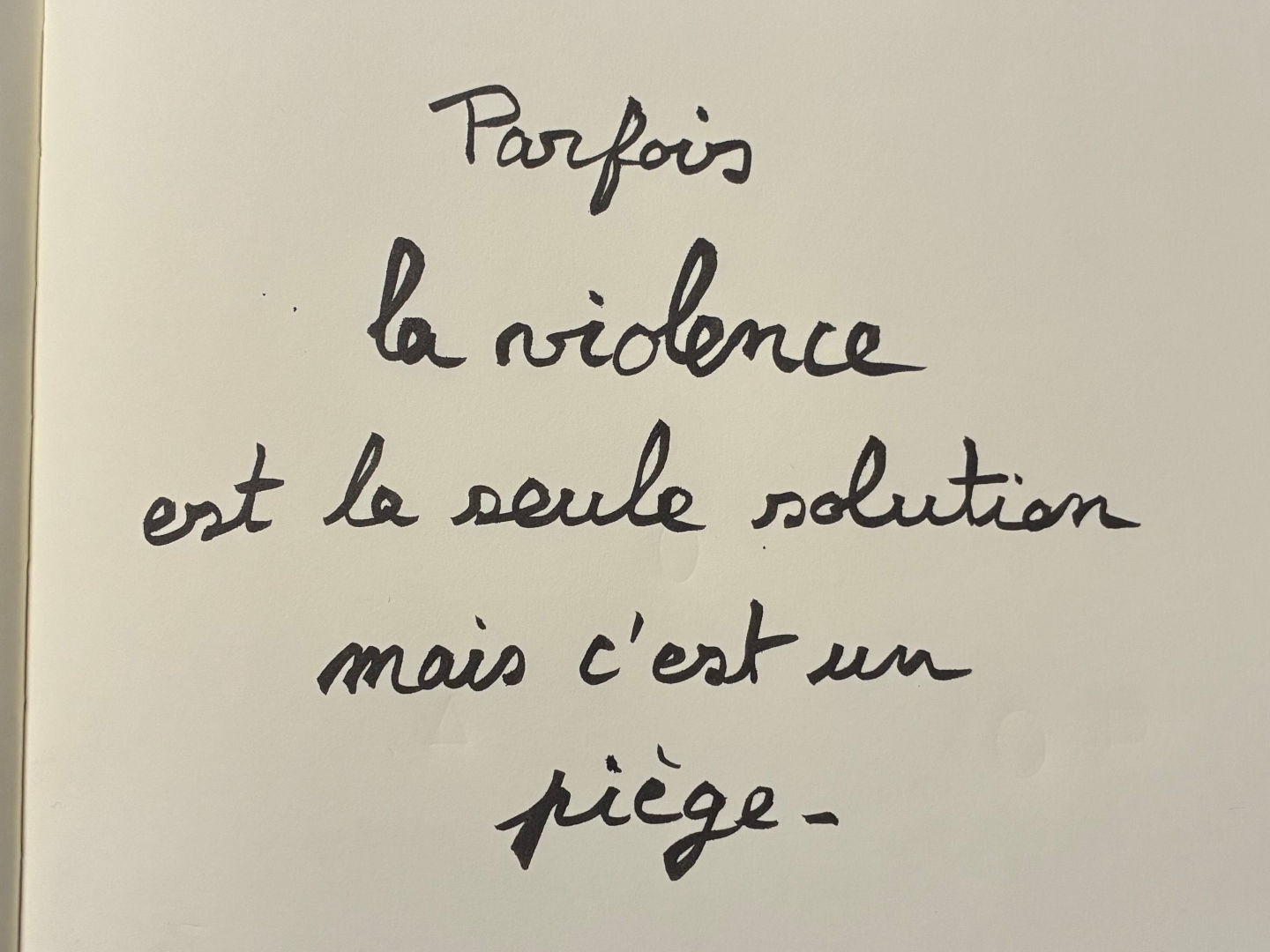
Sometimes violence is the only answer, but it's a trap.
Sometimes violence is the only answer, but it's a trap.
I'm trying out Feedbin.
It's a web aggregator: you read the blogs, sites and newspapers you follow all in one place.
Same goal as always, which I talked about here: breaking free from social media.
I don't mind sharing on platforms run by Zuckerberg, Musk and co. But the source has to be mine. I want a digital "home" that I control, where I publish what I want, and where people can follow me without going through a third party.
But following a lot of websites is tedious. Hence the aggregator. Like a small personal social network you're fully in control of.
And to set an example, I'm trying to follow the creators I like somewhere other than social media. The upside of Feedbin: it also lets you "follow" newsletters.
For now, it's complicated. I can't follow all the creators I want to. It isn't a habit yet.
But it's day one. I'll keep you posted.
Humans organize themselves into groups they belong to.
Fine.
The trouble starts when that group is a company.
Because a company's purpose is to generate revenue.
So here are human beings loyal to an entity whose purpose is neither their survival, nor their well-being, nor the common good, but money.
For these people, it becomes natural to make decisions that put the rest of the world (the out-group) at risk so the company (the in-group) can thrive, when that company won't protect them if real trouble comes.
That's a bad strategy for everyone.
I lied earlier: they're not squares, they're 4:3, like old films.
Here's the first of what should be a long list. Maybe.
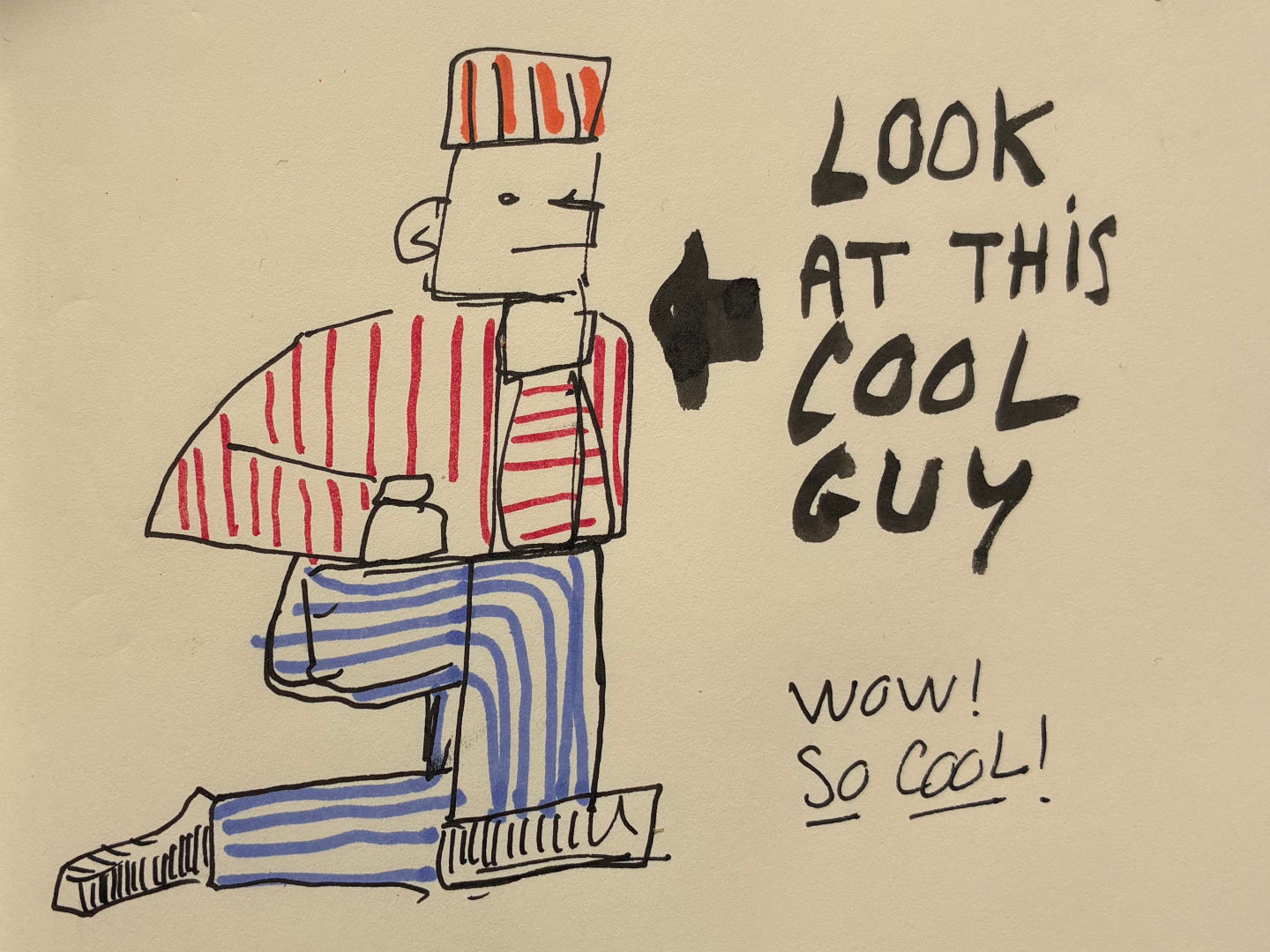
How I'd love to be that cool.
It's not a metaphor. It's very concrete.
Once you've understood that your outer problems are a reflection of your inner blocks, instead of thrashing around where it doesn't matter, you can go straight back to the source and transform what does.
That requires raising your level of inner perception.
It's not a gift. It takes practice.
Right now, I'm learning to spend more time in that space, to hold my attention more steadily on the inner workings.
When I come out, it's to find that out in the world, everything has gotten unstuck as if by magic. And all that's left for me is to enjoy the beauty of the world.
After trying every possible angle, I've written the introduction to my book.
Yes, this is the one.
I know because it brought tears to my eyes.
And everything that felt complicated about the writing opened up.
Two realizations made that possible:
Maybe it'll help you too.
I've said before that I only use Claude to build tools.
I've found another use for it: an error machine.
What it suggests is always sensible, clean... but nothing like what I want.
And those suggestions help me pin down what I actually want.
Not that.
In the middle of the night, I got hassled by two big dogs on the beach.
Not late, like 8:30 p.m. Down by the water, where there's no light.
They came running. One growled and grabbed my pant leg.
I scattered them with a loud "OH!". I left. Toward the light.
They came back. A bit more coordinated. More growling.
Another "OH!". They left again, and so did I. No owner in sight.
Called the police station. "No patrol available, I don't know what to do." OK.
Worth noting: another black dog had given me a dirty look in Paris two days earlier. Is it a sign?
Bad instincts: Psychologically, a black or aggressive dog that growls embodies repressed urges, anger, aggression, or the shadow side we struggle to accept in ourselves.
It's decided: I'm going to tell the comments that piss me off on my videos to fuck off, and own it.
We'll see if that calms the dogs down.
After the two TikTok accounts on spirituality, two accounts about politics and how society is organized:
Found them during a sleepless night. I recommend them.
If you repost propaganda, even out of outrage, you're part of it.
The media have figured out that repeating the unacceptable makes it familiar. They're counting on it.
Some channels draw their influence from shared clips, recycled ideas, and the conversations they spark.
Don't watch them. Don't amplify them.
I keep turning old journal entries into carousels.
The new versions are clearer.
Which goes to show: writing every day for years...
We sometimes have the illusion that some things matter and others don't.
Especially in times of crisis.
But in reality, every event in our lives is linked in a great chain of cause and effect, where each link holds the next.
So yes: the thought you'll have while looking at the dead leaf will affect what happens next. It will count as much as everything else.
And inner work can begin with any link.
Paying close attention to small things is often the best way to become present again.
It's a line I added to my morning note:
Proud? Stop everything.
It's good to remember that the ego doesn't only show up in negative emotions. And pride is often a lie.
"I did that."
But I didn't choose the body that could, or the intelligence that knew, or the privileged position that allowed it, or all the circumstances that made it possible.
It isn't about feeling ashamed either, not at all.
It's about realizing that we're part of a whole that is expressing itself, and that we're one of its notes. Which isn't diminishing, or sad.
In the rare moments when I'm aware of it, I'm freed from a weight I forget the rest of the time, and suddenly I feel truly present.
Reading the passive-aggressive comments under an excellent video about humanitarian aid reassured me a little.
It's not just me.
People attack arguments that the video explicitly addresses. Sometimes in the very same words. In fact, it's the main point of the video. But it's as if they hadn't seen it, hadn't heard it.
Deep down, I think they stay fixed on the part that annoys them, that threatens them, that challenges their identity – and ignore everything else. In poker, you'd say they're on tilt: too shaken to think clearly.
You have to keep that in mind when you reply. You're not talking to rational people with different opinions. You're talking to wounded egos trying to justify their identity.
I listened to the podcast where Bill Gates lays out his very alarmist stance on artificial intelligence (probably for good reason). Three things I noted, not all about AI:
Add that to the pile of problems.
The video about problems is doing well.
Almost 20k more views since this morning.
I'm going to have to find another way to reply to comments. I think I need to give up on the chronological, everyone-gets-a-turn approach.
Until now, I'd start from the latest unanswered comment and work my way back up, so I'd miss almost none and give each one at least some kind of reply.
I think I'll replace that with a more scientific method I came across in a very interesting article:
"Reply at random to the comments you find funny, and that's it."
More and more, I'm becoming aware of a different approach to screenwriting, one I really like.
Writing through the character's unconscious, you could say.
You define the protagonist's existential problem, and the stages of inner transformation he has to go through to reach a resolution. Then the "external" situations come along and confront the character with what he needs in order to change.
These situations don't really need to be "justified" within the story, the way they must be when the hero is simply pursuing a goal.
Even coincidences and deus ex machina (normally avoided in screenwriting) work just fine, as long as they speak to the character's deep-seated neuroses. As if he had called them up himself, and, out of everything that happens, it was only natural for us to focus on those.
To me, that's why the therapist literally breaks his teeth trying to treat the Roy family in Succession, or why Don Draper finds a father figure in Conrad Hilton in Mad Men.
Sure, every good script should have this side to it. But the best ones seem to use it as a starting point.
I can't resist sharing this video by @ashanayaswami, which I mentioned earlier:
Most of us have so much karma to work out, we could learn the lessons we need to learn in quite a few different ways.
You have to be really highly advanced before there's only one road for you to take.
And if you're that advanced, you'll know it.
So if there are a lot of options in front of you, you might think that each one is absolutely destiny-determining, and that you can only do one of them.
Actually, that's not true.
Any one of them can be used to expand your consciousness, or to contract your consciousness.
So a lot of times, we don't know what to do because it really doesn't matter.
The more I think about it, the less this notion of difficulty means anything.
If something is "hard" but, at that moment, the person has the will and the ability to do it, is it really hard for them?
Conversely, is an "easy" activity you feel blocked by really easy?
Difficulty isn't a property of the activity. It's an encounter between an activity, a person (or a group) at a specific moment.
Change any of these parameters, and everything changes.
So there's no point asking whether "an activity is easy or not".
All you can do is note after the fact whether, on that one occasion, it got done. And that says nothing about what comes next.
Not growing in followers, growing spiritually!
Two accounts (in English) offering fairly short videos that have helped me move forward lately:
If you're looking for other recommendations to get started, I talked about some in this post.
I have built work that's true to who I am, after all.
I had a lot of video calls this afternoon. I wasn't too keen.
But every time, I have really meaningful moments with people, and I come out with more energy than I went in with.
Yay.
Here's the game:
When you recognize a thought or an emotion for what it is, it loses its power over you.
So it's not about "manufacturing" happiness.
It's about removing, one by one, the attachments that keep you from seeing it's already there.
That's the feeling you get when you're present.
When you're stuck in your head, thought stands between you and the world. Like an obstacle, or a veil over your eyes: the outside world is blocked out, or heavily filtered.
When you become present again, the veil lifts.
The world reappears in all its color, all its presence. You don't need to pay attention to things: they're there, alive, vibrant, inescapable.
With the unshakable certainty that you're part of it.
This morning, I stopped the voice in my head again.
Inner silence. Just the world. Emotions.
I did it because the voice was especially loud: questions about the future, about my work, about money. Creating problems everywhere.
The mechanism has become clearer: I become aware of the current thought – what you usually do in meditation – but the "trick" is to also become aware of the commentary that follows: the little echo, quieter, less present, but still a judgment.
"Ah, good, we managed to spot a thought" ← also a thought!
It's a classic of inner life: you can neither summon nor chase away mental content, but by stepping aside and noticing it for what it is, you neutralize it.
Silencing my voice takes one extra level of recursion.
It doesn't look like much, but it's often the most important decision in a project.
The moment you say "we're not doing it that way," "we're not going about it like this," "I'd rather organize things differently."
Changing how you do things changes everything. It changes the activity – whether it brings joy or not, whether it creates a good atmosphere or not, etc. And of course it changes the result – which depends on the activity.
So the subject matters less than you think.
It's all in the doing.
I often trap myself by wanting a result.
I picture what the text, the film, the project should look like in the future, once it's finished, and I end up locked into a plan I have to carry out from A to Z.
No more freedom, no more surprise. The thing no longer changes with each impulse, the story no longer shifts with each idea. I shut myself in a corridor with only one way out. I become a slave to the finished product – one I dreamed up myself!
Hence the importance of taking the ego out of creation.
I jump into the void. I accept (I celebrate!) not knowing how it will turn out. I bet everything on the joy of making, on the present. And I let go, right now, of the praise and the pats on the back I had tied to the original plan.
It'll be what it'll be. The reactions will be what they'll be.
And that'll be just fine.
I just posted my first carousel.
No, I'm not starting to handcraft new content, I'm recycling the old.
For four years now, I've been writing journal entries regularly. Nobody read them – but I didn't care.
More recently, when I shared some of them on social media, I noticed people were interested.
So I wrote a script that turns my journal entries into carousels, which I post on Instagram and TikTok. For now, I'm going through them in chronological order.
We'll see if it's any use.
I've been watching a lot of videos about focus lately, including this one.
If you pursue just one thing at a given point in your life, you can put 100% into it.
If you do two things at once, you're not putting 50% into each – that's wrong. Barely 25%.
You lose a huge amount of power by splitting your attention.
Hence the question: which direction do you really want to go in?
Every now and then, I reach a new stage in meditation.
This morning, I "became" the sound of the rain.
That sounds a bit esoteric, but what it means is that I noticed the distance I was keeping all the time between myself and the experience.
Usually, "I observe the experience." I'm a subject (me) looking at, listening to or feeling an object (the rain). But from a distance. I remain myself. The rain remains the rain.
This morning, I became aware of that distance. I realized I was the one creating it, that it came from an inner resistance, probably a fear of losing myself.
Once I'd spotted it, I could lower the barrier. It dropped all at once and I could "become" the sound of the rain, the tightness in my stomach, the worry about the day ahead, etc.
It had happened to me before – it happens to all of us – but by chance.
This time, I spotted the inner mechanism.
I sent out the newsletter earlier.
I still have existential doubts about it, but I've made a decision:
The newsletter is a quick hello and a bisou once in a while, for people who like to hear from me every so often. A way to stay in touch around the big moments (films, screenings, meetups...). Or when I really want to share something.
So three or four times a year, tops. Not monthly. No roundup. Anyone who wants to follow my content more regularly can find it on my website or on social media.
So NO: I won't send out another newsletter just to say that.