"The Stagemaster" Semi-Finalist!
My English feature film screenplay, "The Stagemaster", has just advanced to the semi-finals of the Emerging Screenwriters Drama competition!
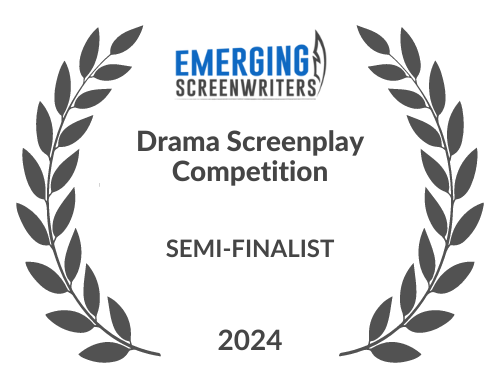
This fourth U.S. accolade puts me in the top 6% of screenplays on Coverfly.
My English feature film screenplay, "The Stagemaster", has just advanced to the semi-finals of the Emerging Screenwriters Drama competition!
This fourth U.S. accolade puts me in the top 6% of screenplays on Coverfly.
Another Surprise Culture Night!
I've mentioned before that I sometimes go listen to poetry in a cellar. Well, completely by chance, I stumbled upon the host of those evenings in another cellar, in the midst of a performance.
I was blown away by her energy, confidence, and humor. It's funny, touching, offbeat, but always kind-hearted. Her latest music video is available here. And here's another one with a bit of French in it (Sophia Lucia is American but lives in France):
You should also spend more time in cellars. It's (literally) where the underground scene is at. And it all starts here --> Freakshowcabaret
I've reached the end of the novel I've been writing for... oh wow... fifteen years?
105 pages, a little over forty thousand words. There's one chapter to revise in the middle, a few corrections to make here and there, but all in all, it should be finished soon.
This is the first novel I've ever finished. Before this, I started plenty that never survived the test of dispassionate rereading after a few months. But this one did. No matter how much time passed—months, often years—I was always surprised to find it still good. And to feel like continuing. And to be capable of doing so.
There are advantages and disadvantages to taking so much time to tell a story.
On the advantage side, there's a "Boyhood" vibe (the Richard Linklater film shot over 12 years): the person who starts the book isn't the same one who finishes it. You can feel a genuine transformation in perspective as the story progresses. And it's no pretense: it's my own.
On the downside, there's the evolution of style: I write better now than I did fifteen years ago. However, I didn't want to revise the beginning too much in order to preserve the original flow and energy. I lightened it a bit, made it more breathable, but I respected the progression and the turns of phrase as if they were written by someone else.
Next step? Get people to read it. Find a publisher. Write the next one a little faster.
The first sentence:
If you ever run into one of my friends, tell them I'm doing fine.
A premiere is always nerve-wracking for a director—especially at the Opéra Bastille—but this event organized by École des Ponts went extremely well. The theater was packed, with the film's interviewees, contributors and a large part of the crew in attendance... truly moving.
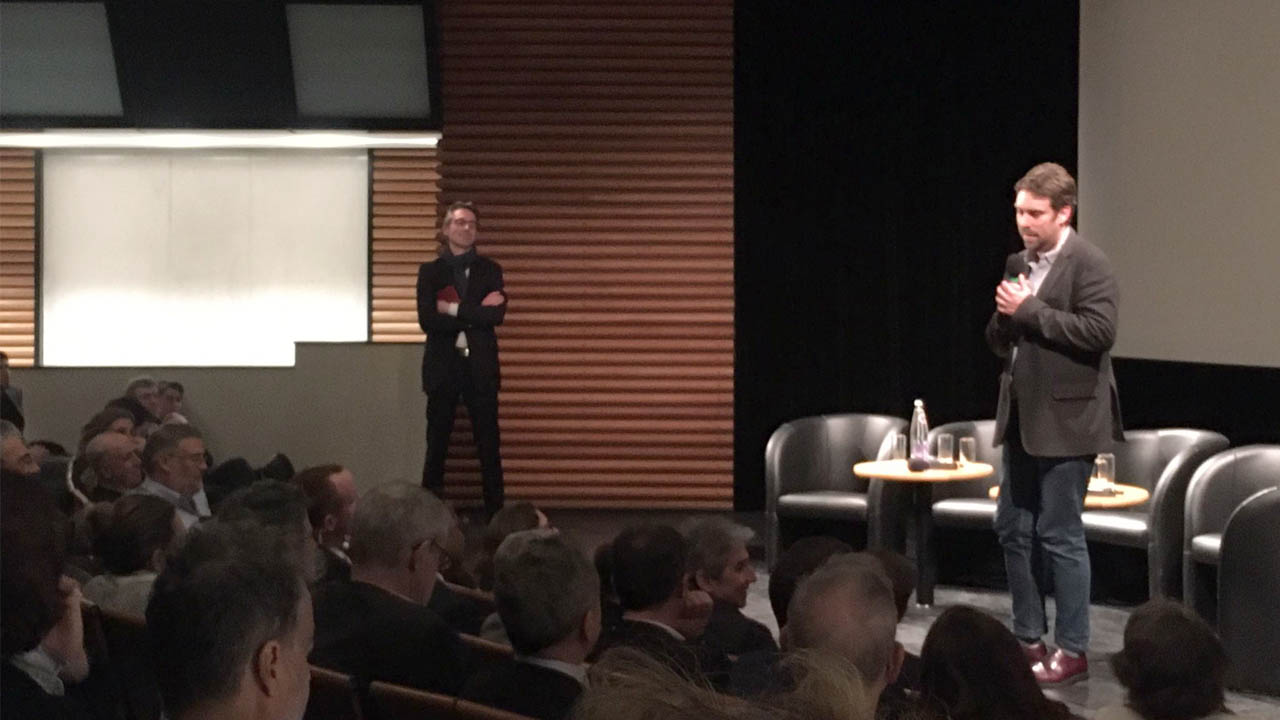
A few words of introduction following Anthony Briant's (left), Director of École des Ponts.
I loved producing and directing this film. I met and collaborated with extraordinary people.
I'll soon be releasing a trailer online. The film will be exclusively screened in theaters (festivals, events) for a year, while we potentially search for a distributor. Afterwards, the distribution will widen. Screening dates will be announced here or on the École des Ponts LinkedIn page.
Culture night was less of a surprise this time since I had made reservations.
When I go see my friends' plays - especially in small venues where you can't hide - I always prepare a line to say after the performance in case I found it awful. ("You made me dream" Françoise Sagan would have said to Jeanne Moreau after a play where she fell asleep.)
I'm happy to say I didn't need it this time.
(I'm in a period where my friends are doing amazing things. This and this, for example.)
The play is simple, intimate, yet uncompromising. It progresses. The staging is delicate, made of small objects and gestures that you find here and there, telling a story. It was also an opportunity for me to see the journey and talents of someone I know making perfect sense within a personal and powerful play. Very moving. But rest assured: no need to know beforehand to appreciate it.
Oh, and also: you'll learn things (about Chile, about Louise Michel...) and you'll come out less ignorant. Which is not the case for most shows nor, let's be honest, for the majority of my films.
Tant que nos Coeurs Flamboient with Lorena Felei, written and directed by Laurent Contamin. At the Théâtre Essaïon until April 30th.
There's something for scientists as well as beatniks. The common theme: reality isn't what you think. Let's dive in.
Starting with science: I stumbled upon Don Hoffman in this podcast by Lex Fridman. He's a researcher in the Department of Cognitive Sciences at the University of California. The thesis he defends in his book The Case Against Reality is simple: evolution doesn't care much about truth. Using models rooted in evolutionary game theory, he deduces that our perception of the world is biased toward survival. In other words, our brain wouldn't hesitate to ignore or distort the truth as long as it gives us an adaptive advantage. It's not its fault: it's been programmed this way over millions of years of evolution.
Therefore, a species that perceives all subtle variations of a signal could be disadvantaged compared to one that sees things in a much more binary manner (red = danger!) but much simpler to analyze in emergencies. In this race – like in many others – neither aesthetes nor poets survive.
On the beatnik side, it's been over a year since I've been progressing through the book Seeing That Frees by the late Rob Burbea.
I'd describe it as an advanced meditation book centered around the notion of "emptiness," which I've already discussed here. The central idea is that reality is much less real than we imagine. We're convinced that outside of our perception exists a "solid" material world that persists over time and continues to exist when we're not looking at it. Through a series of meditations focused on impermanence, attachment, and dependent arising, Rob Burbea shows that reality is partly an internal construction that builds and deconstructs under the impetus of consciousness. He teaches us to use different ways of seeing the world as tools that we can grasp and set down again to gain freedom.
To my friends, I sum it up in one sentence: "reality is made up of the thoughts you can't get rid of." The day I understood that, many things changed in my life.
Finally, between science, philosophy, and New Age, there's Why Materialism Is Baloney by Bernardo Kastrup.
Originally, Kastrup is a Brazilian researcher in computer engineering who has worked at CERN. When he wanted to develop a "conscious" computer program, he became interested in the problem of consciousness from a philosophical point of view and ended up with a metaphysical theory that brings idealism back into fashion. His idea is as follows: it is currently impossible to understand how matter creates consciousness – David Chalmers's famous "hard problem". So he turns things around: it's consciousness that creates matter. The laws of physics would no longer stem from the standard model but would be regularities of a shared consciousness of which each perceives only a part. According to him, we "think" matter into existence. It sounds a bit crazy, but his purpose is precisely to show, through reasoning resembling Occam's Razor, why it's "less crazy" than the materialist hypothesis.
Of course, we're diving into metaphysics here, so all of this won't immediately change how you choose your socks in the morning. But eventually, it should.
UPDATE: All these reflections have led me to imagine the film "Permis de conscience" (Awareness permis). To be continued.
Originally, it's a soundtrack of a video installation by Pipilotti Rist, a cover of Wicked Game. Despite (or thanks to) its strangeness, I find myself listening to it regularly:
"I'm a Victim of This Song," music and recording of the installation.
It starts off normally, then it goes off the rails. Just like my projects.
Keeping a journal boils down to one single activity for me: describing the obstacle.
What's blocking me right now? What's preventing me from being free, happy, and creative at this moment? What hidden snare is hindering the next step?
Two aspects are crucial:
Firstly, it's solely about describing. No finding a solution. No seeking to amend. I unearth the obstacle and examine it from all angles; I explore its ramifications within me; I ponder why it's blocking me now and in such a manner. And then that's it. Once the problem is brought to light, I let other inner forces take care of resolving it.
Secondly, it's an immediate obstacle. Something that's hindering my progress right now. I'm not trying to fix the situation for eternity. In this sense, the effort is neither theoretical nor intellectual; I'm solely dealing with what's present, operating under the assumption that subsequent difficulties will be handled in the same manner: in the present, as they arise – if they arise. We'll address the future when it arrives.
For this reason, journaling has been part of my daily routine for almost 3 years, and it constitutes an essential exercise to stay present.
New surprise cultural evening (SCE, new acronym).
I discovered that the café I regularly visit, called "The Cellar" (la Cave Café) has... a cellar. Where poetry is read on Monday evenings. Lots of people, mostly English speakers. Poems, songs, stand-up, "anything goes." Great atmosphere.
I got on stage to recite this short poem by François de Cormière in French and English (translated by ChatGPT) because you have to seize the moment, right?
Then came the special guest of the evening: Bonafide Rojas, a poet from the Bronx who came to read excerpts from his book Excelsior. So funny. So charismatic. They call it poetry, but it's essentially very personal trains of thought which take a new kind of life on stage.
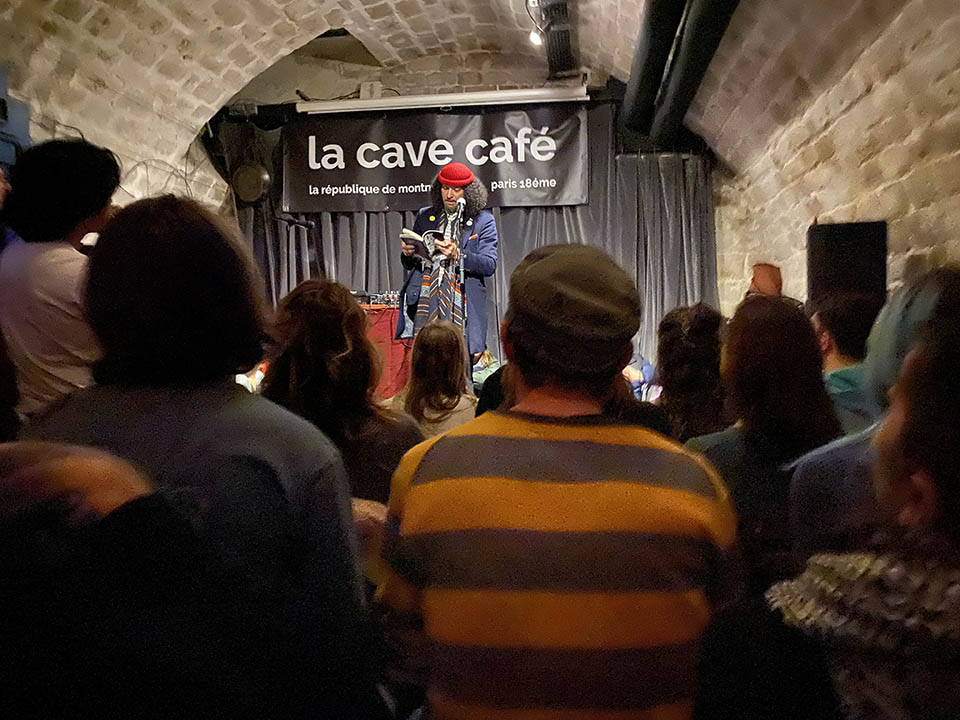
Bonafide Rojas reading excerpts from his book "Excelsior" at the Cave Café.
He signed his book for me. Though I've only skimmed through it, I appreciate how each poem is peppered with footnotes explaining cultural references – a thoughtful touch for those not entrenched in the New York poetry scene. Well done.
I don't go there often, but every time I do, I emerge transformed.
I never read the information: the author, the artistic approach, the family traumas that led them to make ceramics on cows, I couldn't care less. I disconnect my brain.
And always, I feel filled with overflowing gratitude to live in a country where for 9€, you can experience so much freedom in a public place where humans are welcome. At a time when train stations have more advertising boards than benches, that's saying something.
Three things I liked – among many others:
1. No need for an audience
The statues look at the artworks while the mannequins discuss the exhibition. One wonders what the purpose of the audience is.
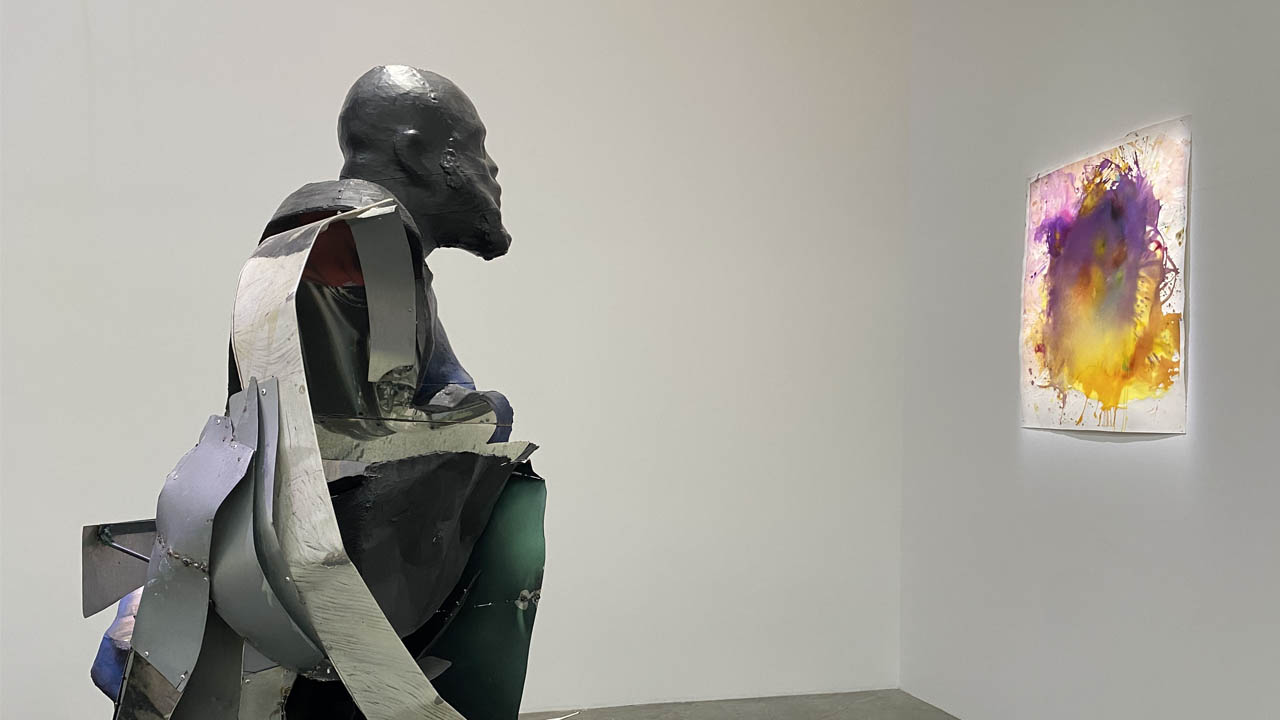
Lenin contemplates the painting that will inspire Sovietism.
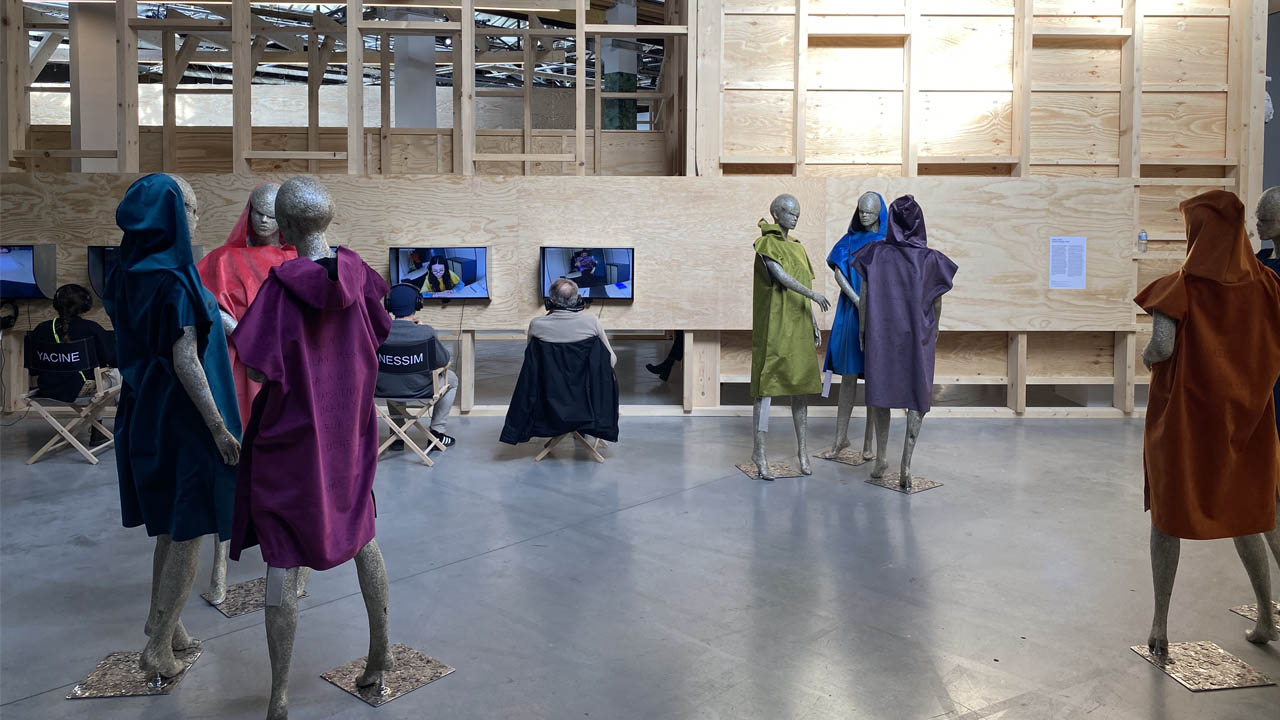
Mannequins in ponchos discussing the relevance of modern art.
2. It's meta
There's always a reflection on the medium. We don't just paint on paper; we reflect on the limits of paper, its relationship with ink, its connection with the viewer. And every time, we think, "Oh, are we allowed to do that?"
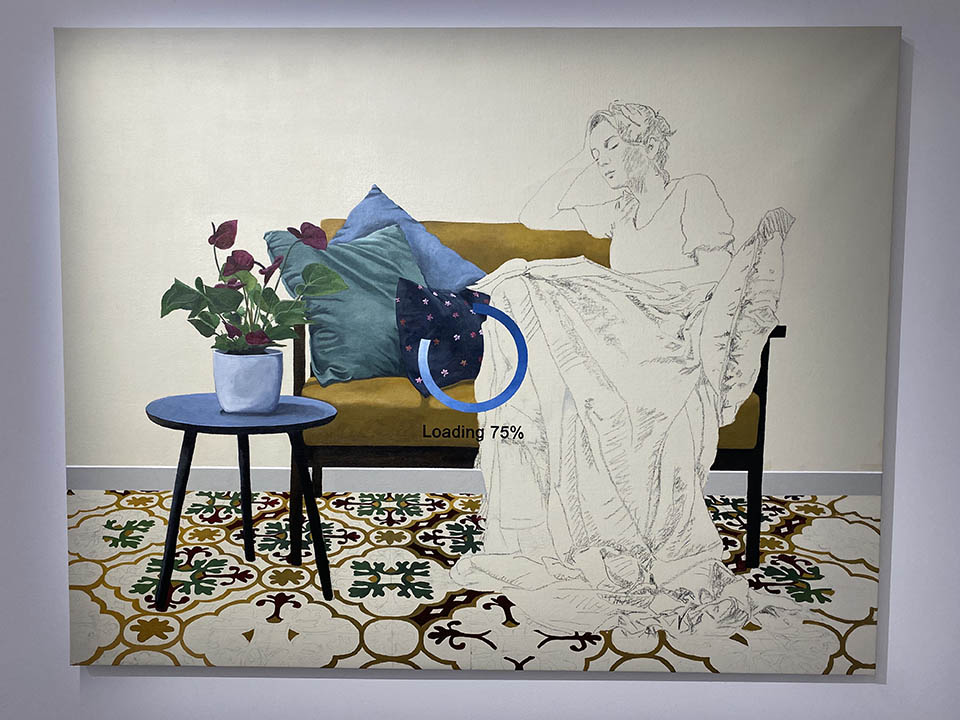
Painting in the process of loading, by May Murad.
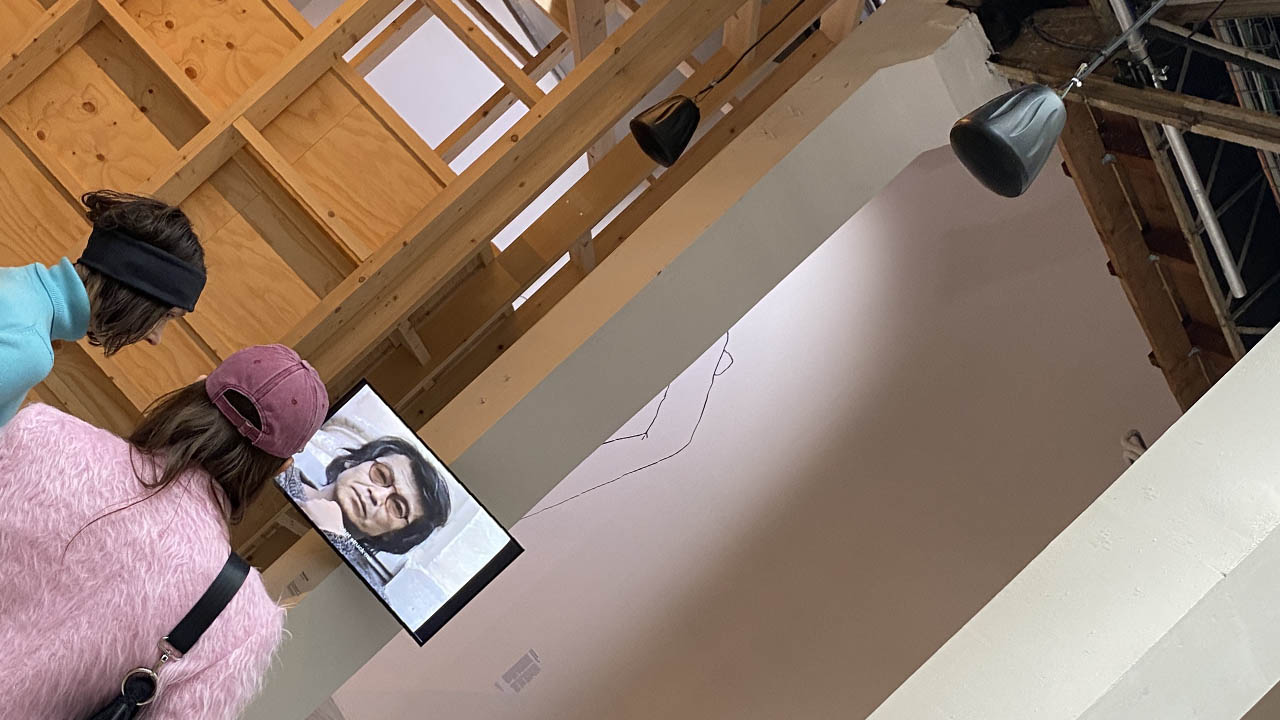
I've dubbed it "video showers": the speaker only sprays sound onto the people below, allowing for multiple films in the same space.
3. The bookstore
Every time, I choose a book almost at random by looking at the pictures or reading a paragraph in the middle. Over ten years ago, I picked up "On the Inside of Jokes" by Nik Christiansen.
This year, I picked up "The Waterfront Journals" by David Wojnarowicz – apparently, he's quite well-known. I'm already halfway through. This book blows my mind.
An afternoon... and everything changes.
I quite liked the original, and once again, no one bothered to notify me of this new version that you all know and that I only discovered this afternoon on the beach:
I took the opportunity to read the lyrics that I had never understood before, and they remind me a bit of Nobody Knows, while still maintaining an almost childlike simplicity, especially:
Went down the hill, the other day
Soul got happy and stayed all day
My eyes well up every time I hear this passage.
UPDATE: I also made a film with rockets flying backwards. And we won an award.
I was about to write an exciting article about the psychological component of effort based on my experience with the rowing machine at the gym: some days, It's a breeze; other days, on the same machine set at the same level, it feels like it weighs a ton.
I was going to explore in detail the psychological, neurological, and physiological origins of this discrepancy, and everyone would have found my article funny, well-researched, and so well-written.
Except that this morning, I discovered the truth.
When I lay my towel on the roller, the fabric prevents the moving air from escaping, and the suction maintains the rotation – or something like that – so that the exercise becomes much, much easier. But as soon as I place my towel elsewhere... Welcome to the Roman galleys.
All of this to say that the laws of physics have spared you another stupid article.
Thank you, science.
I unexpectedly went to the theater last night and saw "Contre-Temps" by Samuel Sené. Fantastic!
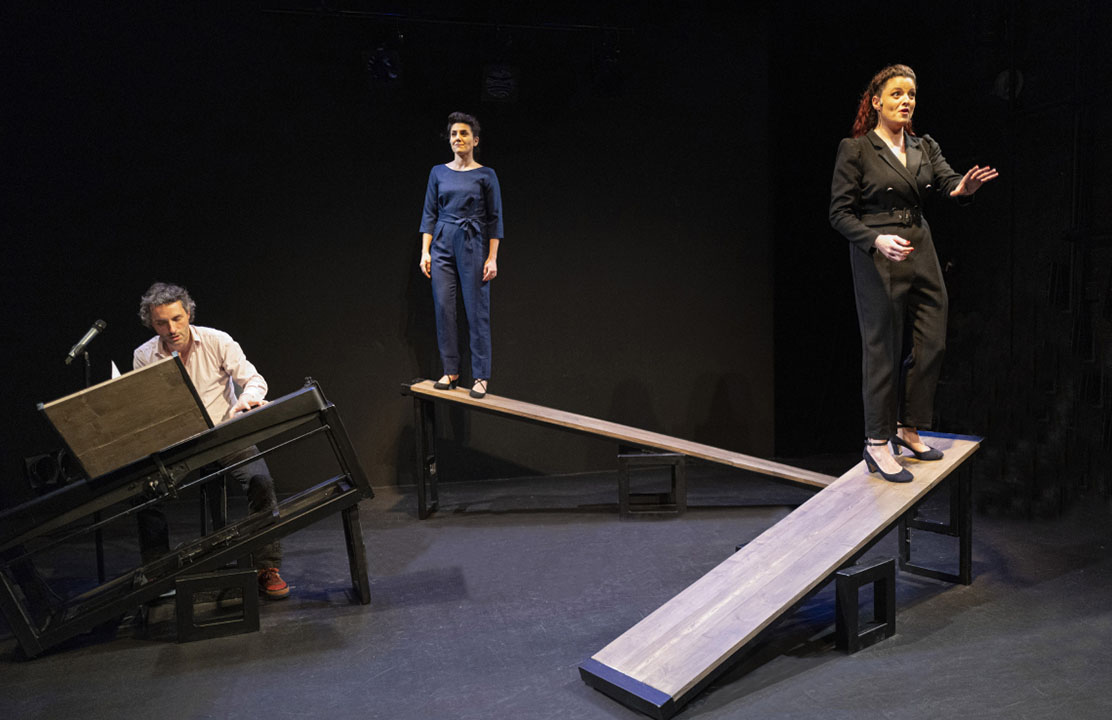
Julien Mouchel (piano), Marion Préïté, and Marion Rybaka in "Contre-Temps".
Like a documentary but on stage: instead of archival footage and a voice-over, everything is narrated in the present by two singers and a pianist who recount the – exhilarating – life of the composer François Courdot by interpreting his main works.
At the heart of the show, there is notably a magnificent interpretation of "The Cold Song" by Purcell, of which I present you Klaus Nomi's version here:
Upon leaving, I became interested in this piece that everyone knows the melody of but often not the lyrics – which could come straight out of Game of Thrones:
What power art thou, who from below
Hast made me rise unwillingly and slow
From beds of everlasting snow?
See'st thou not how stiff and wondrous old
Far unfit to bear the bitter cold,
I can scarcely move or draw my breath?
Let me, let me freeze again to death.
Another amusing detail: I realized that the music for the show had been arranged by Raphaël Bancou, a pianist friend I haven't seen in ten years. I sent him a message, and I'm going to see him on Tuesday at the Rond Point in "Je suis Gréco." Life, sometimes.
It might sound like a New Year's resolution, but it's not at all. It's the culmination of a rebellion I've been brewing for a while.
Last year, quietly and without fanfare, I (almost) abandoned Facebook, LinkedIn, Twitter, and the like. My concerns with social networks were manifold:
In parallel, I created this blog.
My idea was simple: I would post here everything I posted elsewhere. On a site I manage, whose appearance I choose, which is not subject to the control of a third party or an algorithm. And that doesn't enrich anyone (except my hosting platform – and not much).
Of course, in doing so, I lost some advantages:
No more likes. No more shares. And, really, no more visitors.
This last point should have been a dealbreaker – after all, we publish to be read – but strangely, I continued. For a year, I posted content on a blog that almost no one came to see.
Then something unexpected happened.
As the months passed, my content transformed. My articles became longer, closer to my true concerns. I started doing photography again, writing dialogues, publishing drawings, creating more.
I also began to improve the site – appearance, navigation, features – so that it quickly became a "home." Where I feel good. That inspires me like an artist can be inspired in their studio.
But most importantly, despite the lack of visitors, each publication brought me more satisfaction. Strangely, I took more pleasure in creating for no one than for the elusive and shapeless public of social networks.
A year later, I've drawn three lessons from this experience.
First, personally, I realized that the shelf where I place my pottery is more important than I imagined. I need boxes to store what I do – even the little things – otherwise the creative process stalls upstream.
Secondly, you must first create for yourself.
Rather than a clumsy explanation, I recently came across two videos of artists I admire who tell it much better – and with more authority – than me:
"Never play for the gallery. Never work for other people."
– David Bowie, in this video.
"The audience comes last. And I believe that. I don't do it for them; I do it for myself."
– Legendary producer Rick Rubin, in this short.
(Not forgetting this video I've already mentioned: Create or Be Consumed.)
Finally, of course, you still have to share. Otherwise, it's just masturbation.
That's why, for the past few weeks, I've been getting back to posting on social networks. With one significant difference from before: now, creation and distribution are dissociated.
Everything first goes on my shelf. Which imposes no rules, puts no pressure, plays no games. It's an engine that asks a single question: "Do I really like it?"
Then, only then, do I showcase it.
During this holiday season, a song that celebrates love. (Not the possessive and sentimental love of American romantic comedies, but the pure and immediate love of Eastern wisdom.)
As a teenager, I had missed out on Pearl Jam, and I didn't know much about Eddie Vedder except that my musician friends idolized him. Then, I discovered the soundtrack of Into the Wild), especially No Ceiling and Society. Later, I realized that it was him again, who was behind the fantastic soundtrack of Dead Man Walking).
So recently, I've been revisiting this song:
A blend of country and traditional tunes that I would have loved to see live. The burst of voices at the end should be enough to trigger a spiritual awakening when experienced head-on.
For English speakers, three articles I've read over several years about death described by healthcare professionals. I've already discussed the first two, but upon reading the third, I thought it was worth compiling a little anthology.
The first to kick off in 2011: "How Doctors Die" or how doctors at the end of life tend to avoid the therapeutic frenzy they too often witness in their patients.
The second, recently discovered in the fantastic essays of Scott Alexander, dates back to 2013: "Who By Very Slow Decay" or how medical staff abandons illusions in palliative care centers.
Finally, the last one, recently published in the New York Times – if you only read one, I recommend this one: "A Hospice Nurse on Embracing the Grace of Dying". A nurse in a palliative care hospice describes her work and the final moments of her patients in a book titled "The In-Between: Unforgettable Encounters During Life's Final Moments." The stories and analogies she shares in the article are deeply moving.
The goal is not to depress. On the contrary: truth sets you free. A keen awareness of our finiteness is the first antidote against a life steeped in illusions.
During the "Nuit des Ponts" organized for the 25th anniversary of the Fondation des Ponts, 7 projects were pitched for an exceptional fundraising event at the Grand Amphitheatre of the Sorbonne.
I was the last one to take the stage to ask for funds for the post-production of "Building," the feature-length documentary that I produce and direct with ChezFilms for École des Ponts.
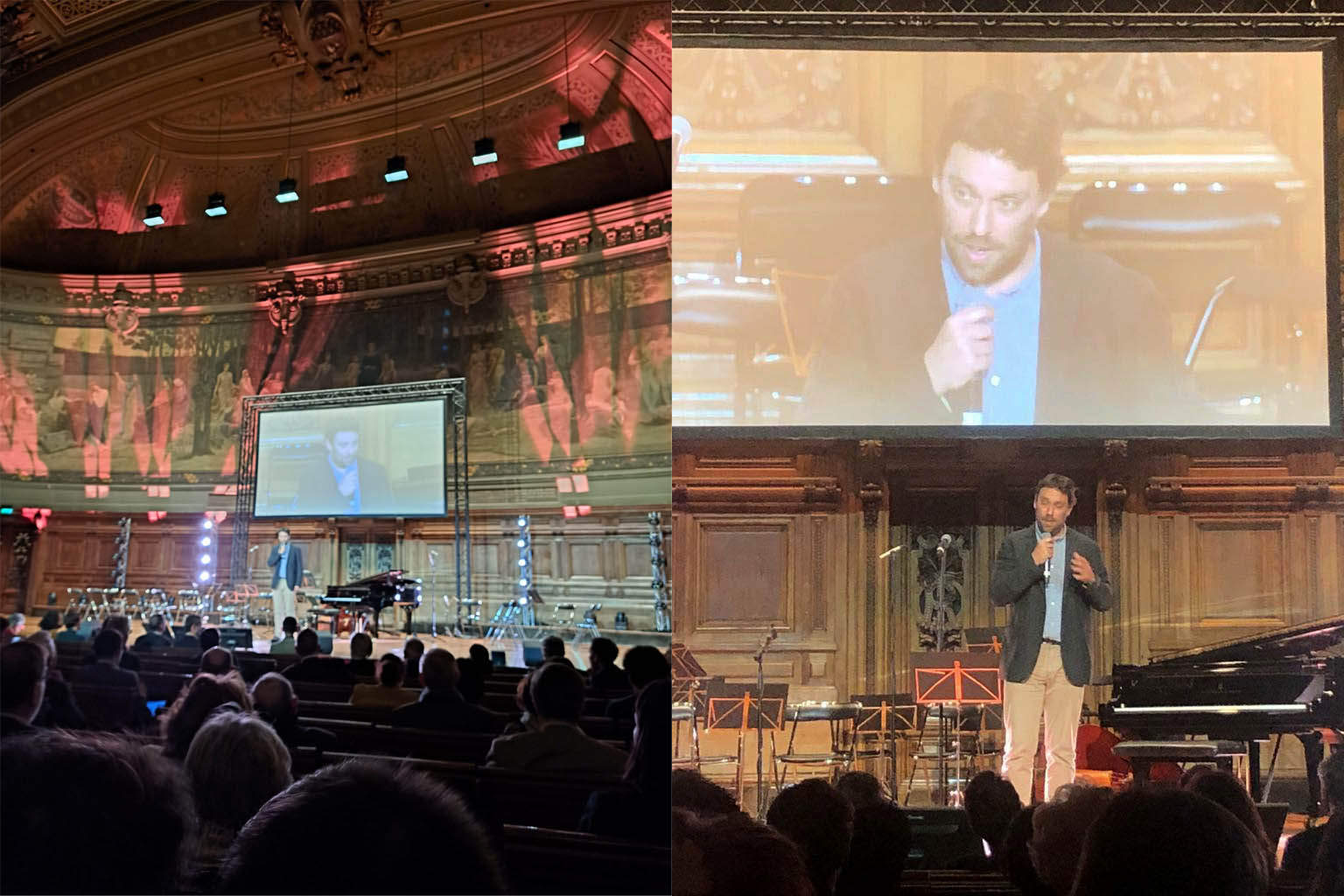
On the right: a magical photo where my eyes are closed on stage but open on the screen.
Happy to announce that, thanks to the generosity of donors, we secured over €50k for the post-production of our film. Also, a big thank you to the sound team that came to support me:
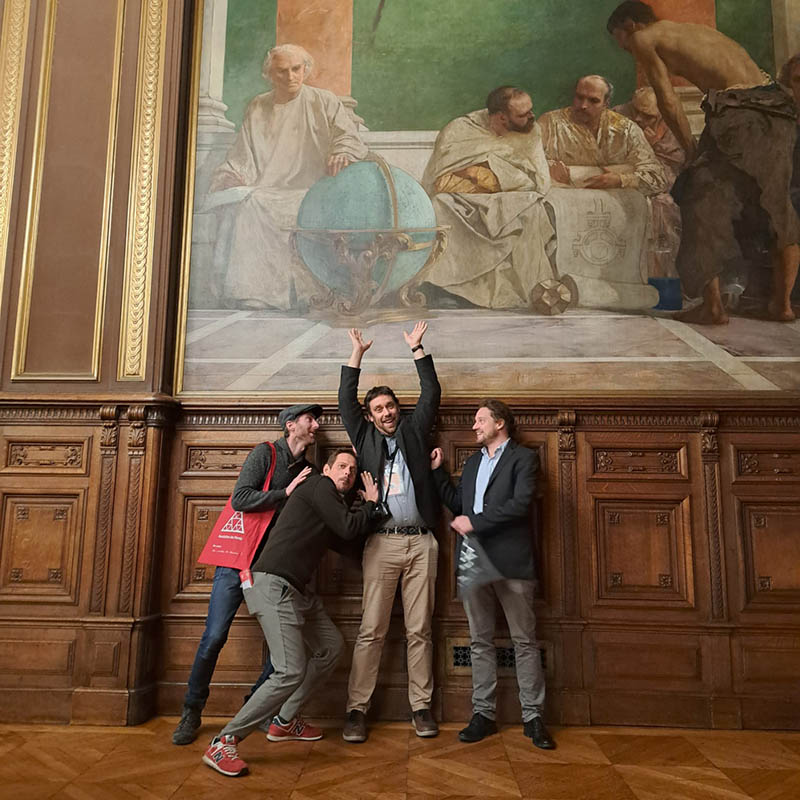
Vincent (sound), Dom (mixer), me, Mathieu (sound) hard at work. Photo Cristina.
Vincent (sound recorder), Dom (mixer), me, Mathieu (sound recorder) in full action. Photo by Cristina.
Premiere coming soon. I'll keep you posted.
It makes me chuckle.
Many commentators seem deeply concerned about the "alignment problem" in artificial intelligence. That is, if we ever reach the elusive "A.G.I.," or Artificial General Intelligence – one that could outperform us in solving all sorts of problems for which it hasn't been specifically trained – how do we ensure that it uses its powerful intellect in line with values we share?
The most commonly used example is that of toothpicks.
Let's say it's asked to "maximize the production of toothpicks" in a factory. Who knows if this intelligence, in its computational desire to fulfill a command that makes no sense to it (it doesn't have teeth, does it?), wouldn't set up a diabolical and irreversible mechanism that, despite our astonished attempts to stop it (remember: it's much, much smarter than us), would end up clearing all the forests on the planet and enslaving the entire population to produce the little picks we asked for.
After all, it knows nothing about the human values that matter to us: freedom, dignity, sharing, etc.
Anyway, that's the argument.
Does it ring a bell?
I submit to you that, for the record, money was initially just a tool for accounting to facilitate exchanges. Then, over the decades, maximizing profit for shareholders became the excuse to colonize continents, wage wars, impoverish the masses, and destroy the planet.
So, an artificial intelligence doing the same thing faster would actually be perfectly aligned with our current values.
The only real alignment flaw would be if the A.G.I. responded: "But what are you going to do with all these toothpicks? Wouldn't you rather go play in the parks with your children?"
Let me tell you, that version would be reprogrammed on the same day.
UPDATE: it inspired me to write this script.
I don't choose what I write.
One morning, I realize that my comedy-drama screenplay isn't progressing. The new scenes are dragging, predictable. Even the corrections I make here and there don't seem to be heading in the right direction. It's a mess.
However, without searching, three ideas for a comedy.
We know that writing (or creation in general) is 10% inspiration and 90% hard work. So if we wait for divine inspiration to move forward, we'll never accomplish anything. Sometimes, you have to push yourself a bit. Start the machine and see what comes. Right?...
I'm less and less sure about that.
Of course, the writing process itself – in the sense of the work required to get the idea on paper, to correct, to review, etc. – that time is largely non-negotiable. I would even say it tends to increase with experience. In many ways, what defines a professional, an artisan, is the awareness of how much time their work takes. Unlike me in music, for example, where I get offended when I can't crap out a song in an hour like the musicians I see on YouTube. (The term "crap" is not chosen by chance, as we will see.)
However, when we talk about pure creation, about the intellectual process of generating new ideas, bringing them out of nothing, my theory is that this time, just like the quality of the ideas themselves, varies exponentially depending on the circumstances.
The formula that you find effortlessly right after a meeting where you've been slightly shaken, which you expand with a line you didn't dare to say on the spot, and then develop into an entire dialogue that could fit into a courtroom drama or a thriller: it would be impossible to write the same thing the following week in front of your computer. Not with the same enthusiasm, the same inspiration.
Similarly, the nonsense that the brain seems incapable of stopping when you come out of an improvisation session with other creators animated by the same joyous and ancestral silliness: none of this would come easily on a Tuesday morning at the office.
Lastly: the nostalgia that tints everything after a painful breakup, the sadness of the world, the shittiness of things, you never express it better than when you're in the dumps.
The best comparison to illustrate this idea involves toilets and taking a dump – here we are. Not out of a love for vulgarity (though, well used, it rarely bothers me) but because I haven't found anything clearer or more universal:
Let's imagine an office worker whose job is to produce... crap. Literally. He's paid to provide a high-quality turd every day and is therefore not allowed to take the life-saving laxatives that would contaminate his specimen.
His day can be organized in two ways:
Or:
Seems obvious, doesn't it?
Yet, how many times do we try to force things rather than let nature take its course and pick the fruit when it's ripe? Count it in a day. It's often much, much more than we think. When it's not the job itself that's built on a constant violation of the world's temporality.
Then again, it depends, I suppose. I progressed in my novel by writing very regularly every morning for long periods. So it's possible, I guess. But in general, these writing sessions only serve to arrange the fruits already picked up by chance on the road. And there's no guarantee that, in the end, it will be a high-quality turd.
UPDATE 1: The sociologist Niklas Luhmann, not known for slacking off, puts it even more succinctly:
"I only do what is easy. I write only when I immediately know how to do it. If I hesitate for a moment, I set the subject aside and do something else."
- Niklas Luhmann
UPDATE 2: Since we're talking about toilets and creation, go watch this (very) short film I just re-released, which deals precisely with that. One of my first films.
Lately, I've been going back to the theater.
Yeah, I don't know what's gotten into me! Probably the onset of depression.
I've seen some fantastic stuff – including I Wish I Were Jeff Bezos which is currently playing, go check it out!
And then I saw... Edmond.
It's the hugely successful play by this wildly successful playwright who only produces hits. Honestly, I was thrilled at the idea of sharing the love for a popular show with the rest of France. I was going to laugh, be moved, and engage in café conversations by shouting, "I've seen it too!" and we'd reminisce about the best moments, laughing together. I might even have made some new friends.
And then... plop.
It's always tricky to speak ill of a play that so many people have loved. To keep it restrained, I'll simply say this:
This play is garbage and everyone who liked it is a fool.
Oh well, no new friends for me.
To keep it brief: I found the script sluggish, the humor painfully forced, relying on accents that drool and lame jokes. It's another remake of "Shakespeare in Love" except the connections between the author's life and his work are artificial and anecdotal – a clumsy device that serves as an excuse for predictable twists.
All of this is performed by actors – all very talented, I'm sure – who take turns from one performance to another in what has become industrial theater.
On the "plus" side: yes, the staging is dynamic, very cinematic, scenes flowing like in a film with music that sounds like a soundtrack. It's like cinema recreated in the theater. Why not.
Then I went to see A Flea in Her Ear at the Comédie-Française.
The text is long – over two hours – but a real delight. You can feel a troupe that has had the time to work on every scene, every line, every line to get the maximum comedic effect – that's what public theater is for. You're surprised by unexpected shifts, gestures, sometimes even stunts that emphasize and invigorate the text, making it lively, accessible, and modern.
And the venue. I had forgotten how beautiful it is.
Well, I might be a bit harsh on Edmond. It's still well-constructed, well-directed, and visually pleasing. It's a show. If you go with friends, you'll probably have a good evening. And above all, when you leave, don't forget to delete my number.
A small touch of the blues on the highway.
No reason. No illness. No new abyss in my life. Nothing to worry about more than usual.
Then I understood why: there was nothing exciting waiting for me in Paris. Neither upon arrival, nor that evening, nor in the upcoming week. Not an unpleasant week ahead – not at all – but nothing that made me impatient.
This made me realize two things.
The first one: my happiness relies almost entirely on anticipating future joys.
There has to be something shining in my future.
Either a small spark in my immediate future: a pastry, a meeting, a distraction. Or a big sun in my distant future: the success of a long-term project, a life change, the promise of a brighter tomorrow.
Strangely, the actual size of the star doesn't matter, only its apparent size. If it's small, it must be close – I want it now. If it's distant, it must be large – worth the wait. So, its diameter as seen from the present is always roughly the same: I need a certain amount of brightness on the horizon.
This perspective explains certain behaviors.
People without long-term perspective, for example, those who have lost confidence in the future (who don't have a distant sun), often compensate with a multitude of short-term sparks. It's the first step in addiction: indulging in immediate pleasures to forget the lack of an overall direction.
Conversely, it's easier to maintain daily discipline when aiming for a shining light on the horizon. The reward gleaming in the distance makes it easier to endure daily sacrifices.
But precisely: in the car, nothing was shining. And I felt... weary. Without enthusiasm. Almost depressed. That was the second realization:
What if this is my baseline state? My emotional neutrality?
What if the state I label as "depressed" is actually a "everything's fine, yay!" state that I misinterpret due to excessive dependence on the future?
Am I like an addict too fixated on their next fix to notice other sources of joy? Do I always need a reward on the horizon to enjoy the moment? Is it possible that I've organized my life (and for who knows how long?) to always have something waiting for me, even if I have to invent it? Even if it spoils what is here and now? Have the fantasies of the future desensitized my palate to the subtler emotions already within reach?
But most importantly: can I recalibrate my brain to be less hypnotized by the future and the junk it constantly dangles in front of me?
(Response: yes, yes. Very easily! Cheers!)
Before, I used to joke that only my mom read this blog.
Recently, I got proof that not even she does.
So when I promote an artist here, it's not like it's going to make a big difference or attract a crowd. But hey, it's a kind of journal. I jot down what I like.
And Sophie Le Cam's concert – just like her previous one – really, really impressed me.
I love this new phase of my life where I get to attend shows by people I know, and I think it's fantastic. It was funny, sweet, rhythmic, genuine, with a unique touch that adds personality without overshadowing the emotion. And a few hit songs.
The music videos are great as well – but if you have the choice, go see the live performance.
And you can find her website here.
Of course, you've been listening to this on repeat for years, while I, foolishly, have just been listening to the original – which is also very good, let's be clear about that.
But this version has something... charming. And rebellious at the same time.
I would really love to make a music video for this song.
I'm coming to think that only presence matters. That there is, ultimately, no right or wrong action, no right or wrong decision: only good or bad reasons to act.
But what does it mean, exactly, to "be in the present"?
Physically, of course, we can't be anywhere else. No one has yet set foot in the past or the future. So technically, we're all "in the present." But we can be in the present without being "in the flow" of the present.
Being in the flow of the present means receiving and allowing ourselves to be transformed by what happens at each moment.
When all goes well, events, sensations, and thoughts arise, run their course, then disappear. This short cycle allows us to be constantly open to what arrives here and now. We can receive the next ray of sunshine, the next idea, or the next conversation because we haven't remained stuck on the previous content. Everything constantly renews itself in interaction with the context.
Yet often, we get stuck.
We "cling" to an idea, a thought, or an anxiety that, consciously or unconsciously, we loop endlessly. This vortex occupies all mental space: the rays of sunshine and the next conversations are blocked outside. The present continues to unfold but we no longer take it into account; we no longer allow ourselves to be transformed by what arrives. We are "stuck" at the point in the past where the thought we're maintaining was formed.
Buddhists call this an attachment.
I am "attached" to mental content like a boat would be tied to the shore. The result is the same: I am no longer carried by the flow of the current.
A few examples of attachment. One: I need to get to a certain place for a certain reason. The journey is just an unimportant transition period between me and my goal. Any event that delays me is an obstacle. I'm too attached to the destination to be open to what's happening. Two: I've decided to say something specific to someone. The conversation is just a necessary passage to trigger the reaction I want. I'm too attached to the outcome of the exchange to be open to the human being in front of me. Three: I've decided that a certain event must happen in a certain way. Any deviation from my predictions is a failure. I'm too attached to my vision to be open to what's actually happening—including the good surprises.
In each case, I favor the idea over reality; I'm too attached to my mental construction to receive—and therefore compose with and benefit from—what actually occurs.
Now, I'm coming to think that nothing is more important than being in this flow of the present. It's surely more important than the action itself.
By that, I mean it's impossible to judge the quality of an action without real presence. If I'm stuck in a mental space that isn't being updated, all the indicators I look at to make my decisions are outdated. I'm reacting to a vision of the world constructed in the past rather than the one manifesting before me.
Conversely, when I'm in the flow, there's no longer a decision to make. The gesture, like a reflex, adapts to the situation. There's no longer a right or wrong decision. Only action.
Thus, my role is not to think intellectually about what should be done, nor to seek the ideal solution. It doesn't exist. My role is to gently untie, one by one, each attachment I encounter. Then let the current do its work.
UPDATE: If you have doubts, here's a nice confirmation by Francis Sanzaro in this New York Times article. For English speakers.
You probably don't know this, but for over a year (or a little less, I haven't done the math), I've been writing a journal.
Every morning and often several times during the day, I throw words onto the page with no literary pretensions. My goal: to analyze my current state. Untangle looming anxieties. "Describe the obstacle," as I often say, meaning that instead of getting stuck or procrastinating, I try to describe what's blocking me in as plain and disengaged terms as possible. And often, it works.
Now, when I reread my journal – which doesn't happen often – I find that it's... how should I put it... not unpleasant to read. At least, not as bad as one might imagine. Less disjointed and less intensely personal than you might think. It's... readable. Sometimes, to my surprise, even quite interesting. With moments of realization, ideas, and just as much humor as in what I write for others.
I think everything should be this easy.
Especially since I recently read a post about writing 1000 words a day. A challenge the author took on, and it had a huge impact on their life, both personally and professionally. And I thought to myself, "But... I'm already doing it!!!" Except I don't publish it, of course. It's my journal. It's too personal. Too poorly written. It's a tool for progress, not content meant to be shared.
And today, I say: fuck it.
I'm going to write in my blog just like in my journal. Gradually, I'm going to practice sharing what seems unshareable. Especially since, in reality, the readership of one doesn't exceed that of the other by much.
There are several reasons why I think it's a good exercise and, in the end, a good idea.
First, it's always this idea of learning in public (or "working with the garage door open," as they say in the United States): not waiting for the product to be finished or for learning to be complete before sharing what we do. Otherwise, we never share anything. Austin Kleon talks about it a lot in "Show Your Work."
Next, it makes what I write more current, more intimate, and more personal. You see, what makes me so talkative in my journal is that I write to explore the concrete problems that involve my favorite character: me. Everything is serious, everything is urgent because these are the problems I'm trying to solve right now. It's impossible to find the same verve and flow on a topic that doesn't have the same subjective relevance, no matter how interesting it may be in the absolute sense.
Finally, it's the approach I took with the video improvisations last year. Remember? A ten-minute video every day, rain or shine. The goal was to shed the weight of technique to be more spontaneous. I want to do the same thing for writing.
So, I wrote this post from start to finish in about ten minutes without correcting, without rereading, without asking too many questions. I'll do one pass – and only one – of proofreading to remove some repetitions and a couple of swear words. And that's it.
UPDATE: Alright, I did two proofreading passes. Some progress, nonetheless.
Swamped before the September screening of Version 1 of the film for the Ponts et Chaussées. But between editing sequences, I stumbled upon this track – yes, I know you're already familiar with it, you always know everything.
It starts like a Western that's ending. Then it keeps going. That's what I like about it.
See you soon once I've come up for air.
First, let me be clear: I'm not religious in the slightest.
Even though I was baptized, received communion, and went through all that, I dropped it all around the age of twelve, and the years have only solidified my rejection of organized religion.
When asked, I say I'm agnostic and atheist – which might seem contradictory. Agnostic because I haven't explored the entirety of the universe, and there could very well be something out there, for all I know. A purpose, an equation, a metaphysics that one might choose to personalize and call God. Why not. But deep down, I think we can't know, and we might as well not bother – which is the stronger version of agnosticism. But if there is indeed something upthere, I am convinced that it has absolutely nothing to do with what religions, past or present, have been trying to sell us for centuries. That's my atheist side.
That's where we're starting from.
Yet, over the past few years, I've discovered a certain spirituality within me.
Spirituality, for me, would be a connection with something greater than oneself. Not necessarily in the usual sense of a god.
It could be a connection with nature, for instance.
I'm talking about nature in the broad sense: that grand whole that has existed since the big bang, probably before, giving birth to galaxies, stars, planets, which in turn allowed the emergence of life in all its forms: bacteria, plants, animals. This gigantic ever-transforming soup that, through laws we're only beginning to understand, is the origin of everything we know. That some parts of this whole develop their own consciousness and are capable of experiencing themselves and the world, that this physical-chemical-biological complexity gives birth to such a simple experience ("I am") that allows each of us to unravel the thread of our lives without needing to comprehend the underlying mechanisms, I find there's magic in that. At the very least, a mystery. Undoubtedly, a beauty.
But above all: this small dose of spirituality is enough to define a boundary between the profane and the sacred.
The profane view of the world would see nothing more than an accumulation of matter and physical laws that we need to seize to benefit ourselves. There would be no mystery anywhere, no questions, no wonder, and from there, no respect to cultivate towards anything. Only resources to exploit. Life would then be just another fuel in service of our vision of comfort and progress.
This thesis, so well defended by Bernard Stiegler in this recently discovered video, also brings me back to what Alan Watts – my guiding philosopher – said on the matter:
Namely, the relationship between humans and nature is built upon a double misconception. The first: that our role is to dominate nature. To fight and control the elements to impose our will. The second: that we are in a position to save it. That the planet – or certain parts of the planet – would need us to continue existing. These two options, far from being equivalent in their effects, stem from the same fundamental omission:
We are nature.
We, humans, are as much nature as cows, trees, ants, or dolphins. We are made of the same matter, arising from the same physical and biological evolution, and are destined to disappear in similar ways. (For instance: by transforming our ecosystem beyond the limits of our own survival – which, in the history of species, is nothing new.)
This doesn't mean there's no difference between humans and other species. Of course, there are differences. But when we return to the fundamentals – living, surviving, finding meaning – it seems to me that our belonging to the living is a better analytical prism than what sets us apart.
Because if we are nature, nothing we do can be against nature.
We are part of the grand whole. The challenges we face are part of the grand game. And the mystery and magic at work in the universe also express themselves through us.
I discovered this person yesterday in this video. He's become my favorite human being. (I hope I don't find out he's a scoundrel... Doesn't look like one. You'll let me know.) French only, sorry.
The example of the Sámi hunter piqued my interest, and I remained captivated: the sumptuous nature of art, the role of aesthetics in society, the connection with the divine, politics, or industry—I found all of it fascinating. It's something to be seen and pondered upon.
UPDATE: I've been told that he went to prison in his youth for bank robbery. Rare are the philosophers who truly live their philosophy to the end...
An article on the front page of the U.S. edition of The New York Times this weekend, which would have been difficult to imagine a few years ago.
To summarize: the trust placed in the market and liberalization after the fall of the USSR - some spoke of the "End of History" - is increasingly showing its limits. Not only has globalization not brought peace, transformed dictatorships into democracies, or ended poverty, but we are living in one of the most unequal eras in history, and the forthcoming changes - energy, climate, and socio-political - are likely to exacerbate this in ways that are difficult to imagine.
So, nothing very new for those who stay informed.
The novelty is that it is on the front page of The New York Times.
Two pillars of Buddhism recently explored through the wonderful book "Seeing that Frees" by the late Rob Burbea, listening to the lectures of James Low that I discovered recently, and tirelessly through the recordings of Alan Watts, who never ceases to amaze me.
Emptiness does not mean there is nothing.
And rightfully so: we see, we hear, we feel. We think. We imagine. Regardless of the origin of these perceptions and the nature of the reality that produces them, we can agree on one thing: we do experience something. So no, there is not nothing.
However, as soon as we focus on a specific object - a tree, a chair, a passerby - we discover that it is extremely difficult to define anything independently of the rest.
The tree, for example. What makes a tree a tree?
Easy! Let's see... A trunk. Branches. Leaves. Roots... There you have it!
Question: does the soil around the roots belong to the tree? Answer: no, the soil is the soil. The tree is the tree. They are two separate things. Fair enough. However, have you ever seen a tree without soil? And if there is no tree without soil, is it reasonable to exclude one from the definition of the other? Along the same line, does the air belong to the tree? Before answering, remember that wood comes from the carbon in the air trapped through photosynthesis. ("Trees don't grow out of the earth" Feynman said, "they grow out of the air.") And, to follow the reasoning to its conclusion, since there is no tree without photosynthesis, and no photosynthesis without the sun, shouldn't the sun be included in the definition as well?
And the shape itself, the color of the leaves, the scents of wood and chlorophyll, the roughness of the trunk, do all of these have any meaning if there are no beings in the same world endowed with vision, smell, and touch to experience them? Therefore, are these characteristics inherent to the tree or inherent to those who perceive them? Is green a property of the leaves or a property of our visual cortex when we look at a leaf? And in that case, is it reasonable to exclude ourselves from the definition?
Tree (noun): Piece of the universe made of soil, air, and sun, with leaves which appear green when observed by some animals.
For Buddhists, nothing exists independently of the rest.
To think of the tree without the soil, the object without context, the part without the whole is to create concepts that mask the true nature of things. Of course, sometimes it's very practical. Our brains not being infinitely expandable, we need to simplify. When I choose my socks in the morning, I don't think every day about the cosmic connection that links each fiber of the fabric to the rest of the universe. I pick the striped ones because they smell less.
The problem arises when we forget that the concept is just a concept.
My sock, like the tree, has no inherent essence, no cardinal characteristic that can be isolated from the rest. That's what "emptiness" is: the impossibility of defining an object by itself. So when, for the sake of convenience, I consider it as a separate entity, I create a concept. And so far, so good: if it makes my life easier and helps me communicate, why not? But when I take this concept for reality, that's when the beans are spilled. I forget that the word "tree" is just an internal representation of a piece of the whole that, at all levels - physically, biologically, historically - cannot be separated from the rest. In doing so, I create an object that doesn't exist.From nothing, I have populated my reality with a new element that will transform my view of the world. That's what "fabrication" is.
The problem with fabrication? It isolates.
By constantly conceptualizing, everything seems disconnected from everything else. Objects from each other. People from each other. Self from others. The world from oneself. We forget that this separation between each thing is just an idea that we ourselves manufactured to grease the wheels of daily life. From it arises a certain solitude, competition, and a desire for control.
The goal of meditation, especially in the practice of non-duality, is to deconstruct these concepts one by one in order to perceive the world once again as it is. Whole. Unique. Present. And of which, just like trees and socks, we are an integral part.